
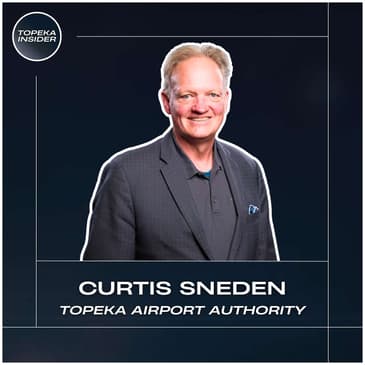
Curtis Sneden, Director of Development at the Metropolitan Topeka Airport Authority (MTAA), shares exciting developments happening at Topeka's two airports and their adjacent industrial park. He reveals plans to bring commercial airline service back to Topeka Regional Airport, with flights potentially starting in early 2026 to destinations like Orlando, Las Vegas, and Phoenix.
• The MTAA operates both Topeka Regional Airport (formerly Forbes Field) and Philip Billard Airport, plus an industrial park with development potential
• Data shows approximately 1,400 Topekans drive to KCI daily, creating strong market demand for local commercial air service
• Airlines have shown significant interest in Topeka after years of indifference, with point-to-point carriers eager to serve the market
• Plans include building an 80,000-square-foot aircraft maintenance hangar to attract MRO (maintenance, repair, and overhaul) companies
• The project would create skilled aviation jobs, with potential partnership with Washburn Tech for mechanic training programs
• Existing airport tenants include Verus Aviation (corporate jet management), Millionaire (fixed-base operator), military units, and museums
• Topeka's collaborative approach to economic development helps attract businesses with seamless support across organizations
• The "Kansas Aerospace Triad" concept connects Topeka, Wichita and Salina as centers of aviation excellence in Kansas
________________________________________
0:00 - Meet Curtis Sneden, MTAA Director
11:14 - Airports Overview and Current Operations
19:24 - Commercial Air Service Coming to Topeka
39:08 - Economic Development and MRO Opportunities
46:24 - Topeka's Growth and Breaking Down Silos
58:32 - Rapid Fire Questions
________________________________________
Beyond the Podcast: 🎙️
Be sure to follow our Topeka Insider Socials below and check out our website for additional stories and articles pertaining to Topeka, KS
Website -- https://topekainsider.com/
Facebook --- https://www.facebook.com/topekainsider
Instagram -- https://www.instagram.com/topekainsider
Follow Your Hosts: 📱
Follow both Justin & Jon on their personal socials to get connected. They would love to connect and answer any questions about the show or their day to day.
Jon Griffith's Instagram -- https://www.instagram.com/thejongriffith/
Justin Armbruster's Instagram -- https://www.instagram.com/armbruster_jd
For Any Inquiries, please DM @TopekaInsider on Instagram!
Yeah, they're cool people and they're. Many of them are local and it's he just call us cool.
Justin Armbruster:Is that what I'm hearing?
Curtis Sneden:Let's go. The globe is our marketplace. I'm not just Calling to Emporia and Holton to see if anybody wants to do business with us. No offense to them, we haven't been recording.
Jon Griffith:All right, curtis Sneedon, welcome to the podcast. Thank you, yeah, you are the Director of Development at the MTAA. Yes, sir, and man. We're so honored to have you on, man. Thank you, this is a pleasure.
Justin Armbruster:Thanks for being here, yeah so good.
Jon Griffith:So can you tell us, mate, what is the MTAA?
Curtis Sneden:The MTAA stands for Metropolitan Topeka Airport Authority, and it is the agency that owns and manages both of our airports here in Topeka, nice. And we also have an industrial park that's right next to the larger of the two airports, which most people here in Topeka call Forbes. Yep, it's technically called Topeka Regional Airport. Okay, because there's a Forbes field over in Indiana or something somewhere.
Jon Griffith:Gotcha.
Curtis Sneden:But those are sort of natives. Yeah, forbes, and then the Industrial Park, and then Philip Billard Airport is, you know, up in historic Oakland, and so we're in charge of all of that. That implies running good, safe airports, which our team does, running good, safe airports, which our team does, and in the case of my position, it means doing the work necessary to wring more economic value and dynamism out of those assets. Because, they really are amazing assets that could be incredible growth opportunities for our community.
Jon Griffith:Wow, so maybe before we get into that I'm sure we'll spend a lot of time talking about that Can you just give us a quick overview of your history, like how you came to be in this position? Who?
Justin Armbruster:is Curtis.
Curtis Sneden:Yeah, I haven't the foggiest idea, I'm still figuring that out.
Curtis Sneden:I like to say I came to Topeka, uh, in 1964, on the day my mom gave birth to me. Ah, so'm a native Topekan, washburn, rural guy, k-state Nice. Worked in broadcasting for a couple of years Cool and then went to Washburn Law School, which opened up opportunities in a way that I didn't even comprehend at the time. But I practiced private law with a law firm here in town called Goodell Stratton for a couple of years and then came upon an opportunity at the company that was called Payless Shoe Source and I was one of their corporate counsel out there. I was there for 20 years and that was again.
Curtis Sneden:Sometimes in life you look back and you think not every day of that was pleasant, but in retrospect I wouldn't change a thing and the growth that came from that still makes me a little dizzy. Wow, the connections, the exposure, part of that involved. I ended up doing government affairs or lobbying for the company, which meant that at least two times a month I was up in Washington DC talking to people in Congress and sometimes leaders from other countries about importing shoes. Because that's what we did Amazing learning experience, amazing exposure to different types of environments. Ultimately, that part of the job wound itself up in 2014.
Curtis Sneden:And about that time I discovered there was an opportunity to continue lobbying at the Chamber of Commerce. So I shifted over to the Chamber of Commerce as their I forget the title, but probably Director of Government Affairs, and shortly thereafter some very major changes started to take place at the chamber Leadership changes, changes in the architecture of the organization, and I was privileged to be part of the team that sort of constructed the Greater Topeka Partnership, which brought together the chamber and Go Topeka, which is our economic development group, and Visit Topeka and Downtown Topeka Incorporated, and there are a number of other groups that are within that constellation of change agents here in town. Very, very privileged to have been able to be part of that and to serve alongside literally hundreds of volunteers on our boards, you know, business leaders and others who all just as committed as as I am to, uh, seeing this community rise up and take its place where it could be. So, um, rise up and take its place where it could be. So ultimately ended up being president of the Chamber of Commerce and so the voice of business in Topeka, over at the legislature and up in DC for about 10 years.
Curtis Sneden:And then along came this other opportunity, which at first I didn't give any thought to. I had been working on some issues that involved aviation. We had been working alongside the folks at the airport to field a possibility, an industry sector, that everything in aviation has three-letter acronyms TLAs, right.
Justin Armbruster:And this is called-.
Jon Griffith:Three-letter TLAs.
Curtis Sneden:And this is called a maintenance, repair and overhaul. Okay, mro, big time MRO opportunity. And what that meant was the possibility, if we got our infrastructure in place, if we stood up the right buildings, et cetera, to attract companies that do work on wide-body aircraft, meaning an aircraft with two aisles, like 747s, 777s, et cetera Amazing possibility for jobs and capital investment and just all of the other economic again dynamism that goes along with that. So at the chamber I was very engaged with trying to explain to our legislators why they should be supportive of that and we had a level of success. And then this position was created by the board at the airport authority, called director of development. They have a crew out there 45, 50 people who run airports really well, and they have for quite some time.
Curtis Sneden:But the board decided at that point that they wanted somebody on their team who would wake up every morning and worry about growing the place Wow, bringing business and turning up the knobs economically. So at first, like I say, I was like that'd be a cool gig for somebody. I hope that's enjoyable. I am.
Curtis Sneden:For months that was my attitude towards it, but more and more people from well, I won't name names, but people whose opinions mattered to me, would come up to me at events and say, hey, are you going to try for the airport job? And at first I was like no, I'm the president of the chamber, I'm fine, this is cool, this is a great gig right now. But over time, this idea that maybe I could make a new type of contribution to the same project of growing our community out there started to gel and ultimately my boss at the time who's Matt Brevarnick you've had him on your podcast um, a friend, a coach, a manager. He called me in and basically said look, this is going to kill me, but I'm not sure what should be worse you leaving the chamber to take that job or you not taking that job? Um, so I threw my hat in the ring and and um went through the process and I'm very, very privileged that the board decided that I should be the first one to fill this spot. And here we are.
Jon Griffith:So that's awesome, man, yeah, wow, that's incredible. So you've had already, I mean, quite an amazing career doing so many things.
Curtis Sneden:It's been a good ride. I mean Topeka native, like you said, and there's nothing self-aggrandizing about this. But think about it. This kid from Wanamaker Grade School has had dinner with the president of the Dominican Republic, for example, and the Chinese ambassador to America. I've had the privilege of touring the Boeing facilities up in Seattle and talking to folks up there about what they might do in Topeka. Wow, and I could go on and on. You're right, it's been an amazing career. Quite the resume. On top of all of that, I've been married to my wife, chris, for 38 years. We're madly in love with each other. Come on, three beautiful children, a grandbaby. I've seen examples along the way of vibrant, exciting careers that tend to be a little jealous of that other side of a person's life, sure, and I've been privileged and very lucky that it's all been able to balance Cool. My only complaint today is the heat. Yeah.
Justin Armbruster:Nothing else. So here's a question I'm sure we'll get into, maybe what the hopes for the topeka airports are going to be. As a topeka native, I don't even know if I know what goes on now, what, what kind of it says. What do the topeka airports do now? Are there flights that are daily, weekly, what?
Curtis Sneden:goes on. So one distinction that might be helpful to kind of ground our little tour here is that we at the airport speak in terms of airside and landside, which is a secret code.
Jon Griffith:Yeah, is there a TLA for that? Yeah, is there a TLA for that?
Curtis Sneden:No, because that's only two words. So obviously, I guess, to simplify, on the industrial park side, the land side, we have a number of tenants there who run a range of businesses out there. We have an event planner, we have a FedEx ground depot, we have a bottling company, we have a rider truck rental. It's a whole range of things. And maybe more prominently, we have hundreds of acres that haven't been developed yet. Wow, so there's a lot. You know. Ask me that in a couple of years. So that's near Forbes, where all those warehouses are.
Curtis Sneden:It can be a little confusing because the warehouses west of Topeka Boulevard, I think at one time it may still be called Forbes Industrial Park. I'm not sure that's a little confusing. It has nothing to do with us, that's private property.
Jon Griffith:But the ones on the east side, east Between Topeka and Forbes, right, okay, yeah, I think that's where Joylight and Blue Jazz is, maybe. Right, exactly, yeah, that's where Joylight and Blue Jazz is, maybe, yeah, right exactly, yeah, I should have mentioned them.
Curtis Sneden:I'm sorry I haven't mentioned all of our tenants. No, no, no, it is a diverse group out there, and we'd love to have many more yeah that's great, and there's plenty of room to grow out there Now on the air side, which I think is probably really where you are.
Jon Griffith:Yeah, yeah, right.
Curtis Sneden:So on either side have military installations. On the south side we have the Marine Reserve Center and then the Army National Guard, and then on the north side we have the 190th Air Refueling Wing and you will have seen their KC-135s flying over town. And I have to say that, keeping in mind that anytime you're talking about military endeavors there's a certain sobriety to what we mean, Right, yeah, I just burst with pride when, for example, a couple of weeks ago, in the context of what the United States did over in Iran, a newscaster was talking about those B-2 bombers and how they represent this important element of force that the US can project. But they can't project that force unless they can get over there. The only way they can get over there is if they have planes along the way that can put gas in them. And I thought that's our guys.
Jon Griffith:That's us. That's us, topeka, come on, it may not have been our guys in particular at that time, but that's what they do.
Curtis Sneden:They're the reason the United States is able to project its force the way that it does. I couldn't be more proud of the.
Jon Griffith:One-Ninth.
Curtis Sneden:On top of that, I know many of them and they are us. They're cool people and many of them are local. Did he just call us cool? Is that what I heard? Come on, many of them are local.
Justin Armbruster:Did he just call us cool? Is that what I heard Come?
Jon Griffith:on, let's go. As cool as a pilot, as cool as a pilot, as cool as pilots it doesn't get much cooler than that.
Curtis Sneden:So they're up there, they operate and maintain and fulfill their mission. Up on the north side we have another air side tenant named. That's called Verus Aviation. I'll probably say it wrong and they may correct me, but the way I think of it, they essentially sort of run the aviation departments for their corporate clients. If you were a corporation that had a jet, all of the logistics and licensing and scheduling and everything that goes into operating that jet?
Jon Griffith:Oh right, I think they do like. Aes stuff, yeah Right.
Curtis Sneden:I think their motto is we make aviation easy or simple or something. It's a great niche and they are highly successful. I'm very proud that one of the first things we've accomplished during my tenure is that they are going to be expanding their footprint pretty dramatically out there because their business is growing, so we're collaborating with them to they'll be standing up some new hangers and Wow yeah, so we're, they're, they're great.
Jon Griffith:I had a buddy who got to ride on AE's private jet. Oh really, and when you get back so they like valet your car, yeah, and when you, when your car comes back, it's washed and deep cleaned Like they've detailed your car while you're gone. Oh yeah, and he was shocked. He's like I did not know. They're like it was awesome. So it sounds like they're very good at what they do.
Curtis Sneden:You know they are. And there's really something to be said for Primo service. You know um there. I don't know, I guess if you grow up in Topeka there can be a little bit of I've heard it said before inferiority thing or like a limitation on what we could be. But there's no inherent reason that a service provider here couldn't provide the best service in the world. And for all I know, verus does. To my knowledge they do Right, they certainly aim to. That's very cool. So yeah.
Curtis Sneden:I mean there's no constraint on good service. Anyway, they're awesome.
Jon Griffith:That'll preach. Actually, man, that's solid. Yeah, anybody could take that and run with that.
Curtis Sneden:Well, it's kind of. You know, I'm far from this, but in my mind I have a little sort of fantasy scenario that again, I don't see any reason it couldn't be true, except for getting it right. But the day will come when we will field a tour from some CEO from, say, belgium. I mean it will. The Globe is our marketplace. I'm not just calling to Emporia and Holton to see if anybody wants to do business with us. No offense to them, but in this business the Globe is the market, wow. And so when that CEO comes, he or she and I and my team will talk to them about possibly operating some level of their facility here, maybe even moving their headquarters here, who knows? People should not get back in their car to drive to their hotel or KCI or wherever and look at themselves and say I have never seen a more professional bunch of people in my life. Wow, those, those people in Topeka really know what they're doing. Wow. I mean, if you just think that through, why wouldn't that be?
Curtis Sneden:a scene that could happen and I thoroughly believe that it should and could, and there's no point in targeting anything lower than that. Sure right, I love that. Anyway, our tenants we also have. The company called Millionaire is one of our major tenants. They play the role of what we call fixed space operator, fbo, and FBO is to put it, the core function is they're the ones who run out and put gas you know, fuel in your planes.
Curtis Sneden:But, that's just to kind of anchor your thinking. They're actually a whole array. There's an array of services that they provide For, like private planes, yes, okay, and they do a little bit of chartering, charter work, et cetera. So to say they're just about gas is belittling it. They actually offer primo service too, but anybody who pulls up and needs assistance they provide it. Importantly, they have a contract with the military so that somehow or another, the military, it's preferential in some way. I guess probably a fuel discount or something. I don't know the details of that, but thanks to Millionaire, we see a great deal of military traffic and you may have noticed it Sometimes. You probably don't, but there will be fighter jets coming in and out of town all the time. Every now and then I'll go out there.
Jon Griffith:I saw one yesterday. Did you, yeah, yeah, like F-16 or whatever? Fly over my house, yeah.
Curtis Sneden:So they come over in part because of cause millionaire gives them great service, makes them feel like Kings and Queens, and that's what you do. Part of it is that airspace is so easy to get around with. Part of it is the huge runway. So they, you know they come over from Whitman or wherever they're coming from, do a little, do some training runs and then head on home for the evening. So that's, we are filling a real. We're a good place to do that. Every now and then I'll come in in the morning and there'll be like a 757 out behind my building, which again is sobering because I mean they are awesome to see. But they're there because probably before long, seven or eight buses from Fort Riley are going to pull up and there'll be some soldiers deploying somewhere. God love them, you know. God bless them Right, it's still freaking cool to see those big jets out there.
Curtis Sneden:I'm proud that we're able to play a role in that. Millionaire helps with that. We've got a couple of museums out there Combat Air Museum and then the American Flight Museum. I take my kids there several times.
Jon Griffith:It's awesome.
Curtis Sneden:They really do a nice job. They're always expanding, changing up their inventory On the flight side. I'm probably missing somebody, but that pretty well sums up what's going on there. Now there's a distinction you've hinted at that I'll go to, and that is commercial service versus sort of private and charter service. At this point we don't have commercial air service at Forbes At this point. At this point, I mean, keep your presses warm.
Curtis Sneden:We have been engaged in a very intense effort recently to win a contract with a commercial airline. Yeah, come on, let's go. Yeah, we, I hope, are very, very close to being able to announce that that has been accomplished. Wow, and in a period that would be counted in months, not years. Yeah, Wow, topekans will be able to just drive down to Topeka Regional and hop on a jet and go to their destination Not Forbes, topeka Regional, topeka Regional, tra. So that's been quite a project. It's been sort of stewing since before I got there, but in the last couple of months our board really dug in and said let's do this. Yeah, and that involved intense conversations with the airlines themselves and a fair amount of outreach in the community to ensure that we had support out in the community for such a thing.
Justin Armbruster:So people would actually buy tickets and fly out you know how nice it would be to go to Florida and you just drive to Topeka.
Jon Griffith:It would be a game changer 15 minutes across town, or whatever, kansas City is not that far, but it is so annoying to drive to the airport from here, Right, and you could just add up all of the factors.
Curtis Sneden:the convenience At least for the first year, we don't plan to charge for parking. We will eventually, but at this point we took the old machines down, so I don't think we could if we wanted to, we'd need some guy standing out there. But, even once we do charge for parking, it'll be nothing compared to what you pay over in Kansas City.
Justin Armbruster:Here's a question. So say you said months, not years, and it's all hopeful, it's all up in the air at this point, but say in the next couple months it gets approved, what's a tentative timeline on when? If I wanted to go to Orlando, I could hop on a flight in Topeka and go.
Curtis Sneden:If it gets approved in the next couple months or whatever, I think at the outside you're probably looking at March of 26.
Jon Griffith:That's not that far, that's not far away.
Curtis Sneden:We are actually. I'll tell you a little bit of a story here, and I'm going to speak deliberately because it's important. This is the type of information that has to be handled carefully. Sure, yeah, because nothing's public.
Justin Armbruster:Yeah we only have 10 people that watch this.
Jon Griffith:So, it's us two, gabe and a couple others.
Curtis Sneden:You two and your spouses. It's us two, gabe and a couple others, you two and your spouses.
Jon Griffith:Yeah, we count our children as viewers. Yeah, yeah.
Curtis Sneden:It's kind of fun because my boss, whose name is Eric Johnson he's the president of the airport. He's been at this a long time, he's very knowledgeable about the airport business and most years he and our consultant have gone to a sort of convention of sorts where all the airlines are brought together and they walk around and talk to airports like us. It's sort of a speed dating thing. They went if they walked around and one or two airlines even looked up at them and said, hey, here's a mint, here's a key chain, thanks for coming by. That was a banner year, that was a big deal. In other words, topeka wasn't really featuring very brightly on any of their radars.
Curtis Sneden:This last I kind of have trouble with time. Since COVID I don't know about you, sure, yeah, laying out time is difficult for me. Several months ago, so I guess in the spring, early spring, my boss and our consultant went to this convention and they already had like nine airlines who had called ahead to schedule appointments. Wow, so you know quantum difference. Yeah, several of those, some of those meetings were really didn't go anywhere. Probably Delta, for example, wasn't all that. You know, fitting us into their schedule maybe isn't really a doer at this point, but three or four of them were very exciting. And you know, and my boss called me that night from Colorado where this thing was, and he said we had some really good meetings. Wow. And I said you sound really excited. What have you done with my boss?
Curtis Sneden:You've obviously stolen my boss's phone Because he was jazzed up about the possibilities. These airlines could see the same passenger data we know we have and the data is unequivocal. It kind of boggles your mind. This is from like 24 and recent. You know, it's real, live data. Every single day, something on the order of 1,400 Topekans drive over to Kansas City to fly somewhere Really.
Jon Griffith:Every single day, every day On average, yeah, wow, okay.
Curtis Sneden:Of those, something like 250 to 275,. 300 of them drive over to KCI to fly to one of three places Orlando, phoenix, las Vegas.
Jon Griffith:Really Every day Vegas. I would not have pegged as a top three, but that's hilarious. It's on there, yeah.
Curtis Sneden:And so the airlines are looking at this and they're thinking just like we are the market exists.
Jon Griffith:Right.
Curtis Sneden:And we're not going to have to drum up passengers, they're already going to those places. So the airlines who have shown the most interest, and the ones we are trying to, where we're getting closer to, are what we call point-to-point carriers, meaning they go from Topeka to, say, orlando and back, or Topeka to Phoenix and back, and they're destination airlines. Yep, it turns out that I mean we would be filling flights if we had flights going to Orlando. The data just shows that, um, and these airlines can see it too. So we've had some very productive and promising discussions. At least one of them, apparently, has kind of raised their hand and said you know what? We feel so confident in this that if we can get things lined up, we'd be flying out of Topeka this fall, if we can move that up Now. There's a lot of moving parts, sure.
Curtis Sneden:And so nothing can be promised until it's actually signed. Sure, that gives you a sense of how enthusiastic that part of the industry is and how enthused obviously we are Wow.
Jon Griffith:That part of the industry is and how enthused. So what's changed between now and years ago, when no one would pay attention at those conferences to Topeka?
Curtis Sneden:That's a great question, curtis Craig Curtis.
Justin Armbruster:Yeah, he started in 23. Come on, let's go.
Curtis Sneden:It's important to note that I've had basically no interaction with the airlines, so I can't. All my role in this has involved the community outreach talking to corporate leaders to try to, and get them to, pledge their support, so we know that they're behind us. So, yeah, I can take no credit for this. I think part of what's worth noting is that in 2014, we did have air service for about eight months. Oh really, yeah, it was, it was United, but it's for about eight months. Oh really, yeah, it was United, but it was only for eight months Because it flopped.
Jon Griffith:Oh brutal.
Curtis Sneden:Frankly, topekans were getting on those planes. We were putting people in those seats, but the airline at that point was being managed in such a way that their reliability was abysmal. And I don't know if you had this experience I know I did. You go out there and the first flights were just giddy. Most of us flew to Chicago in January. And you get on, there's the mayor. Hey, mayor Wargast, how are you? And we're all just delighted.
Curtis Sneden:You come back out in April and maybe your flight's delayed about 20 minutes. Okay, no sweat. Come back out in June and maybe your flight's delayed about 20 minutes. Okay, no sweat. Come back out in June, say You're finding these reasons to go to Chicago because there's a plane down there. Okay, so you go and your flight's been delayed maybe an hour and a half and you start thinking well, hang on a second, I'm going to—my connection is at risk here Right. And then you go out there in September and they say sorry, no, plane Was the experience and I've talked to enough people to know that that's characteristic of what happened. It was a real buzzkill, okay. The other side of it is that if a community has air service and then it leaves, that's a terrible thing to have on your transcript.
Jon Griffith:Right, that's an.
Curtis Sneden:F on your transcript, right From the airline's point of view.
Curtis Sneden:So I don't know, but if we are putting people on flights, I mean I think that it's if you work for the airlines you're moving quickly to sort through potential routes and Topeka just. We were bruised badly for a while by that in their eyes and we, frankly, the psyche here was kind of banged up. I mean, this time around as I talk to people about air service, most of the people I talk to who've been here a while would say, yeah, but what about United, right? Yeah, we've done this before.
Jon Griffith:Get that out of your bloodstream. We're going to win this time.
Curtis Sneden:Get that out of your bloodstream. We're going to win this time. So it's probably a combination of economic factors, travel changing and our unique experience with that failure that made us less than appealing for a while. But this last year all that changed, Wow, and I, like I say there are enough moving parts that I'm a little nervous to be, you know, overly optimistic, but I believe we'll be able to announce in short order that service is coming back. Come on, let's go. So, yeah, it's going to be exciting.
Justin Armbruster:And then this service is that happening out of TRA or Billard's?
Curtis Sneden:TRA, tra, okay, yeah. Yeah, billard isn't really kind of eligible for those size of aircraft. There's a lot of possibilities up there that we're pursuing to grow the aeronautical business.
Justin Armbruster:Is that more just like private planes?
Jon Griffith:Yeah, Just because of the length of runways and stuff like that, and just facilities.
Curtis Sneden:We have a new sky bridge out at out at um forbes, which I think people, when they first get to get to fly to first flights, will probably be to orlando. Gosh, that's so cool. I mean, it just is.
Justin Armbruster:Yeah, think about a weekend trip instead of having to go to kansas city and you know, deal with all that. It's like I just hop on is. Yeah, think about a weekend trip instead of having to go to kansas city and you know, deal with all that.
Curtis Sneden:It's like I just hop on over to forbes and well, that's, hop on a flight and be back by monday it's interesting, um, because if you look at those ticket numbers, that's historical data and and you say, okay, this is a, a, this is, this is a number of people, and we we know that not all of those people who go over to KCI to fly to Orlando will do this, because maybe they there are reasons, maybe they needed to go on Monday and our flights will be on Tuesday, whatever.
Curtis Sneden:So, we won't capture all of those people, but I think there will be an interesting phenomenon called stimulated demand and to me, quite simply, it means that Chris and Curtis and Eden, at this point in time, do not sit at our dinner table and say, hey, you want to go to Orlando next week, but if we, could fly out of Topeka and the fares are going to be.
Curtis Sneden:I'll tell you about the fares in a bit, but they're going to be very reasonable. If that were true, we would. Oh yeah, absolutely. I think a lot of people around town was like heck, let's go to Orlando, yeah, you know.
Curtis Sneden:So there, I think there we will see we're going to fill those planes. That's all I can tell you as far as the fares go. It's worth noting that you've been over to KCI, Then over to KCI. You know they have that big, beautiful terminal building. Yeah, Costs a lot of money. Fair enough, they're passing that on to the airlines. It's actually much more expensive per passenger for the airlines to fly out of KCI. That's just a reality.
Jon Griffith:I had no idea. That's how airline tickets are priced. That's why prices are different on a given day and airline and things like that Wild.
Curtis Sneden:I think there are probably some pretty baffling algorithms at play but the airport has to pass through their bond payments to somebody, and that's how it gets done, so it's more expensive to do business in Kansas City now. Really, we don't have that at this point, and so we fully anticipate that. I mean, I was privy to a conversation not really too close into it, but introductory rates that were like less than $100. I don't know what it'll be, I mean, that'll change.
Curtis Sneden:Ultimately, an equilibrium will be found and the airline knows how to do their business, but we're talking about very reasonable rates. That is awesome, and no parking and 15 minute drive, so let's go right.
Jon Griffith:I mean, it's 20 minutes away instead of an hour. And I mean just like one of the factors I feel like my family always forgets about is we get our flight and we'll go somewhere. And then the flight home. You're just eager to get into your house as fast as possible. You're like man as fast as flight can happen the better. And then you're thinking home time is your arrival time.
Curtis Sneden:Right, but you still have to add like two hours to like get your luggage and then you drive, so you get home at.
Jon Griffith:Depending on your flight, you might get home at 2 am and you're like that was so much later than I thought it would be, I know. So to get home into Topeka would be kind of a game changer. Wouldn't that be something it would?
Curtis Sneden:be amazing, and none of that waiting around for the van to take you out to parking lot B and all that stuff and just walk out, stroll out to your car and drive home. It'll be giddy.
Jon Griffith:So facilities? You're saying we already have the facilities, we wouldn't need to build terminals or anything.
Curtis Sneden:We have a big picture. We have everything. The one thing that is still will be addressed is the TSA clearance Security, the secured area. But that's not a hurdle at all. The TSA is already on site. They're working it through and will be ready when they need to be ready. I've learned that they refer to the area where the passengers sit after they've cleared security. They call that the sterile area, which sort of sounds like something at a laboratory or something Surgery yeah, you can go back in there.
Jon Griffith:And or something, right, yeah, surgery yeah, you can go back in there. And some guy's Patients ready for surgery. I'm in the sterile area.
Curtis Sneden:Some guy's sitting with his sandals kicked off. I'm like not sterile?
Jon Griffith:Yeah, exactly, not sterile, but that's the term Give that guy some rubber gloves?
Curtis Sneden:Yeah, thank you so anyway, there's a little bit of internal remodeling that needs to be done to account for that, but in general we're ready to go. Yeah, come on.
Justin Armbruster:Do you think that if this gets approved and things are going, I mean that'll be it. I mean that's a ton more traffic in people that are just going in and out of that area. I feel like that'd be attractive to some more businesses to, you know, to put up some restaurants, to put up some you know hotels, or whatever Ban. To put up some restaurants, to put up some hotels, or whatever. Banjo's is about to blow up, yeah, banjo's is about to blow up.
Jon Griffith:Probably I love Banjo's.
Justin Armbruster:Do you share that opinion that that could be a catalyst for more development, or what?
Curtis Sneden:do you think? I think that you're onto something. Now, how directly that catalyst will operate is a little tough to judge, but I would say that the presence of active commercial air service has the effect of just putting you on the map in the minds of people who are thinking about making location decisions. Okay, so a restaurant's a possibility. I don't know whether the numbers somebody else would have to do the math but I think you're onto something. In other words, the other part of what I'm trying to do.
Curtis Sneden:The air service is very exciting, and that's usually people want to talk about that most. But I'm highly focused on trying to explain to companies all over the world, like I say, why locating in Topeka would be the right move for them, and we already have a number of positive things. You know that that sales pitch has a lot to it, but for them to be able to say, oh yeah, I've heard of Topeka, that's where you, you know you've got an airport, you know that will. I think there'll be some catalytic effect to that as well. It just helps to be on people's minds. At this point, if I talk to people, they may have heard of us, they may have heard of Forbes from the old days, but there's a lot of prep work to do mentally with them.
Jon Griffith:Is there a benefit to the airport and some of this development in terms of bringing businesses to topeka? Is there a benefit to the fact that places like walmart already has the huge distribution target, already has something free to lay, like places like that already have kind of a big central hub here? Is or is it? Would it be more things like that Like bring a central manufacturing and distribution hub?
Curtis Sneden:Well, the interesting benefit that derives from that is a little subtler than you might think, and that is to say that we've been most of the companies we've been reaching out to and I do need to put a plug into Go Topeka and Molly Howie, who's the president of Go Topeka, top pro.
Curtis Sneden:She is like national caliber and we're joined at the hip now. We used to work together under the same roof and we see each other more now than we did then Because we're both doing the same thing we're trying to grow the economy. So she and I spend quite a bit of time on Zooms with companies from, like I say, all over the world, and typically we are targeting sort of aeronautical companies, higher tech firms, and it helps to be able to tell them that, despite what you may have heard, there's actually quite a bit of high-tech manufacturing that goes on here, and or people who are doing work on sophisticated technology conveyance systems, for example, at Walmart or Mars, et cetera. So it enables us to clear out any any misconception they might have that this is sort of an outpost right for skilled workers.
Jon Griffith:We have a lot of skilled workers in those very places working on, you know, robotics so give some like credibility, basically like, hey look, they've, they've built here, so why couldn't you Exactly, okay, cool.
Curtis Sneden:That's awesome. Every company we talk to asks about workforce to the extent that they hire a lot of people.
Jon Griffith:And so being able to answer that with saying ecosystem of the city, of having a Washburn and a tech university that potentially could be feeding some of those as well, like kind of all of that plays together.
Curtis Sneden:So, yeah, let me pull on that thread, if I may. The other big part of what we're trying to work on goes back to that TLA. I laid on you maintenance, repair and overhaul.
Jon Griffith:Love a good TLA.
Curtis Sneden:We have been working for quite a while now to um answer the market's demand for a large, wide span hanger 80,000 square foot hanger Wow, the sort of thing that you could drive a 777 into and work on it. Okay, there are hangers like that out there but there aren't very many available because once they're built they're taken Right and there aren't too many people in a position to build them ahead of time and hope somebody shows up Right. So the demand in the market and the inventory of those sorts of properties is out of whack. Accordingly, opportunity, we are working very hard to get one of those stood up and At Forbes yes, sir, Cool, yeah, yeah, and that will be a massive facility.
Curtis Sneden:We are very appreciative to the legislature and our delegation. Senator Brenda Dietrich and Representative Jesse Bourgeon and Ken Corbett and the other people on our delegation really worked hard this last legislature to have some monies appropriated for us to help offset the cost of building that sort of hangar and, frankly, nobody else was getting much appropriated to them. I actually had other lobbyists come up to me and say how'd you get that money? I said go talk to Brenda.
Jon Griffith:Dietrich, she's my hero.
Curtis Sneden:So we are working on attracting that and there is virtually no doubt that once that building is erected whether we do it or a developer comes in and participates with us, we'll see how that plays out that a company with that type of aircraft will move in and start performing that sort of work there. They're going to need what? Again? This isn't a TLA, but it's the A&P mechanics okay, airframe and power plant mechanics. If you'd talked to me in June of 23, I wouldn't have known any of this.
Curtis Sneden:This is like the sort of stuff that's just you pick it up in conversations. We need A&P mechanics. On the one hand, we're blessed because the 190th Air Refueling Wing already has about at least 100 or so crew chiefs who know how to do that kind of work on aircraft. They might require a little bit of extra paperwork so they can do it on civilian aircraft, but they're there. We have this hidden gem of talented, skilled people over at the 190th. We're also in conversations have been from day one with Washburn Tech to look at standing up an A&P training program so that young people coming out of high school might say that sounds like a cool job. Yeah, get them trained up so that all of those people. When they go to pursue their careers, they don't have to think in terms of finding some other town where they could apply their trade finding some other town where they could apply their trade.
Curtis Sneden:They could just park in a different parking lot and go in and work on the 777s that this company's bringing to town. So Washburn Tech, huge partner, took me. I kind of lost track of why we went there. Washburn Tech and Washburn, the development of the workforce all of this feeds together. Nothing in a bona fide economic system can sort of function on its own.
Jon Griffith:We're all wedded. Is there potential with K-State Salinas like pilot programs feeding into airline development or anything?
Curtis Sneden:like that. I think there's a potential for that.
Jon Griffith:That would be more like way long-term or something.
Curtis Sneden:Well, I'm not sure about the time horizon. I do know that Wichita State has a very robust aeronautics program and you're right about K-State over in Salina. The direct role that they might play here in Topeka is a little hard to make out. Direct role that they might play here in Topeka is a little hard to make out. I think we're mainly thinking that Washburn and Washburn Tech will be our players there. But there's an element there that helps and that is something that Molly Howie and I have taken to calling the Kansas Kansas Aerospace Triad. Okay, If you draw the K-A-T, if you will.
Jon Griffith:There you go. Now you're getting the swing of it.
Curtis Sneden:You stop it, you dirty dog, you're getting the swing of it. If you drew a triangle from Topeka down to Wichita, up to Salina and back, you would encompass this area in which, first of all, all three of those airports have very long runways, the sort of thing you can land 747s on, or happens to be the longest, come on, nevertheless, they're all major airports, just subtle flex.
Jon Griffith:Do we bring that up every time we see the Manhattan people.
Curtis Sneden:Yes, absolutely we do, yes, we do concentration of talented people, engineer types, who all I think could contribute to the fertilization of this part of the country as kind of a future Mecca for Like airline, for avionics, aeronautics, yeah, all of that Wow. So again I couldn't really speak to whether case a salina will sure stand up shop over here, but having them out there makes the whole garden a better place to grow yeah, that's awesome, dang man this is very exciting.
Jon Griffith:This is really cool, it's very exciting.
Justin Armbruster:I'm just hoping. I'm just hoping I'm not getting my hopes up.
Curtis Sneden:I do too, and I will tell you in all directness I feel very secure that we're not getting our hopes up in any ultimate sense. Great Timing could slide here and there, and it always can. When you're talking about business development and something, something as major as attracting an airline, I mean right always takes a little longer than you think, yeah so there could be a little disappointment in terms of shoot. I thought that was going to be you know, but but ultimately I I believe this is gonna that's super exciting.
Jon Griffith:yeah, well, I'll just say I'm already planning to go to florida in the so we'll do what we can.
Curtis Sneden:I'm going to call you. I'll be really upset if there's no airline here.
Jon Griffith:I'm kidding, I'm kidding. That's awesome. No, that is very cool. Well, maybe can we shift gears a little more, just kind of like local experience. Yeah, you're, you grew up here. You were born and raised in Topeka. We'd love to hear, just as someone obviously you're very involved in city happenings as well what has it been like for you growing up and living here, in terms of like being at Topeka, and what's changed in Topeka. What are you excited about just for the city as a whole? Things like that.
Curtis Sneden:Well, there are certain issues that I can make out now not issue problem issues, topic areas that I can make out now that when you're younger maybe you aren't in a position to attach as much significance to them. For example, well, when Forbes Air Force Base closed, that was a huge economic Right. It was Blow.
Jon Griffith:Blow yeah.
Curtis Sneden:Yeah, it wasn't a disaster because we've managed to come back and do things, but yeah, it was a blow. When I was a kid I was dimly aware of it, but it's the same, with Menninger leaving I was not a kid, then that's what I was going to say, yeah.
Curtis Sneden:I was not a kid then, but I was sort of wrapped up in starting my family and my job and just wasn't as dialed in. So there's certain aspects of that. That. You example like, say, White Lakes Mall can happen at such a pace that you're kind of a frog in the hot water, right. Right, it's not until you look up towards the end and say what happened to our mall.
Curtis Sneden:This is terrible, so, if you ask me what it's been like, there's been ups and downs. Like most people, most of my attention has been on my career at the time and on my family. The thing about going over to the chamber, though, is that, by definition, your scope opens up to take in the entire community. Oftentimes, when I worked out at Payless, I did lobbying, and I was also. I did contract work for them, which most corporate attorneys do, and it was frequent that I would sit at my desk at some afternoon and kind of think to myself I wonder what's happening in my hometown. You know I live here. I don't even know what's going on. That never happened once in my 10 years in the chamber and the partnership, because, by definition, that's what those jobs are. Yeah, so I am.
Curtis Sneden:I will tell you that there have been some some terrific advancements that are, like you know, tangible the arrival of Target, the distribution center, and Bean Bowl Bakery, and the Home Depot, rapid Deployment Center, and Mars and Walmart and various others. Ptmw has had kind of morphed, but grown and done some good things. There are some other companies that have found their way AE, of course, is an amazing phenomenon to behold and they've contributed so much to the community via things like the, cyrus, et cetera. There's just a lot to be proud of the Plaza downtown, proud of the, the plaza downtown. I think the, the, the zoo, uh, becoming that new taxing district has, yeah, turned the key on some amazing possibilities. I just drove by yesterday and saw how big that discovery center is going to be now. I really didn't know. Um, you know, shawnee lake is a jewel. Yeah, we live kind of out on that side of town and it's an amazing thing. It really is. Yeah, so there are some—I'm very proud of our schools 501 and the TCALC. You could just go down the list of the things that various change agents have really set their sights on and made happen, and I'm probably missing things really set their sights on and made happen, and I'm probably missing things. Washburn, of course, has consistently been something to behold all along. I would say that through my aperture, which is naturally enough narrow, I am, I think, most proud and appreciative of the fact that, in this community, we've done a darn good job of breaking down silos and creating an environment where the people who are engaged in the project of growing the future tend to speak the same language, tend to have a similar understanding of where this thing's trying to go, and that makes all the difference in the world.
Curtis Sneden:I can give you one example from my own experience. Even just out at the airports About a year and a half ago, I had a guy call me and he said hey, we've got a company with some big jets, we're growing, we need a place to put jets. I said, okay, let's talk. And he. He then said you know, I'm kind of new to this, so I'm not really sure what to do from here. Now I'm. I'm looking on the website and I see this thing called Go Topeka. Do I need to call Go Topeka? What do I do? I'm fresh. I said you have made your last phone call. Okay, because by reaching me, the very first person I'm going to text is the president of Go Topeka. And, if it's okay with you, the next person I'm going to text is the mayor of the city of Topeka, and they won't be long before the governor's aware of this. If this plays out, that's because we are networked in such a way that all you have to do is breach the network somewhere and it's going to happen.
Jon Griffith:That's so good, and I'm very, very proud of that.
Curtis Sneden:I think if Molly were sitting here she would say the same thing. I think the mayor would say you know, all of those people would say yeah, because in other communities it isn't necessarily like that. You might get an answer like well, here's a number for the desk over there. They don't usually answer, but you can leave a message, let's see if they get back to you Not in Topeka, so I don't know if that answers your question.
Curtis Sneden:Living life in a place, especially when you're raising kids, it's usually kind of hyper local. It's like your church, their schools, dance recitals, your job. It's been amazing.
Jon Griffith:It makes me think. Before we hit record, I think we were talking about adapting to challenges.
Curtis Sneden:I misunderstood your tonality. I was going to say we haven't been recording.
Jon Griffith:No, no, yeah, Before we were about to go.
Jon Griffith:Oh no, we got all this yeah yeah, yeah, we were talking about adapting, being adaptable to change and to challenges.
Jon Griffith:Adapting, being adaptable to change and to challenges and, like COVID, was a huge pressure that created you either adapted or died.
Jon Griffith:You know a lot of businesses and stuff. And it makes me think, obviously this happened way before COVID, but all the changes with the chamber and the Topeka partnership, it kind of created like a lean machine, like we're running lean kind of on like a wartime, like operation, where like things can happen quickly and uh, you know, it makes me think just like how much of like a real hunger there is, uh, on the people associated with all those different organizations. Like, you know, when you're not hungry to chase what we could become, it's easy to kind of just get lackadaisical. But because we've been through maybe things like the United failure in the past where we're like, okay, we've got to really shift, to really get into a lean, effective operating team that can just handle things quickly, make adaptations as we need, you know, get flexible, I don't know it's kind of where my mind it seems like that's kind of in the place that we're at as a city to where, when things happen, we're a little more able to take advantage of. Does that resonate?
Curtis Sneden:Do you feel like that's true? It does. And something happened I was conversations predated me going to the chamber, so sometime between probably 2010 and 2014,. People like Brent Bowles, for example, and probably Cody and Jim Klossman and John Dykus and various other leaders you know Marsha Pope out the foundation, et cetera, john Dykus and various other leaders, you know Marsha Pope out the foundation, et cetera had developed an itch or a discomfort of some. You know this sense that we're not where we should be and could be, and they seem to have crystallized around this idea that Topeka could be so much more. I can't really speak to that directly, but I'm aware of the evidence of it.
Curtis Sneden:The chamber did one of its inner city visits, which every year they go to a different town and gobble up ideas. Hopefully it's a town that's doing better than us. In some sense we can steal their ideas and implement them here. I went to the one in Tulsa and we learned a lot. And then the next year we went to, or either the next year or two years after that we went to Des Moines and there was something in the air that was a little bit like what you're describing this hunger, this sort of sense that like why not us?
Curtis Sneden:You know this is, it is time for Topeka to just take these reins and make this thing happen. Yeah, which for me. I guess, if you ask about growing up here, I wasn't privy to that kind of zeitgeist prior to that, there was always something sort of Just living your life, yeah.
Curtis Sneden:Yeah, and there was always something a little victim hoodie about being in Topeka. Like well, sure everybody loves to go to Lawrence, lawrence is cooler than Topeka. It's not really true anymore. Like well, you know, sure everybody loves to go to Lawrence, lawrence is cooler than Topeka? It's not really true anymore.
Jon Griffith:No, it's not.
Curtis Sneden:So, yeah, I mean, we're over that and these people, some of whom I named, seem to really just develop that hunger you described and ultimately they ended up bringing to town Matt Pivarnick, who it's because of the size of his personality it's tempting to credit him with the whole Right, Sure Right, give him all the credit he deserves, a lot of credit.
Jon Griffith:Yeah, I mean, it's bow ties.
Curtis Sneden:But one mustn't forget that he was brought to town on the wave of this hunger that realized that a person like that would be exactly how we can feed that Right. So, and I give him all the credit he's due.
Jon Griffith:Totally. I'm just pointing out that there are. Well, he was the first one to deflect credit to the team as well. Yeah, yeah, exactly, exactly.
Curtis Sneden:And so you have this hunger that was simmering out there. You bring a spark, like Matt, who not only had a terrific kind of, you know, urgent personality but had come from an environment where I don't think people in Tulsa have much of an inferiority complex.
Jon Griffith:You know they're like what do we got to do?
Curtis Sneden:So he brings this, we start seeding these ideas, we bring these organizations together and, from then on, you know, the attitude has just been you know, get out of my way, I'm, I'm. I don't accept any inherent limitation on on where we're going. If there's, there may be something in our way, what we got to do to move it Right, that would be new in my experience. Um, if you ask about the whole, my whole life here, yeah, so Come on, man, that's awesome. No, it's exciting stuff. That is exciting Well do we want?
Justin Armbruster:to hit them with some rapid fire.
Jon Griffith:Yeah, yeah yeah, yeah, we love to hit. Okay, we love to hit all our guests with some rapid fire Between the ferns, exactly.
Justin Armbruster:We like to end our time with some rapid fire.
Jon Griffith:We usually ask Between the ferns. That's a clutch reference man we usually ask the same questions.
Justin Armbruster:Sometimes they differ, but first thing that comes to your mind, we're going to hit you with some questions.
Curtis Sneden:Okay. So what's rapid? The questions or my answers, your answers, okay, like one word, just the first thing that comes to your mind. You can tell I'm a little wordy. Okay, no, you're good.
Justin Armbruster:We'll try in Topeka Milk and honey. Okay, let's go. I think that's the first time that was said yeah.
Jon Griffith:That's a that's over in your natural woods?
Justin Armbruster:Yeah, it makes sense. You know. A quick little, not so rapid input on that. Before milk and honey was brought to town there was a group of us who were doing ministry over at Shawnee Heights Young Life. We were praying for a coffee shop for years to be put in over there, because we didn't have a great place to meet with students.
Justin Armbruster:Yeah, love it, it was always like do you want to go to el dorado? And you know, it's like we can order food, I guess. But and so we were praying for years, and then there comes milk and honey.
Curtis Sneden:Yeah, that means something to a neighborhood, to a community a corner of town. Yeah, yep, because that southeast quadrant has been through a lot yep yeah um and so for them to locate there and sort of choose there meant a lot.
Jon Griffith:Yep, they're heroes to me. It's great. I love milk and honey. Yeah, dude, now you got two Judes. There's another Judes over there now in the God's storehouse.
Justin Armbruster:All right, awesome Doing a home project. You're going to fix something up. Are you going to Menards Home Depot or?
Curtis Sneden:Lowe's, I've found myself going to Menards more. Let's go, curtis, I knew I liked you.
Jon Griffith:It's because you listed it first. You listed your option first.
Curtis Sneden:Oh, there's no psychology to it, you kind of forced the three clubs on me there he just knows good product when he sees it.
Justin Armbruster:We have an internal debate going on.
Curtis Sneden:Are you more fond of one of the others, I go to Home Depot. Okay, we need a tally board that we need to bring out here. Currently, Home Depot is winning, but Menards is catching up.
Jon Griffith:I think I've had some really really nice customer experiences out there.
Curtis Sneden:Absolutely, I don't know why that's relevant, but, ladies, I'll go back and ask about something to do with my deck. In each case, it was a lady who would say well, let's walk around and find what you need.
Jon Griffith:They were good experiences. The stereotype is definitely like you have an old, seasoned man who's kind of like oh, you need this screw and this tool.
Curtis Sneden:Yeah, I don't mean to sound chauvinistic, it just jumped out at me that those ladies really nailed their customer service. So I'm going to go for it. Love it.
Jon Griffith:Love it. You're going on a date night in Topeka. What?
Curtis Sneden:are you doing Either Celtic Fox or the Thunderbird Grill?
Jon Griffith:Okay, let's go.
Curtis Sneden:We also like La Rocca's, la Rocca's, yeah, yeah.
Justin Armbruster:Love it. Those are different parts of town. I like that they are different. I went to Celtic Fox for the first time. Their french fries are unbelievable. Oh yeah, their food's pretty solid.
Jon Griffith:They're great food yeah.
Justin Armbruster:How many potholes did you hit on the way over here? Did you count Too many to count? Not enough?
Curtis Sneden:Well, I got up to 17, and my back started hurting, moved the lumbar in your car seat.
Jon Griffith:Yeah, I needed to change the subject. I'm assuming that there are less potholes on the airport runway than your average Topeka street.
Curtis Sneden:Is that the case? Yeah, that is the case. Yes, it's a smooth drive out there.
Jon Griffith:Potholes are filled much quicker, probably.
Curtis Sneden:Well, yeah, hopefully there really aren't any too much Are you a golfer? No sir.
Justin Armbruster:Okay, so you don't have a favorite golf course.
Curtis Sneden:That's okay. Well, I would say that, by all accounts, uh, the prairie fire the one up at the casino oh yeah fire keepers. Yeah, uh, that, if I think. If I were told to recommend one, I think that's what I'd say even though I don't have any personal experience of it.
Jon Griffith:Good choice, yeah, you could do the uh, the ku basketball uh with bill self tournament, where it's like a thousand dollars a person.
Justin Armbruster:Yeah to play your team. That's funny. Uh, what else we got. I think those are the big ones, man that's the big one okay, uh, we'll end on this one. What is topeka missing? If you could bring one local restaurant something to do realistic or not, but you're like, hey, I think, I think Topeka could have this.
Jon Griffith:Aside from obviously like major airlines. Yeah, really.
Curtis Sneden:I will give you an answer, but you can't follow up because I didn't bring anything with me to perform. Okay, I happen to be a magician.
Justin Armbruster:No, I heard about this. I heard about this.
Curtis Sneden:But I got in the car I was like I have nothing, I'm just, I'm flat. What about a deck of cards?
Jon Griffith:I can go find a deck of cards really quick. Your viewers your 10 viewers want to get on with their lives.
Curtis Sneden:Our 10 viewers are very patient. I don't know if this is the thing that is missing, but I would love for there to be more live venues for music and performance. You know there is a place called Cosmo. I think down in.
Jon Griffith:Kansas City.
Curtis Sneden:Yeah, which is a try at that, and I admire that Old Chris is going after it down there. I would love to see more of that down there. Would that be game-changing? Probably not, but I think more of that down there. Um, would that be game changing? Probably not, but I think more of that sort of thing would play into the idea of this being a community where you know quality of life people want to be yeah young people growing, yeah, so oh, definitely yeah and there'd be more places for me to perform I've heard.
Jon Griffith:I've heard that, like comedians, magiciansians, musicians, I think all of that that would be like to have like quality, something like that you know every weekend, that would be awesome. That would be awesome, that would be good. So maybe last question how did you get into magic? Are we talking like closeup magic, like cards and stuff like that?
Curtis Sneden:Oh, a little bit of that. Mostly what I do is referred to as platform or parlor magic, which is a way of saying that. Usually my audiences are between 30 and 70 or 100 people. So it's not stage, you know, cut the lady in two stuff, but it also needs to be able to be it's not three people on a corner street, corner Right right and I've done a little street magic and that's got its place.
Curtis Sneden:that's not really my my yeah jam, um, usually like corporate sales meetings and that sort of stuff you've done these you've done corporate sales gosh.
Jon Griffith:I feel like. I feel like a failed podcast.
Curtis Sneden:I know we're not getting this out of you sooner well, you know well, you have to have me back and I'll be ready.
Jon Griffith:The next one will be purely a magic show.
Curtis Sneden:We can have a lot of fun with that. There's a lot to be said there.
Justin Armbruster:When the airport is open and we're headed to Orlando.
Curtis Sneden:I'll be up and down. Yeah, I'll have something with me at that point.
Jon Griffith:We'll do a five minute airport update and then a 45 minute magic show Put on a clinic.
Curtis Sneden:I mean, surely you guys, when you were little boys, probably had your little affair with magic, oh yeah, oh, most boys do yeah.
Jon Griffith:Remember the masked guy in the 90s? I grew up watching that guy who, like, told all the secrets on how the magic tricks worked. Yeah, that guy was that came out when I was I don't know eight or something, and it was. It blew my mind. Yeah, it was amazing.
Justin Armbruster:I have no idea what you're talking about. What's?
Jon Griffith:it called Gabe. You know he's called the masked something, the masked magician.
Curtis Sneden:Yeah just the masked magician. Yeah, and it's kind of funny. In the world of magicians there's a divided opinion. Some of the guys that you talk to online or in person are just furious at that as a phenomenon, because you're not supposed to give away the secret.
Jon Griffith:Yeah, and that's true.
Curtis Sneden:It's sort of malicious on his part to build his career on that. But the truth is that magic is much more than the secret. It's the engaging with the audience. It's the getting the effects across in a way that you want to be there with this person and see what's going to happen, so just knowing intellectually how something is done. Frankly, I'm not sure he had all that many viewers and I don't think it really dinged magic all that much at all.
Justin Armbruster:Definitely not as many as this show.
Curtis Sneden:So he doesn't worry me. But yeah, that's really what it's about is about interacting with people.
Jon Griffith:Well, well, a lot of magicians are funny, like a lot of like good magicians. When you go to a show that you're laughing the whole time too, because they got you on the hook. They're building the tension.
Curtis Sneden:Yeah, I agree, I agree, I have learned that as I've been performing for like 25 years and almost every joke that I wrote ahead of time flopped, yeah. But what happens is that as you go along you say something and it gets a laugh, yeah, and you think, oh wait, and that becomes part of your stick. So I get some laughs, but it's almost all just like organically Off the cuff Nothing, anything I ever thought oh, they're going to love this.
Jon Griffith:Well, I think I mean it's a pity we are we're like running out of time here, but I think there's something like the whole thing. Well, one of the parts of magic, like you mentioned, is like you're building the tension and the expectation where people are on the hook and they they're like the delight that people are experiencing and I think that lends itself to humor as well Like people want to be there, laughter is a way of responding lends itself to humor as well.
Jon Griffith:Like, people want to be there, they want to laugh, exactly, and so you might say something that I mean, as, as a pastor, the bar for humor is very low, like you know. So, like people there's actually, there's a joke, tim whoever Tim Robinson, uh, has this line about this about how, like, pastors could say the least funny thing, but because no one's expecting a pastor to be funny, everyone laughs, and so it's pretty unfair for me, like, I can say the stupidest, like the most low hanging fruit thing, and people will laugh, but if an actual comedian said it, no one would laugh, you know, and so but I wonder, like there's an environment where people like I pay to be here.
Jon Griffith:I want to be here. I'm really excited to see where this goes and you're leading me on this thing. It lends itself to being a laughing environment, you know what I'm saying?
Curtis Sneden:Yeah, and if it didn't, either you're not entertaining them or you've taken the thing in a different direction, like the Long Island Medium. Do you remember that show? That show, well you're. You're like um, legitimately purporting to get into people's minds or contact the supernatural or whatever.
Jon Griffith:It's kind of like a scary, like mysterious element. So if they, if they weren't laughing.
Curtis Sneden:It would mean one of those two things I don't I do some mind reading stuff, but it's always it's. It's never like. I don't expect anybody to literally walk out and think I've got that special power that would be a little weird. The idea is, imagine what it might be like if our minds really could work that way, and then that gives you a lot of room to play around in.
Justin Armbruster:But we'll have to go there, next time Totally. Curtis, thanks for being here. Thank you, it's been a pleasure. This is so fun. This really has been a pleasure.
Jon Griffith:We really appreciate your time and, man, I just want to say we appreciate what you're doing for the city. You know, obviously, with the work you're currently doing, the work you've done in the past, really excited about, you know, the projects with the airlines and things like that but also just appreciate to the city. So it's my town, man, yeah.
Justin Armbruster:Exciting Cool. Thanks, Curtis.