
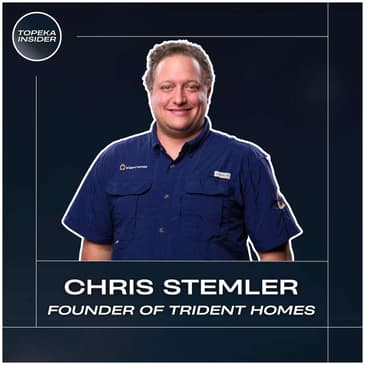
We sit down with Chris Stemler of Trident Homes to hear how a giant concrete 3D printer is being used to build a real home in Topeka. We dig into why attainable housing is disappearing, how infill lots could help, and what it takes to earn trust with a construction method most people have never touched.
• Chris’s Topeka roots and the career path from consulting to real estate investing
• The Beacon renovation and how historic projects exposed the pace problem
• The moment concrete 3D printing clicked and the step-by-step path to permits
• How the wall system works with conduits, insulation, and closed cell foam
• Why ADA-friendly design gets easier when walls move in the code
• The real driver of housing costs: supply, inventory turnover, and missing mid-price new builds
• Infill housing, land banks, and public-private tools like down payment assistance grants
• Common objections like renovations and wall texture plus options for finishes
• Production goals per print crew and what scaling looks like in developments
“Trident Homes is just Trident Homes on Facebook” and “3Dhomebuilder.com is the website”
________________________________________
0:00 - Cold Open Sponsor And Introductions
1:51 - Chris’s Path Into Real Estate
4:56 - The Beacon And A Housing Bottleneck
6:06 - Discovering Concrete 3D Printing
10:40 - First 3D Home How It Works
14:49 - Why Housing Supply Is Broken
22:47 - Infill Lots Land Banks And Grants
29:27 - Objections Codes And Cost To Scale
37:58 - Curiosity Led Entrepreneurship And Impact
47:30 - Rapid Fire And Where To Follow
________________________________________
Beyond the Podcast: 🎙️
Be sure to follow our Topeka Insider Socials below and check out our website for additional stories and articles pertaining to Topeka, KS
Website -- https://topekainsider.com/
Facebook -- https://www.facebook.com/topekainsider
Instagram -- https://www.instagram.com/topekainsider/
Follow Your Hosts: 📱
Follow both Justin & Jon on their personal socials to get connected. They would love to connect and answer any questions about the show or their day to day.
Jon Griffith's Instagram -- https://www.instagram.com/thejongriffith/
Justin Armbruster's Instagram -- https://www.instagram.com/armbruster_jd
For Any Inquiries, please DM @TopekaInsider on Instagram!
Cold Open Sponsor And Introductions
Chris StemlerHired a crew, purchased a printer, and the first house should be finished, we think in June.
Justin ArmbrusterI mean, I've been hearing this in the real estate space for the last three or four years.
Chris StemlerNot enough houses are being produced at a price point that is viable for most people to afford.
Justin ArmbrusterThis podcast is brought to you by Washburn University, a tight-knit college in a city of opportunity.
Jon GriffithWashburn offers small classes and big experiences. It's public prestigious and has the lowest student debt in the state.
Justin ArmbrusterAbove all, Washburn delivers a personalized education that you won't find at larger schools. Learn more at washburn.edu. All right. Hey, today we have Chris Stemmler, the founder of Trident Homes 3D Printing here in Topeka. Let's go, dude. Thanks for being here. Thanks for coming to the city. Thanks for having me. Appreciate it. Chris, do you want to give us a little bit about your backstory, your relationship to Topeka? How'd we how did we get here?
Chris StemlerSure. Uh I moved here in '98 from Canada. So went to high school uh in middle school at Washburn Rural, graduated in 03, did a bit at Washburn, uh, finished my undergrad at Fort Hayes, got my MBA from Baker, uh, and then started working for security benefit, and then just kind of progressed to different roles throughout the years until you know we get here. Washburn, Fort Hayes, but you kind of made your way around here in the mid-white. Yeah, I had originally wanted to do law, and then I realized if I couldn't be like Tom Cruise and a few good men, I was like, there's way more writing involved. Yeah. So I I dipped and decided to go into business.
Justin ArmbrusterI said the same thing about uh Harvey Specter and suits. Like, I want to go be a lawyer, I want to be Harvey. That's not how that works.
Chris StemlerIt is not. There's a lot of writing, there's a lot of technical stuff, and it that's just not my forte. So super cool.
Chris’s Path Into Real Estate
Chris StemlerOkay, so then you're here, you left security benefit, you uh Yeah, I worked for a number of major insurance carriers over the years until about three years ago, uh stepped away and do independent consulting. Um, and all through that time uh we had been real estate investors. Nice. So doing some rentals and stuff here in town and just slowly expanding what we did. I feel like independent consulting is something someone in the CIA would say. Yeah, I mean it might be, but that's not me, man. I'm Canadian. I doubt they'd recruit I doubt they'd recruit me. But um no, so we myself, my brother-in-law, a number of others, we work for a company here in town that we founded that does like 401k and ERISA consulting, and we have clients all across the country. So still in the financial. Yeah, so basically the same thing I was doing historically, just for ourselves, for independence, that kind of stuff.
Justin ArmbrusterSo it seems like you're kind of involved on two different ends of the spectrum as far as you know, like investment worlds, the the finance side and then the real estate side. You got kind of got some experience with both.
Chris StemlerYeah, my so I'm I'm not anywhere nearly as smart as the financial advisors that are in our community who do like that great work. Um my finance is really more like how do 401ks work, how should a company set this up if they're trying to accomplish these goals, that that sort of stuff. It's kind of the boring side of finance. I don't get it. Yeah, I don't get into investments, we don't get into any of that. It's it's all about the the general legal structure of the retirement plan. Gotcha. So it's not maybe as like boiler room exciting as it might sound. Sure. It's mostly me sitting at a computer reading documents and then making suggestions to it's like the uh the the lawyer life you're trying to avoid. Kind of it's it's really interesting. We work with a lot of CPAs and advisors and lawyers in town, and it's really kind of an adjacent to all of those um lot of recommendations like hey, you're doing this, you said you want this, let's change it, yeah, you know, do it this way. So, how'd you get into real real estate? Uh honestly, my wife's idea to some degree. We had um our starter home that we bought in Topeka, I don't even remember when, and we decided to upgrade, move into the house that we're in now, and we're like maybe we keep it as a rental. Other people do, maybe we could. Worked out great. I mean, we learned some lessons. Our first tenants, it was rough. Um, but you know, we've learned over time, and we just kind of up until really just into the beginning of COVID, we just kind of kept acquiring as deals, you know. You kind of know how it goes, right? As deals happen, right? As you get access to stuff, you know. We weren't buying all the time, just when it made sense to, so that went really well.
The Beacon And A Housing Bottleneck
Chris StemlerAnd uh actually during COVID is when we jumped from the single family real estate into that kind of commercial, which is when we bought the historic building that we turned into the beacon. Yeah, yeah. Tell us a little bit about that. Kind of a lark. We had been talking myself, my brother-in-law, uh, and my wife and her sister. We had been talking about an event venue of some kind. Um, and my wife was driving down past ninth and Topeka where the beacon is and saw an auction sign. We went to the auction, we bid, we actually won, which was crazy. We didn't really think that would happen. Wow. Um, and then we spent most of COVID doing the renovation. Uh, worked with Seni and Co. on that, and they did a great job um kind of converting what was there uh to what we have now, and it's from that experience, right? We were able to take the tax credits and use those appropriately, and so we got into more historic renovations, and that's ultimately what led us to the 3D houses.
Discovering Concrete 3D Printing
Jon GriffithYeah. Really? How did that how did historic renovations lead to that?
Chris StemlerSo we started a historic renovation project in Independence, Kansas. So a number of buildings that were doing commercial on the first floor, residential on the second floor. And uh it's been a long project because it's multiple buildings, about 20 residential units, eight commercial units. And I was traveling, I was like, man, this has just taken a long time. The city needs housing, they're bringing new businesses in, right? We got Panasonic, we got the Chiefs, right? Kansas is bringing these businesses in because it's more affordable to do business here uh for a variety of reasons, but there's nowhere for people to live. And when you look at the project, if it takes six years from start to finish to do all these buildings, that's only about three or four living units a year. Who the heck who who does that really help? And so for about a year I was frustrated like, what can I do to speed up the deployment of housing? Right? Like, I'm taking a historical building, the walls, all that stuff is still there, the cost per unit's still really high, the time still takes forever, even though we've got some of the kind of more arduous red tape stuff really down pat. Right. Uh, you know, we have great vendors we work with who help with that. And I was in a hotel travel one day and I was on YouTube and I saw a video of a concrete printer.
Justin ArmbrusterCrazy.
Chris StemlerYeah, it must have been listening to me because I was talking to my construction buddies and stuff, and yeah, it was just like he'll like this. And I did. It was I was like, you know, if this isn't some weird generated something, right? Yeah. I was like, this is pretty cool stuff.
Jon GriffithYeah. That is crazy, side note that sometimes you see these videos, you're like, that's amazing, and then it's AI generated. Yeah, like, dang, I thought that was real. Yeah, but so you just you stumble across this video of someone using basically a giant 3D printer with that uses concrete, to it just kind of goes around like a router. Is that how it works?
Chris StemlerI mean, it's it's ex if you've seen a standard size, they call them FDM or filament printers, right? It's just a giant version of that, except for plastic filament, it's a mortar mixture. Wow.
Jon GriffithEasy. And you how did you get from seeing that video to like, hey, I'm gonna buy that, and where did how where do you even get one of those? Yeah, I mean, there's yeah, there's Amazon.
Chris StemlerThere's five or six manufacturers, uh, a couple US-based, some German, a couple others. Um, the largest one has had a couple spots on 60 Minutes. They're called Icon. They did a development called Wolf Creek down in uh Texas, where they printed a hundred houses. Um Icon's a really interesting case, they have some great designs. Um but basically we started at the very beginning, and I called some friends, architecture, engineering, and I was like, hey, I have this crazy idea. Like clearly the technology works, right? But like, how do we bring it here? How do we deploy it? Is it even viable? And that was about three and a half, four years ago. And from that point on, we just kind of took it step by step. It's like, okay, how can we design an architectural plan to fit what this printer can do? What's the footprint? How fast does it deploy, you know, the the mortar, how many layers, and and we basically went through, you know, architecture, structural, engineering, you know, uh some of the mechanical stuff on the printer. And just every time we got to kind of a gateway of where it's like, is this possible? Can it work? The answer was like, yeah, probably. And so November of 24, we presented to a number of municipalities across Kansas the idea where we were and what we were gonna start doing. And they basically all said, Hey, this all looks fine if and when you're ready, pull permits. And at that point, we hadn't even functionally started the company yet. We were still in that exploratory phase, and so from November of 24 to now, we've hired a crew, purchased a printer, done all these things, and the first house should be finished sometime, we think
First 3D Home How It Works
Chris Stemlerin June.
Jon GriffithCrazy. Wow. Yep. That's wild. Are we allowed to know where it is?
Chris StemlerIt's here in Topeka. Um, once we get it dried in, the security that we have will come down and then people be in the city.
Jon GriffithSo it's hush hush. Like people don't know where this is in TikTok. If you ask around, you'll find it. But it's not public, it's like, yeah, okay.
Chris StemlerAnd it is somebody's home. So like it is a purchased house, it's not a spec build. Okay. So someone's already bought it. Correct. Wow. Yeah. And we have a pretty strong order flow behind it as well. Wow. That's awesome. That's wild. Yeah, we'll talk about why, yeah, financially, like from an economics perspective. But um the individual's uh state house rep Marilyn Poskin out of Kansas City. Oh, really? Yeah. So she's been a great help and ally. And she wanted to buy the first one. She was she was fairly insistent, and I checked. I was like, are you sure? Um, but one of the big things is, and and you probably know this from dealing with houses. Uh, houses that can be retrofit to be ADA compatible are very hard to find. New builds that are ADA are very expensive. Yep. The house we're building is actually designed as like an ADA house. Okay. So like zero entry, like that kind of thing. That kind of stuff. And what's really cool is unlike in a traditional framing, we were able to just in in the G code and the tech, just move the walls where they need to be to create the space that they needed.
Jon GriffithOh, interesting. Yeah. In terms of like entryways and entryways, bathrooms, right?
Chris StemlerAll that stuff. Wow. We were able to adjust it to their needs because we're not worried about, you know, 16 inches on center, right? You know, this, that, or the other thing. Are the walls solid concrete? No. How does it work? Yeah, so you can. There, there's a German company we're talking to that does produce a five-inch thick wall. Um in Nordic countries in Germany, they they insulate both sides. So they kind of do it a little differently. Whereas here we have our sheetrock insulation in the middle, and then our exterior. This printer prints uh a bead on the outside, a four to five inch air gap, and a bead on the inside.
Jon GriffithSo you can insulate the inside, run, do run electrical, still through the colour.
Chris StemlerYeah, everything's conduit, everything's through the walls, just like normal. Uh, there are some differences in how, but yeah, and then it's filled with closed cell foam. Yeah. So we're getting between R28 and R32 in the walls, which is pretty sout.
Justin ArmbrusterSo maybe this is a dumb question, but uh I didn't know that. So I was thinking it was full concrete. And so part of my thought process was, you know, if I wanted to move an outlet or something like that would be impossible. And so with this, it sounds like it would be just as easy as drywall.
Chris StemlerYou have other, like just like in any renovation, you have to adjust some of what you're expecting. But you can go to Home Depot. You might need more than just a DeWalt drill. But you could drill in a hole, you can put an electrical box, you could run the conduit, absolutely. Yep.
Jon GriffithBecause it's hollow all the way up to the top, so you'd up to the top plate. Yep. That's correct. Interesting. Yeah, that is, yeah, that's not what I was expecting either.
Chris StemlerYeah, and then the plumbing, at least for these the the ones we're talking about, they're all gonna be slab on grade. And so all the plumbing is coming in through the slab, but it's not coming up in the wall, it's coming up like into the cabinetry.
Justin ArmbrusterGotcha.
Chris StemlerBecause what we don't want to do is if there's a leak, right? We don't want to create basically a pool in your wall and the leaks coming out from the ceiling. Yeah. So the plumbing and stuff is kept separate from the wall cavities in the electricity. Interesting. Yeah, so it's those little differences, right? That we just have to, okay, what do we normally do? How's that gonna work here? Let's make some slight adjustments, yeah. Yeah, right, and and get to that different end result. That's crazy. It'll all ultimately feel and look the same, sure, but our process with development is slightly different. Yeah.
Why Housing Supply Is Broken
Jon GriffithSo you talked about the need uh for housing and kind of your backed up wait list and why that might be. Can you tell us more about that?
Chris StemlerWell, I mean, housing prices since the beginning of COVID have skyrocketed. Crazy. And the old idea that when interest rates rise, house prices drop, right, that doesn't matter anymore. And what we're really seeing is actually a knock-on result of 2008. So in 2008, if you were a builder and you were not well capitalized, had good orders, or could just weather the storm, you failed. Well, most of them didn't come back to the industry, they left, they did other things. Well, the folks in town who have been building all our houses are are 20 years on almost, and a lot of them are closer and closer to retirement. And those are businesses that don't typically translate between generations, some of them do, but not all. And so what we're really facing now, you know, inflation's bad, prices are bad, but it all comes down to a supply problem. Not enough houses are being produced at a price point that is viable for most people to afford. Okay. I mean, how many houses are currently available for sale right now in Topeka?
Justin ArmbrusterSingle family, Shawnee County, like 140.
Chris StemlerRight. And and generally the the idea I've been told is that we want about three times that many. Wow. And so what you're facing now, and you probably have clients that'll tell you this if you have downsizers who want to sell their big house, right? Kids have flown the coop and they're ready for something a little less maintenance heavy, they're like, Yeah, I could sell at a high price, but where am I gonna go? So the problem is we have an inventory turnover issue. We don't have enough supply at the start to move people from those higher end or kind of last rental houses into the house ownership market, and at the top of the housing market, we don't have an ability for those people to come back down into a downsized style home. And so inventory can't turn over. You have, you know, a thousand, three thousand people shopping the same hundred houses, they keep looking at the same ones, right? Because it it does feel like the same ones tend to come back up, and they're like, Oh, well, this would be good if this would be good if. Right, right. Then we get into the age of the houses. Average age in Topeka is what, 60 to 80 years old? In that first time home buyer price range, probably even older. Yeah, yeah. So what we're running into is now not only do they have to go buy, I mean, I think I bought my first house, uh it was a while ago, but it was sub $100,000. That and that used to be fairly typical in Topeka. You could get a two-bed, one-bath kind of 1950s house for $60,000 to $100,000, and it was it was good. Yeah, that's just not possible anymore. Yeah, and so with the increase in population, right? With the lack of supply, what we're really facing is that there is a gap in new home production in that $100,000 to $300,000 range. You want someone to build you a three or four hundred thousand dollar home, slam dunk. You can find it, at least here in Topeka, right? Kansas City, that's five or six hundred thousand, but it's the same idea. But if you want something that most of us would call attainable pricing, you're buying a house that's a hundred years old that probably also needs some work.
Jon GriffithRight.
Chris StemlerYeah. So what we've really come into is this economic pressure that's really all driven by a lack of supply.
Jon GriffithA lack of actual homes.
Chris StemlerWell, yeah, there's just not there's just not enough. And it's not, it's not just single family. There's not enough multifamily, there's not enough duplexes, like there's just not enough supply and things like that. Period. You know, the developments that Scent and these other groups have going on are great because they're gonna help alleviate some of that in different areas, but for for that hundred to three hundred thousand dollar buyer of housing, there's just a huge gap.
Jon GriffithWhich is that the majority? The majority of buyers want a hundred or three hundred. Yeah.
Chris StemlerWell, so here, we'll just go right to the source, right? If you could take your person out, any client out, and for 250 grand, they get a two or three bedroom, two-car garage, brand new house.
Justin ArmbrusterYeah.
Chris StemlerThey're gonna think about it. Mm-hmm. Right?
Justin ArmbrusterYeah, no doubt about it. New construction 250, unheard of.
Chris StemlerYeah. And so what this is really trying to do is produce attainable housing. Wow. This can be used to do all kinds of stuff societally that will help. We can build houses for the unhoused, we can provide shelter, we can do lie tech and low income, but ultimately the real pressure, the real pressure is on that kind of same range I've been talking about. And if we can produce quality housing in that range, it's going to kick start inventory turnover. Because like we talked about alleviates the pressure, yeah. It does a little bit, right? And so the reason we have a lot of interest in order flow is simply put that whether they care about the the material or whatever, the price point puts it in an area there that that most people are gonna have to consider. Yep. Yep. That's awesome.
Justin ArmbrusterThat is interesting. When you started all this, I feel like so, you know, there's other cities that are doing this or other states that have done it. What we're what we're bringing here isn't uh new technology, but it's new to Topeka. Chris. What kind of I don't know if this is the right word, PR work do you feel like you've had to do to convince people that this is a safe, sustainable, and a really good alternative option to what's currently out there? I mean, I can talk all day. Washburn, a proud sponsor of this podcast, wants to keep its homegrown talent at home. Graduates of Shawnee County High Schools and homeschools qualify for the Thrive Scholarship. Other local graduates may qualify for the Promise Scholarship, so you can go to college tuition-free. Learn more about these incredible opportunities at washburn.edu.
Chris StemlerWashburn is just right, just for you. Our friends, the people that we work with, they can talk all day about it. At the end of the day, we're here in the Midwest. People are gonna want to put hands on it. Yeah, right. They're gonna want to see it. Yeah, so as much as I've talked about it, some of the news articles and all that stuff. We have to finish producing the first house so that people understand that it's not gonna be that much different. Yeah. I've spent four or five years with this. You know, I I grew up, my grandfather worked for a very large construction and concrete company. I'm used to the material, but not everybody is. It's just gonna take a minute. Yeah. Right? That's all. Uh there's not anything I can go out and promise and say and do. Right. We're Midwesterners. We're gonna want to put our hands on the the the wall and be like, Oh, it's okay and see the construction. Like we just have to do our due diligence.
Jon GriffithSo is the challenge then that you don't have a model, like you've already sold it, so people can't just like come and walk through this one.
Chris StemlerUh the advantage is because she's a state house rep and she lives in Kansas City, we will have the ability to do it.
Jon GriffithTo show us so people can calm, get a feel for what it's like. We'll have all that scheduled out.
Chris StemlerYeah.
Jon GriffithOkay.
Chris StemlerYeah. Cool. Yeah, that's why it's a good partnership with Marilyn as well. Just because she's gonna get to use it when she needs it. We're gonna occasionally be able to use it. Right. But I think once people really get a chance to see it, right, they're gonna understand the value it can bring.
Infill Lots Land Banks And Grants
Chris StemlerAnd especially because we can do those price points that I talked about, we can do that in infill lots. One of the inside. So let's say you're driving around Topeka and you see house, empty lot, house. We can go into that empty lot with our technology and printer and put a house back there. Like it's flexible enough, basically, it can fit in there and well, and our cost per square footage, which you know, our cost per square footage on those smaller lots doesn't really change. Oh so we can produce infill housing. We all complain about property tax, right? Well, if we had 400 more houses inside of Topeka able to bear some of that burden, it might alleviate some of those pressures, right?
Jon GriffithAnd these homes will be in that one to three hundred, generally speaking, range.
Chris StemlerYeah, and so we do um my guess is it's probably gonna be 150 to 3. Wow, and it's really probably 150 to 275. Wow, yeah. We do everything just like normal builders uh on an allowance basis. Okay, so that means yeah. So let's say what what's your favorite feature of your house? That's what do you use the most? The living room. Okay. So let's say you want a really cool fireplace and you want a vaulted ceiling and all this stuff, right? Well, we have allowances for everything, and if you're whatever you want, whatever you want, you're like, well, I really want this really cool fireplace or something. Oh, gotcha. Okay, well, here's your allowance. You want it to be ten times that much, you're just paying the difference.
Jon GriffithRight. Yeah.
Chris StemlerAnd so the range I'm giving is that if someone wants to come in and just buy a house, they're gonna get a great functional house. It's not press board cabinets, it's not any of that stuff. But especially for downsizers, they're gonna have those two or three things. They're like they can update this. Is my deal. My old house had this, so I want great, but think about things like heated floors and radiant heat. It's so much easier to do that in new construction, right? Yeah, and the cost is much less compared to trying to retrofit it into a house that wasn't built for it. Right. And so what we'll find is that there will really be a couple of types of buyers. There will be buyers who want the house because it's in a price point and in a neighborhood they want to be in and can afford. And there will be buyers who sell a big house they don't want to live in, get all the amenities they want, and still probably put some extra money back in the bank, which is a great formula for them in retirement.
Justin ArmbrusterYeah. I had not thought about the info housing. I didn't even know that was a term, but I mean, I see it all the time. You're driving down the road, and you know, there's a home for sale that I'm showing. The lot next door is empty, it's owned by someone random. And as you know, in the real estate space, I'm over here thinking that's never gonna get used. You know, that's basically the neighbor's lot at that point because there's no way that someone's gonna build typical new construction on it. It's just yeah, too small of a lot, it's gonna be way too expensive, it just doesn't make sense.
Chris StemlerThe first house we're building is an info lot. Nice, yeah, really, yeah. It's it's it's really critical to it is less efficient for us. I I would love a hundred lots in a straight line, right? Yeah because then we just set the printer in the tent up and just bang, like knock them out. But that takes a lot of time and getting roads and utilities and infrastructure and trying not to use RHIDs and trying not to put in specials. Like, there's a lot of work that goes into those neighborhood developments. But we have hundreds of lots. Now they're hard to get sometimes. Uh in Topeka, I know you know the mayor and folks are working on getting the land bank up and running, which is great.
Jon GriffithThat'll be why are the why are the small lots hard to get?
Chris StemlerThe infill lots they're owned by who knows who sometimes they sound like somebody somebody dies, an estate inherits them, it's a hundred bucks a year to keep and nobody cares. Right. Or some random company picked them up and they're just holding them because they're holding them. Yeah, right. A lot of the infill lots in Topeka are owned by people who don't even live here.
Jon GriffithReally? Yep.
Chris StemlerYeah, wow.
Jon GriffithAlmost most of them inherited it or ended up with it somehow. Yep. Wow.
Chris StemlerYep. And so the city's working on uh a lot of municipalities in Kansas through statute have land banks. And so the municipality can go in and basically claim the land back at some point. We're working with a number of them who have granted us lots to build on. Uh, independence is a great example, they've been a great partner. Uh, we're working on a project with them, an equity bank that's 50 houses. And FHL Bank actually gave us a grant for down payment assistance on those. Cool. So anybody in independence who goes to buy one of the houses gets up to $35,000 of down payment assistance. So it starts to really make a difference because I'm not charging for the lot. Yeah, we got it for free. Why would I do that? They get down payment assistance. You know, we're talking, you know, a $200,000 to $215,000 three-bed, two-bath, two-car garage, brand new house.
Jon GriffithThat someone can now get into correct much easier. Wow, that's cool.
Chris StemlerYeah. So once we really get that public-private partnership humming, it's great. Topeka, it's a little challenging because a lot of the state level incentives do not apply within the city limits. Uh-oh. Topeka is an entitlement city. It receives funding directly from the federal government. And so the Kansas grants that we can use for other housing and stuff do not apply here. Gotcha.
Justin ArmbrusterInteresting.
Chris StemlerIt's a little more challenging.
Justin ArmbrusterYeah.
Chris StemlerBut out in the communities we're working with across Kansas, a lot of those tools we're using. Yeah.
Jon GriffithInteresting. What are some of the kind of back to his question? You know, you're saying, hey, people need to like feel it and see it. Um, what are some of the big objections you're having to kind of help people overcome in like, hey man, this is just as good of a home as well.
Chris StemlerWell, renovations are gonna definitely be one, right? Not that you add outlets to your house a bunch, but sometimes you're like, oh man, it would be really nice to have. Right. So renovations are a big one because the concrete is between four and seven thousand psi. So I mean, it's pretty stout concrete, right? You're gonna need a hammer drill, you're gonna need some special tools. Most contractors and builders have them, sure, but an individual person might not.
Jon GriffithRight. The DIY guy.
Chris StemlerYeah. Um, and
Objections Codes And Cost To Scale
Chris Stemleryou know what? We've even joked about giving people hammer drills when they buy a house. Yeah, here's a hammer drill and some tap cons, right? Um so so that's one. The texture of the wall is the second, and it's probably the most talked about.
Jon GriffithSo people just paint the wall. There's no drywall over the concrete. Correct.
Chris StemlerThere's no drywall or sheetrock. Now interesting. Again, because we're building these as allowance, if somebody wants the walls to look a certain way, they can just look a certain way. Concrete is just a construction material. Right. We can put skim coat over it, we can put wains coating, stucco, brick, faux stone, regular stone, doesn't matter. Yeah, can be whatever they want. But at a base level, I think that's probably gonna be the thing people have to come to terms with the most is that uh right now, and if you go look at the videos, you see those layer lines. Now we're working on some stuff that by house three or four, those layer lines will be very faint and or non-existent. Sure. But in the short term, you're probably gonna have them.
Justin ArmbrusterYep. Gotcha.
Chris StemlerUm a guy that we we work with said that it looks like sedimentary layers. Like if you see like Grand Canyon, you can see the layers of stone. But once it's sealed and painted, uh it's it's not gonna look right that different. Yeah. But it is that's gonna be probably the biggest thing to get used to.
Jon GriffithRight, right.
Chris StemlerYeah. Everything else, doors, windows, flooring, I mean, it's all all generally the same. If we can figure out a good way to get rid of sheetrock on the ceiling, we'd like to. Sure. Right. Uh specifically using like tongue and groove or something, that way we can soften up the space a little. Uh, but again, the nice thing is with us doing it generally not spec because of our order flow. Right. And having allowances, people are really going to get a lot of choice in what it looks like. Yeah. On the outside, it really looks like a stucco material, honestly.
Jon GriffithSo the outside will be the same.
Chris StemlerThere's no like siding, it's just well, you don't you really don't want to put siding on the concrete. There's really no need to trap moisture in the correct. Typically, stucco's a great option or efus because there's once you put it on, right? There's no moisture. Like stucco fails in Kansas because that freaking humidity just gets in there and rots it out. So those would be really good. Um, you could do Waynes coating, stone, right?
Jon GriffithLike you see, you drive through creating an air gap between your correct, right?
Chris StemlerBecause since that concrete isn't gonna breathe at all, if we trap moisture next to it, it's just gonna damage whatever we put on.
Jon GriffithYeah, yeah. Same reason maybe you're you want the ground to slope away from your basement so water doesn't go into your foundation.
Chris StemlerSame, ultimately the same idea. Yeah, yeah, yeah.
Justin ArmbrusterCool, man. Um man, this is crazy. Yeah, this is super awesome. I mean, I've been hearing this in the real estate space for the last three or four years.
Chris StemlerIt's coming. I mean, it's in the building codes already. Yep. We don't have to like you know, building codes are kind of boring, but in 2024, I think they they've started to give like more wall envelope details, and like it's it's on the way. And the advantage is that so long as it's in some code, even if Topeka or somewhere else hasn't adopted that most recent code, we can reference those because they're often more strict than less strict. Right. So it's not like we're trying to invent something crazy, like we're just deploying a technology that's already building houses. I think over a thousand were built last year across the US with this methodology. Wow. But I mean, I say a thousand, the US is four million houses behind on its supply. Wow. So there's work to do. Kansas is about 50,000 houses behind on supply. Topeka by itself is six or seven of that. So six or seven thousand homes is what we could use in Topeka.
Justin ArmbrusterWow. Interesting.
Chris StemlerYeah. And so when we talk about demand and issue, when we started this, we're like, oh well, you know, we don't want traveling crews, but how do we deal with like other states? And the answer is it we should just do it here first. Right? We can help other people, we can figure out franchise models or whatever, right? But there's so much need here at home. That's what we're trying to focus on.
Jon GriffithSo six or seven thousand more homes in Topeka would get us back to a place where supply and demand are in a good tension with each other.
Chris StemlerThat's what all of the housing studies that are currently available are suggesting.
Jon GriffithYeah. That's wild. That's a lot of houses. Yeah, just a lot of things.
Chris StemlerYeah, no, that's housing units. So some of that can be expressed in multifamily, some of it is single family, some of it is higher-end single family, right?
Jon GriffithBut it's still got the spectrum of correct.
Chris StemlerYeah, it's not just six thousand in the market we're looking for, but it is a big number. Yeah. Right. And so for each printer, our goal is depending on a whole bunch of variables, between 25 and 50 houses per print crew per year. Okay. Whoa. Now, if we're doing a development and we can find the stash, sure, well, we can actually do shift work. Oh. So we can run the printer longer.
Justin ArmbrusterOkay.
Chris StemlerOkay. So instead of just doing an eight or ten hour shift, we could have shift work and run it multiple. Now, in infill, when there's neighbors, right? We're not going to do that because they would not be very happy. Right. But ultimately, the idea is that from the time we start printing until the time it's delivered to the end client is about 90 days.
Justin ArmbrusterYeah. Have you guys either started or started thinking about you buying up you know acres of land for subdivisions, that way you could do the steam lines? Yeah, and we don't even have to because developers have it.
Chris StemlerOh, I gotcha. Yep. I I really don't of all the things I like about construction and home building and stuff, uh the ground development is stuff I just personally at least I'm tapped out on. Sure. That's not my specialty. There's a lot that goes into that.
Jon GriffithNot my so there are developers who are getting it ready for builders and they're taking it a bare, you know, hundred acres and putting roads and plumbing and all that.
Chris StemlerThey're putting all that stuff in, and we've had some great conversations with some regional and semi-regional developers who have been struggling to do new projects because the cost of stick building is sure, let's say 225, but realistically it's about 250 bucks a square foot for finished stick build. Yep. And we're sitting around 170 to 175 dollars a square foot. Wow. Yeah. And so for developers, especially in build-to-rent communities or duplex communities, that number is a huge difference maker for them being able to even do the project and do the development. Right. Right. Yep. Wow. So we don't we could we go get the land? Yeah. We've talked to a bunch of people. We've had some stuff under contract off and on. We'd love to pick up, you know, individual lots around town. Yep. Right. That's that's really in the short term what I'd love to do. Um that'll help Topeka, that'll help us, that'll help the communities that they're in. Um, but we're gonna get to that point. There's uh a group out of Colorado, they're using a different printer than we're using, but they're doing similar stuff, and they won't generally take an order that's less than a hundred houses. Nice, okay. Yeah, just because it's they'd rather go do those big developments. Right sure.
Justin ArmbrusterYeah, I mean then your costs would probably go way down.
Chris StemlerYeah, if we can do a larger development, our cost per square foot goes down pretty substantially. Yeah. Wow. Yeah. Just because it's a couple we we print under a big tent, it's a couple days to set up the tent, set up the printer, then you gotta take it down, right? And if you're in a development, you can just get a crane and you just lift it from site to site.
Jon GriffithWow. Yep.
Curiosity Led Entrepreneurship And Impact
Jon GriffithWow. One of the things that's fascinating to me about this conversation is kind of the bigger picture about um a lot of people sit in this chair, very entrepreneurial people, and you seem to be a very entrepreneurial person yourself. You see an opportunity, seize the opportunity, and um not that it's only a financial decision, but it seems to be um, you know, a very lucrative opportunity. And uh I'm just I'm fascinated by like I kind of I say this almost every week now. Like I'm just I'm I don't feel like I have a brain that works quite like that. Like seeing like if someone gave me a hundred dollars and said, hey, make $5,000, but like, I don't know, like hope uh, hope Apple can give me a return on this, you know. But there are people who sit in this chair and they're like, oh man, like we could do this, we could do this, we could do this. And it's just fascinating to me. And you seem to have a brain that seems to work like that as well. We're just seeing opportunities. And I'm not saying it's all financial, I don't mean to kind of frame it in that way, but um, but what it what is it about just the way kind of your brain works that where you're seeing, like, man, this is an obvious opportunity to serve the community, meet a need, make money, build a business, you know, that where other people are struggling to like, I don't know what to do, but you're here like, dude, look at all this opportunity. Does that make sense?
Chris StemlerYeah, I for me it's just having a curious mindset, right? So I think I come by it naturally, right? I I've been in consulting and stuff for a long time. My job is to understand problems and and not just like the surface level problem. I'm supposed to, you know, you see the tied up Christmas lights, you know. I'm the type of guy who will spend a while pulling on that yarn to sort of figure out what's really going on. Um interesting. And and it's just a curiosity thing. You know, I'm I'm not a builder by trade. I mean, there's no calluses on my hands, right? That's just not what I've ever really done. I've been adjacent to it for a long time. I have a ton of friends who do it. My stepdad builds beautiful houses, but that just wasn't I'm I'm a business guy. Yeah, but then I started looking at the economics of what we're facing, right? We could have come out and tried to sell these for the same cost per square foot as a stick build, right? And we probably could have sold them at the same price.
Jon GriffithInteresting.
Chris StemlerBut there's a reason, multiple reasons why we don't want to do that. Some of them are societal, right? Myself, I know you guys have talked to uh a bunch of folks in town who have this altruistic streak in them. Right. Yeah, like listen, better housing in our community helps everybody here. Wow. Full full stop. Housing insecurity is a huge problem. Yep. If we can start to address some of that, it makes a lot of stuff better. People will spend more money at small businesses because they are able to afford more of a house. People will stay in jobs longer because they aren't worried about, hey, my my landlord just sold their I don't know who I'm getting now, that kind of stuff. And so that type of security, if you guys remember back to college, Maslow's hierarchy of needs, right? Shelter is at the very base of what people seek to find. And so we can provide that in a meaningful way, right? And yeah, in the first year, 25 to 50 houses, it's it's 25 to 50 houses. But there were only 70 new single family permits pulled last year, and almost all of those sold above $300,000. Wow. That's so the idea is can we add 25 to 50, 100 percent of what we're currently doing to increase that supply? And if we can, it it's gonna make a difference over time.
Jon GriffithYeah. Wow. That's super cool. That's interesting. So it um I yeah, I'm just um it's very interesting what you're saying, because I think a lot of people, you know, that I think about maybe young people trying to kind of make their way in the world and kind of you know, be successful in life. And a lot of times the focus is on, hey, how can I do well? How can I make money? How can I become successful? Um, and obviously you do need to make money, you need to find a way to provide for yourself. But what you're saying is uh, hey, like are like instead of thinking how can I make as much money as possible, think just find a problem and think about that problem until you get a sense of what's really going on and some good ideas around how to solve that, and then just see what happens, is kind of some of what you're saying.
Chris StemlerWell, uh in a lot of ways, yeah. I mean, you know, whether it's we've made tons of mistakes in this process, right? Tons, and we're gonna continue to make mistakes, yeah, and that's okay, right? We don't have to get it perfect, we just have to be trying, right? And yes, have to make money, have to pay for the company, have to pay money, like all that is a yes, but there's no reason we have to do it at the detriment of the people in our community, yeah, yeah. It doesn't have to be predatory, yeah, right. And I don't think I don't think a lot of businesses really are, right? But we also understand that this is new technology. So if we're gonna sell it at the same price as stick build houses, then all we're gonna do all day is fight, well, which one's better? Right, right, right, right. Yeah, I don't know, they're both good. Yeah, depending on what you want, right? Right? You want flat 90 degree corners, go with stick build, right? You don't mind the curves, we can do some cool stuff with that, right? It's it's one of those things where we understood very quickly that to help people understand and adopt this model, because everywhere else in the world but North America uses concrete to build, yeah, everywhere else, Caribbean, South America. America, Central America, Europe, Africa, Asia, right. They use concrete like crazy. Anywhere where there's a hurricane, a monsoon where it's really wet, they're using cinder block, they're using concrete, right? Because it doesn't mold, it doesn't rot, it doesn't.
Jon GriffithRight.
Chris StemlerWe don't. But if you go back, right, you go show a client a house that's an old, you know, farmhouse that was built 150 years ago that was made of sandstone, they're like, Oh, this is kind of cool.
Jon GriffithYeah.
Chris StemlerIt's not that much different.
Jon GriffithRight.
Chris StemlerRight. So it's one of those things where I think we've been kind of spoiled with the abundance of what we have, right? And we didn't want to come out with the same price because we want people to be encouraged to look at adopting it.
Justin ArmbrusterYeah.
Chris StemlerRight. Right. And so the real benefit here is that a stick built builder isn't going to want to build a hundred and fifty thousand dollar home. We would love to. Yeah. Right? We'd love to do it on an infill lot. They would hate to do it on an infill lot.
Jon GriffithRight.
Chris StemlerWe're just going to start addressing different needs.
Jon GriffithYeah, that's great.
Chris StemlerBut we're both necessary. Wow. Because if you look at the problem on a scale, not a single one of us can actually fix it.
Justin ArmbrusterSure.
Chris StemlerThe housing shortage in Kansas is about 13 to 15 billion dollars of housing short. And we have one of the smallest populations of states, like people in a state in the country. Yeah. It's just a crazy amount.
Justin ArmbrusterThat is wild.
Chris StemlerYeah.
Justin ArmbrusterI want to applaud you for your uh I don't think entrepreneurs get enough credit for this, but your discipline. I mean, this is a long project. Yeah. And you've invested time, money, and resources, you know, five years ago that you know what you said you might not even see for years to come if we're building 25, 50 homes a year at a time. I mean, this is a a uh a deck, this will be decades of paying off. And so that is super cool. And I want to thank you for you know you taking a risk. It's very cool. And you uh jumping out. I mean, I'm sure there's a lot of things you could be doing with your time and you know, addressing a problem like this, a passion project to some extent. To some degree, is super cool.
Chris StemlerYeah, I appreciate that.
Justin ArmbrusterThere's not a lot of people that would do that.
Chris StemlerYeah, I appreciate that. Honestly, like I said, it's kind of it's we've fallen into it sort of, I say by accident, but we just kept pulling on that string and seeing seeing what was next. And I've had tons of help and great people helping along the way, and I'm sure that's gonna continue, right? It's definitely not just me. Um, the the folks doing the printing and the folks helping move the needle on grants and FHL Bank and the cities of Topeka, Independence, like Parsons, all these places. Like, I'm not, it's not monolithic. I've had, I wouldn't have gotten here without their support too. Yeah, because it it has been a long time. And there have been days where I'm like, I am so tired of trying to figure it out, but it's worth continuing. Yep. It's worth trying to figure out because not only will it eventually make money and be a good business, um, but it's gonna address some needs that we have.
Justin ArmbrusterThat's cool. I always and maybe we end on this. I've always heard the uh the line that pressure is a privilege. When you go to bed and you're and you're you feel pressure, you're stressed out, you should know that that you're you know that's a privilege. You know, if you weren't stressed and you weren't up at night thinking about how this is gonna work, it's like you're probably not doing something meaningful. Yeah. So that's a great thought.
Rapid Fire And Where To Follow
Justin ArmbrusterCool. Yeah. We want to hit them with some rapid fires.
Jon GriffithYeah, man. So we like to hit everybody with the same kind of rapid fires, mainly just about life in Topeka generally. So not specifically to do with the business. So um, do you have a favorite local restaurant?
Chris StemlerUm up until I turned 40, it was definitely wheelbarrow. All right. A little lactose intolerant now. So that's disappointing. But uh we we love going there, so that's probably tops on my list.
Justin ArmbrusterUh shout out to Wheelbarrow. They have not only do they have great uh grilled cheeses and sandwiches, there are chips in queso.
Chris StemlerYeah.
Justin ArmbrusterUnbelievable. They have like queso is good, yeah. So good.
Chris StemlerYeah, my kids love the uh the pretzel and the cream cheese and stuff. So okay. But lots of dairy, so yeah, uh it's been a struggle for me lately.
Justin ArmbrusterOh, dang. Sorry to hear that, man. Um potholes on the way over here.
Chris StemlerUh no, but I didn't drive down 17th Street.
Justin ArmbrusterThere it is.
Chris StemlerSmart.
Jon GriffithThis guy's been around the block. Smart. Do you have a go-to date night? Uh to Pika Civic Theater.
Chris StemlerOh, my wife and I, for years, have been season ticket holders. Really? Yeah, we're really busy. And so because we're able to book a year in advance, we can pick all our shows and the dates. Cool. It's set on the calendar. That's it's it it's just been it's been great. We've loved it. We love the community. That's awesome. You know, our kids go to theater camp now. Um, you know, we do a lot with like shades of theater here in Topeka and some other folks at the beacon and places. I'm on Civic Theater Board now. Okay. Really? Just because we've spent time, but that's definitely cool my go-to. Wow.
Jon GriffithYeah. My kids have done some of the little kids plays in the last couple of years and have loved it.
Chris StemlerYeah, it's it's a great environment. And again, just because we're busy, it helps us set a schedule and that's great. It gives us opportunities. How many kids do you have? Three. Cool. Yep.
Justin ArmbrusterUh, you're doing a construction project, speaking of. Uh yeah, construction project. Home depot, Menard's Lowe's.
Chris StemlerOh, I'm a Home Depot guy.
Jon GriffithLet's go. Yeah. The home builder is a Home Depot guy. I'm a Home Depot guy. My man, let's go. We I feel so vindicated right now.
Justin ArmbrusterI was afraid he was gonna say that. We've been asking guests that question from the beginning. And what we have found out, John does Home Projects, he loves Home Depot. I hire Home Projects, I like Menards. People who do their Home Projects go to Home Depot, people who hire Men project.
Chris StemlerSo I will I will be honest. If I lived closer to Menards, I would probably go there more.
Justin ArmbrusterIs it because they have cereal?
Chris StemlerNo, it's not. That actually freaks me out a little. No, um those those are my two. I'm not a Lowe's guy. Cool. Not a Lowe's guy. Cool, cool, cool. Yeah, which is actually really funny because I have to shout them out. They're really involved in the 3D home building projects with us. Yeah, so they're helping us with the buckets that we need for the concrete and stuff. Okay, come on. And I think I really do think it's location. We live just off Huntoon. It's so easy to get down the street. Yeah. So I literally have a bag. I stopped there right before the show to pick some stuff up.
Justin ArmbrusterMine's mine's not location. It's because they have cereal and they have other snacks. Oh. Snacks are good. That's awesome. Uh, what else we got?
Jon GriffithUm, man, do you are you coffee guy? Yes. Do you have a favorite coffee place? Circle. Okay. Come on.
Chris StemlerJust because I'm again, yeah, right there. It's really close.
Jon GriffithYeah.
Chris StemlerUh you know.
Jon GriffithOh, you're giving us you're giving us clues on where this might be.
Chris StemlerYeah, so Circle, uh, we really like Coffee Head. Yeah.
Jon GriffithYeah. Yeah. Both really good. So we're we used to live right by there and we'd go there all the time.
Chris StemlerWe we buy blue jazz, so we try to buy local. We do some stuff with Joy Lights.
Justin ArmbrusterYeah, yeah. Uh we had Jack on, gosh, can you believe it? Probably a year and a half now. He was one of our first guys. Yeah.
Jon GriffithYeah.
Justin ArmbrusterUm, are you a golfer? Uh if I can. Okay. Cyprus, where do you lake? Where do you like to golf?
Chris StemlerUh used to be country club. Yep. Um, it's been probably two years since I really got out and swung sticks. I got young kids.
Jon GriffithYeah.
Chris StemlerThat's that's the deal. But uh, when I was traveling more, I'd golf and do golf events and stuff, but haven't haven't recently. Cool.
Justin ArmbrusterWow. Uh final question, I guess. Where could people, if they want to follow Trident Homes, want to follow you a beacon, where can they find you at?
Chris StemlerYeah, so Trident Homes is just Trident Homes on Facebook. Uh, it'll say Topeka. Uh there's I think there's an Instagram too. I don't manage that account. Um, 3Dhomebuilder.com is the website. It's got our floor plans, it's got ways to get in touch with us, all that stuff. Uh and solid website.
Justin ArmbrusterI was that's a solid domain, man.
Chris StemlerWe we locked that down pretty early. Uh you have to fight somebody for that domain? No, dang. No, that's awesome. Yeah, so we got that pretty early. And there's there's a again, there's a lot of people doing this same stuff. I just we got that. So wow. Um, and then you know, the beacon uh here in Topeka, uh, it's helpful that QXO or whatever changed their name from Beacon Building Supplies because that was a little confusing for a while. Uh, but really those two things, right? Beacon Topeka or 3Dhomebuil.com.
Justin ArmbrusterYeah, we didn't talk about it a lot, but shout out to the beacon. I've been there several times for events. Awesome.
Chris StemlerAppreciate it. Awesome. Appreciate it. We're uh we have a project coming up um on our third floor. There's a balcony, we're redoing the roof, and then that'll end up actually being rentable and be a rooftop. Come on, so that should be done sometime in the next month or so.
Justin ArmbrusterWow. Awesome. Chris, thanks so much for joining us. Thanks for being here. This has been awesome. Thanks, guys. Appreciate it.