
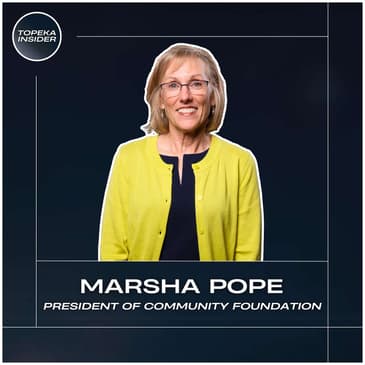
We talk with Marsha Pope about how the Topeka Community Foundation grew from a $10,000 idea to a $120 million engine for local change and why the team moved from quick fixes to upstream solutions. We explore impact investing, mental health, housing, and the power of data to guide funding.
• Origin story of the Topeka Community Foundation and Junior League roots
• How donor-advised funds stay local and responsive
• Endowments, spending policy, and grant making basics
• From apples to upstream: reframing health through zip code data
• Social determinants of health and Shawnee County mapping
• Mental health, housing, community safety as health priorities
• Impact investing examples, including fixing predatory contracts for deed
• Leadership pipelines, student social enterprise, and collaboration culture
• What Topeka needs for identity and civic pride
• How to apply for grants or impact loans and who to contact
Find us on Facebook and Instagram, and visit TopekaCommunityFoundation.org for grant guidelines and details
________________________________________
0:00 - Meet Topeka’s Community Foundation
2:35 - How a $10K Idea Became $120M
6:50 - What Donor-Advised Funds Do Locally
11:30 - Marcia’s Path Into Philanthropy
16:45 - Community Development Is Economic Development
22:40 - From Apples to Upstream Solutions
27:45 - Zip Code vs Genetic Code
33:10 - Mapping Health and Targeting Need
36:50 - Mental Health, Housing, and Safety Priorities
_________________________________________
Beyond the Podcast: 🎙️
Be sure to follow our Topeka Insider Socials below and check out our website for additional stories and articles pertaining to Topeka, KS
Website -- https://topekainsider.com/
Facebook -- https://www.facebook.com/topekainsider
Instagram -- https://www.instagram.com/topekainsider/
Follow Your Hosts: 📱
Follow both Justin & Jon on their personal socials to get connected. They would love to connect and answer any questions about the show or their day to day.
Jon Griffith's Instagram -- https://www.instagram.com/thejongriffith/
Justin Armbruster's Instagram -- https://www.instagram.com/armbruster_jd
For Any Inquiries, please DM @TopekaInsider on Instagram!
We would never guess that philanthropy could play such an important role in a community.
Jon Griffith:And we're gonna put Topeka on the map. Convince the Savannah bananas to move this Topeka.
Marsha Pope:Yeah, yeah, there we go. It's like we really want to be able to make a difference around mental health and he's really excited to ask you for money like this.
Jon Griffith:We've got Marcia Pope, you are the president of the Topeka Community Foundation in the studio with us. Thanks so much for carving some time out to the video. Thanks for being here.
Marsha Pope:Yeah, thank you.
Jon Griffith:Absolutely. So, Marcia, maybe could you start like, what is the Topeka Community Foundation? That is a great question. Yeah.
Marsha Pope:So the Topeka Community Foundation is a nonprofit organization created in 1983. Back, I'll give you the backstory. Yeah, please do. Please do. So uh four ladies from the junior league drove to Lincoln, Nebraska to learn more about how to write grant applications for funding for junior league ideas. And while they were there, they learned about the Lincoln Community Foundation and on their drive home said, Topeka should have something like that. So the junior league had some conversations and started the community foundation with a $10,000 grant. Wow. From that time, um, that was November of 1983, we've grown to $120 million in assets, all while having granted that much money back into the community too.
Jon Griffith:Wow, wow.
Marsha Pope:So um good investment from the Junior League.
Jon Griffith:What is the Junior League?
Marsha Pope:So it is a volunteer organization of women that really builds leaders, and then like I think maybe they started Meals on Wheels here. I mean, they they create programs, they fund programs and then launch them.
Justin Armbruster:Cool.
Marsha Pope:Um and we're one of those programs.
Justin Armbruster:So when you say $120 million under assets, what what does that mean exactly?
Marsha Pope:So we have um we so it's weird like a nonprofit organization, you usually think you serve meals or you build houses or you run programs for kids. Right. We don't have programs and projects of our own. So what we have are um charitable funds. And so we have over 400 different charitable funds, um, donor-advise funds, scholarship funds, um, field of interest funds. We hold those dollars, invest those, they can grow in those funds tax-free. Um, and then some of those funds come to us, maybe in estate gifts. When St. Francis was sold, um, that foundation came to us. And so we have a mental health fund, we have a community health fund. In those unrestricted or field of interest funds, then we can use those dollars, they're endowed, and we can grant each year around what the language is in that fund agreement.
Jon Griffith:Gotcha. So is it like they're treated like an endowment? And i i if tell me if I'm understanding an endowment. An endowment is basically you can give off the interest of the investment.
Marsha Pope:So we hold I don't know what percentage of our dollars are endowed, but for those funds that are endowed, our spending policy is you take a three-year September 30 balance, um, take the average of that, and then you take uh four and a half percent of that average, and then that's what we would grant.
Justin Armbruster:Okay. So you guys are receiving grant applications for people who want money, and you guys get to decide whether or not this is a good use of guidance.
Jon Griffith:But you're also receiving donations too, like in investment. So like you said you have charitable funds people can give to those.
Marsha Pope:So um just like um our competitor in that arena would be like a Fidelity or a um there are four commercial donor advice funds, but you can also do that at the community foundation. And so, you know, Fidelity or one of those groups, they would be really good transactionally for you. But if you have a fund at the community foundation, we're gonna get to know you and what you care about. So here the story, there's a story. Um, we had a donor, has a donor advice fund years ago in Dillon's, you know, where we live in Topeka, buying apples, and we run into the donor, and they're like, Do you know of any like kids' education programs they were interested in funding? Well, that was the year that Highland Park High School had started um requiring their freshman class to wear uniforms, and there were kids who couldn't afford the uniforms. So they made a grant from their fund to Highland Park High School and helped kids purchase uniforms.
Jon Griffith:Okay, that's awesome.
Marsha Pope:Yeah, and Fidelity would never know that.
Jon Griffith:Right, sure. Right. So you're serving local needs. That's very cool.
Justin Armbruster:Um so I guess before we dive more into that, uh, I'd love to hear a little bit about your backstories. But how did you how did you get into this? Are you from Topeka? Right. Who is Marsha Pope?
Marsha Pope:Yep, so grew up in Iowa. Um, went to college and Morningside College in Sioux City, Iowa, where I met my husband. Um that took us to Houston, Texas, and we were there for a while. Couldn't wait to get back to the Midwest. Um Let's go. Yeah, right. So back to Omaha, Nebraska. Um, side note there, you guys, I don't know if you were even alive when this happened, but when the plane crashed in Sioux City, Iowa, I was working for the Red Cross at the time and was sent there to be like their national spokesperson for all the media and all of that. Um and when CNN asked me for an interview, I like gave them 30 seconds because I was so busy. So that was my claim to be. Right. Yeah. Um, and then from there to Peoria, Illinois, and then um here since 1996, but always been in nonprofit work, the YMCA, the Red Cross. Wow. Um, I had worked um for 501 in the communications department part-time. Our boys were little, and so I was in a job share. And at the time, the community's sesquicentennial celebration was going on, so there was a community committee, and I met the president of the community foundation, and she was smart and hardworking, and we hit it off, and there was a position open there. So I left 501 to um work at the community foundation, overseeing their grant making, um, scholarships, the women's fund, things like that. And then when this position became available in 2016, um, became the president.
Justin Armbruster:Okay, so you've been the president for coming up on 10 years. Yeah, almost.
Marsha Pope:Yeah.
Justin Armbruster:What uh what excites you most about the community foundation? What do you what about your job do you love doing? What gets you out of bed in the morning?
Marsha Pope:Well, the you know, you would never guess that philanthropy could play such an important role in a community. Um, so um beginning really in 2017, the Greater Topeka Partnership was working on Momentum 2022 at the time and um asked the community foundation to be part of that conversation and really shifted the conversation from um talking about making the prosperous more prosperous in our community to what's it look like for prosperity for all? Um holistic economic development. And so that was we were able to kind of partner at that time then with uh with the partnership, and so they know economic development and we know community development. And it the light kind of came on that community development is economic development. Wow, and so um aligning our goals and moving us forward together, um, each of us doing what we do best, um, but we know those, they know businesses, they know um jobs, all that kind of stuff. We know communities, and so we are able to kind of get in each other's business to help make progress for the whole community.
Justin Armbruster:Who's been your and I'm sure there's several, who's your contact at the partnership that you work hand in hand with?
Marsha Pope:Well, Matt Pavarnik was on our board until he left.
Justin Armbruster:Um unbelievable RIP.
Marsha Pope:I know, so sad. Um, beginning in 2026, I mean it has to be voted on, but Molly will be um yeah, on our board. And I'm on the uh momentum 2027 executive committee. So we're in each other's business all the time.
Justin Armbruster:We had Molly on a couple weeks ago. Yeah. So that's awesome.
Marsha Pope:Yeah, smart, hardworking. Yeah, yeah.
Jon Griffith:Yeah, so fun. Yeah, and just her transitioning in. Um this is a little random, but I'm still stuck on something you said earlier. What is a sesquentennial?
Marsha Pope:The ses is that 150 years? I think it is. Okay. I mean, I'll take your word for that. Yeah, no, I think that sounds great.
Jon Griffith:I was thinking it was like 15 seconds to turn my mind. What is sesquintennial makes it? Did you say that's what it is?
Marsha Pope:Yeah, I'm pretty sure that is 150 years. Amazing.
Jon Griffith:There you go. You learn something every day. Wow. So what are some of the projects you're okay? Well, so MacroView. You receive funding of some kind, like donations, government grants, maybe. No, just all donations. And then you invest that, try to maximize those donations, and then you give those to community projects you're excited about that seem like they fit within these goals. What are some of the projects you're most excited about right now?
Marsha Pope:So um through a strategic planning process, we looked. Okay, I'm gonna tell my Apple story, which I tell all the time. So in the past, the community foundation would have said, we have these health dollars available, submit your grant applications, and we'll give grants around health. And we would have gotten application, we'll say, from the Boys and Girls Club for $1,000 to buy apples for their after-school program. And we'd have written the check for $1,000 and they'd have bought the apples, and the kids would, and that would have been great and still is. Now, what we do would say is here's your check for $1,000 to buy the apples because kids need apples. But what is the barrier for families buying their own apples? And how do we get upstream on this? Is it transportation? Is it access? And how do we fix that problem? Well, because otherwise we're just gonna buy more and more and more expensive apples forever. And so um, we learned um at a Shawnee County Health Department event about the social determinants of health. So your health is 20% your genetics, it's 20% your health care, but it's 60% where you live. So your zip code determines more about your future health than your genetic code. Wow. And so when we learned that, we totally flipped our grant making upside down because we can do something about that. Um, save like community and we broadened our definition of health from um community health and health um initiatives to things like community violence, um, education, childcare, all of that, affordable housing, that's all health. And so we are now using both, and then that's why we went into impact investing, because you can't grant your what we didn't we knew we could never use our grant dollars to move our community, make progress in those areas the way that we wanted to. So we unlocked this other capital to be able to make loans to for-profit developers and businesses to provide the programs and services that we knew we wanted to.
Jon Griffith:Essentially changing the makeup of the zip codes is kind of okay. So say that was pretty profound. So your health is based on the three things 20% genetics, 20% uh healthcare. Healthcare. And then the rest is where you live, the zip code or neighborhood you live in. Can you just flesh that out a little bit more for us? Like what exactly are the factors that in that 60% where you live? Like what is it exactly about where you live that affects your health?
Marsha Pope:Well, and if you look at like we have a community health map, and so if you look at that map, there are there's dark blue, which is super healthy, light blue, which is healthy, pink, which is like I don't can't remember the exact term, and then red, which is like intensive care. And so er pretty much everyone in the community providing programs can see where the intensive care areas are. And if you look at those areas, you'll see uh very few grocery stores. You'll see billboards that have like I don't know about your neighborhood, but in my neighborhood, there's no billboards for cigarettes. Right. Um, there's no I've got sidewalks that I can walk on at night. I feel safe walking on those sidewalks at night. So there's just all there's just an infrastructure that's missing in their zip codes in our community.
Jon Griffith:Yeah. Interesting. Wow. So how are you guys getting that information? Is it like surveys? Is it someone just driving around and seeing, okay, here's all of the grocery stores and here's all of the cigarette shops? And you know, how exactly is that mapped out?
Marsha Pope:So there is the Robert Wood Johnson, I don't know something. They productwood Johnson scorecard for health is produced by maybe Indiana University. And they by zip code, by county, can give you what those are. So obesity rates, um, smoking rates, um, early births by zip code. And then you take all of those things into consideration and then you get your scorecard. And so then that's what we found out was that our health was bad and getting worse, basically, in Shawnee County.
Jon Griffith:Wow. Wow. One thing that uh you said Shawnee County, yeah. I was I was gonna ask about the Topeka demographics, but it's you said Shawnee County. Man, that's very cool. So, what are some projects you said you're investing in some developers? What are some other things that you're excited about that are you're trying to move the needle on that?
Marsha Pope:Well, mental health is one of the things that we have a uh two separate funds for that we over our committee, our grants committee oversees that. And so tying so much to mental health and community health. And so we're having conversations with like the police department, um, some with some schools, um some kind of unusual suspects to see what we we've had these funds, and it's almost been like the I don't know, paralysis of analysis. It's like such a big problem that doing anything seems like that's not gonna help. But it the time I feel like has come that it's like we really want to be able to make a difference around mental health. And so those are we're spending a lot of time on that right now. Um, housing is an issue, uh, affordable housing is an issue, um, community safety is an issue. And you know, we can't be all things to all people. Sure. But it it because we don't have programs and projects of our own, we can be parts of lots of conversations because we don't really care how this goes forward. We just care that the best thing is done for the community.
Justin Armbruster:Right.
Marsha Pope:And let us play whatever role we can play to help make that happen.
Justin Armbruster:That's really cool. And I that adds maybe a little bit of perspective into your job as far as some maybe some of the pressure of, you know, some of these issues, affordable housing. I hear that one all the time in my line of work. And, you know, whenever I hear it, the first thing that comes to my mind is like, well, I'm not gonna be the one to solve that. I have no idea. Right. And it sounds like maybe you're not the ones who are trying to solve it, but you're the ones who kind of have to dictate whether or not a solution is a good one that deserves funding or not. Right. Yeah, that seems right. Um I'm hearing this, knew nothing about your job, very little about the community foundation going in, and now I'm leaving thinking, that's a tough job. That's a stress, that's a stressful job having to be the ones who decide, yeah, it's a good idea, or no, that's not a good idea. It gets cool. It's a cool job, though. It is a very cool job.
Marsha Pope:And every day's different. Um you know, on the flip side of that, so we have like these 120, 150 scholarship funds, and so many of those are set up um in memory or in honor of someone. And so um, someone passes, we work with their family, we establish a scholarship fund that's awarded in the spring. We have a reception where the donors come and the kids and their parents come and we read about why the scholarship was created. So the first one, Dr. Tiffany Anderson, established when her husband died the Stan and Tiffany Anderson scholarship. And we read a little bit about him, and she stands. Then the the student who wins, they stand. Um, we have a photographer there, we take their picture. So there's like there's there's like the we deal with po we want to solve poverty in our community side of the job. And then there's like we get to connect donors to these awesome. Maybe a little less stressful. Yeah, so cool, yeah. Uh-huh. Yeah.
Jon Griffith:Kind of two sides of the core.
Marsha Pope:Yeah.
Justin Armbruster:In some ways. Right. Wow. That's very cool. Do you guys do much with uh the Topeka Rescue Mission and like home I I think of homelessness as one of those big issues that I've always heard societal. Yeah. I've heard a big part of the Topeka Rescue Mission, and you maybe know more than I do if you're involved in that department. But a big part of the Topeka Rescue mission is what they do is kind of like what you're talking about. It's not solving the issue of someone's homeless right now, let's give them a place to live. But hey, how can we prevent uh homelessness from being a problem in the future? Because if we just give them what they need today, then you know the problem's still out there, and the reason why there's homelessness in Topeka and all over. Right. Um, do you guys do much with that? Is that something you're involved in, or is that maybe well?
Marsha Pope:I mean, it's always on our radar, but what you're talking about is like changing systems.
Justin Armbruster:Yeah.
Marsha Pope:And that's so I'm gonna an example of that would be um when we started doing this impact investing work, um, Janice Watkins from Habitat for Humanity came into my office and she's like, I've got this crazy idea. And so they do um home weatherization for seniors. But to do that, you have to own your home. And so as people were coming to them with documentation that they thought showed that they own their home, instead of a mortgage, what they had was a contract for deed. And so what they were finding out was and contract for deeds can be awesome business tools, but they can also be used in a predatory nature. And so what they found out was like lots of not lots, people had these contract for deeds, thought they were mortgages, they were putting infrastructure into their home, adding value to their home, and then at the end of this contract, it would their homes were being taken from them.
Jon Griffith:Oh my goodness.
Marsha Pope:So she said, What if we could um work with an attorney, get these people out from underneath their contract for deeds, and then remortgage these homes to them. So we gave her a loan to kind of help do that. They have turned that, so like we're changing the system. Wow. For in a perfect world, you wouldn't even be able to issue a contract for deed on a home. And they're working on that.
Jon Griffith:But this is that like rent-to-own kind of advantage?
Marsha Pope:Oh, kind of. But then at the end, you don't really own. You still own you don't own.
Jon Griffith:I haven't even heard of that.
Marsha Pope:You probably know more about it. Uh yes.
Justin Armbruster:It's I let me put it this way. I spoke to my attorney once about Vim, and he basically told me there is no reason why a seller should do a contract for deed unless they're trying to take it back in the end. You know, there unless or, you know, the only time where it makes sense uh for a seller to do it, you know, you're doing a contracted deed with your kid and you're giving them a reduced interest rate because rates are at a seven right now. Um any other time where you're doing a contract for deed to a buyer that you have no outside of reason to give them a discounted rate, the intention is you're probably gonna take it back in the end. Yeah.
Jon Griffith:Um the idea is you get a discounted.
Justin Armbruster:Well, the idea is the idea of a contract for deed is when a homeowner, someone who owns the property, owns it outright, there's no bank lien on it, there's no mortgage. I could, if I owned the home, say, hey John, do you want to buy this home? And I will be the bank. You're gonna make payments to me, and you're going to be making uh payments to me instead of a bank, instead of you getting your own loan. Sure. And then what happens is uh the moment you default on that loan, you miss a payment, you know, my mortgage terms are I'm gonna take it all back. Oh and so you've been making payments on it for four years, and you should have legally some principal interest in that. Some equity. But the way that these um homeowners set up their mortgages is they I don't know if it's in the writing or if it's just you know understood, is that no, you don't own any of that. You met you defaulted, I'm taking it back. Wow. And so now you've been making payments this whole time and you don't have any equity or principles to share. Basically, and that's essentially what my attorney if I'm understanding that correctly, is it's you know, they should have some principal equity, but some um homeowners, you know, just take it back. Whether that's just the agreement that was set up in the beginning and the you know, buyer, renter didn't know. Is that kind of what's a lot of times they just didn't know? Right. They thought it was a real mortgage. And so what you were saying is that you were working with a thing somewhere.
Marsha Pope:Yeah. And so then habitat then would this attorney would send a letter to this evildoer person, they would then allow that to let the um habitat buy out the that, then they could create a real mortgage for the people who own the home. That caught the attention of the national habitat. So that is being done like across America now. And then it's even being done internationally just because of a great idea right here in Topeka. And had we not opened our eyes and our doors to the idea of impact investing, we wouldn't have had the kind of capital needed to make that kind of a uh deal happen.
Jon Griffith:Yeah. Do you uh so so it was basically like property and like real estate investors who had lots of properties and they were doing that on all of their or a majority of their property? Wow, that's messed up. Yeah. Um do you know anything about uh like the effects of like predatory loans, like payday loans?
Marsha Pope:And is that kind of something that we've never gotten into any of that. Um we've had some conversations with some credit unions in about using some of our impact investing dollars to like help maybe set up credit or uh accounts or something like that. But uh you have to have there's tons of great ideas out there, but you have to have the right people in the right place at the right time. Totally. Yeah. And if one of those is missing, then if and sometimes that happens and it comes around years later. Um at one point we wanted to have we we love Leadership Topeka. I think it's a great program, and thought it'd be great to have high school kids go through something similar, but it just never took root anywhere. And then for a while, we well, till COVID, we partnered with Washburn University's Leadership Institute, and they created something like that. It was a summer institute for kids, and it was basically like leadership Topeka. But you just we had the right people in the right place at the right time. Yeah, and from there the Topeka Youth Commission was born from that leadership experience at Washburn, and it was because of you know, just having the right people in the right place at the right time. Yeah.
Jon Griffith:That actually I think is a really interesting conversation that would be interesting to have uh is how many problems really will only be solved as more leaders are developed, you know, and and one of the things I think about a lot of times is like just the like like the value of a human being in in terms of the slice of like man, you you gotta think like the next greatest idea is from is in the heart of some undeveloped leader, you know, who's a kid or a person who just like you know is is un is raw in their sort of leadership potential or whatever. And so, you know, like who's gonna solve world hunger? Like it's gonna be some dude in Africa with a dream, you know, and uh you know, things like that, that they're like, there's a person out there, and so it it's I think it like I don't know, I'm I'm just kind of like uh in orbiting around this idea of like I think a lot of times people have this idea of like, hey, why don't why don't just like the two people who are in charge of everything fix everything? And you're kind of like yeah, I mean, yes, there are like good ideas and bad ideas and all those things. Ideas have consequences, um, but like you can't handle to spin five more plates than you're already spinning. Like you can only have you don't have the time and energy to do things you're doing. So in order for that to get solved, someone else is gonna have to step into that position, right? You know, that role or whatever. So yeah, that's it, that's interesting.
Marsha Pope:Yeah, one of the things that we're doing, sorry, didn't want to interrupt you, is um this whole idea of investing for a financial and a social return, which is what we're doing with like the child care center and the affordable housing, is um Washburn School of Business in the spring has a like a pitch contest for businesses that have a social return to them. And we sponsor the prize money for that. And so we're three or four years into that. Um, but you're right. I mean, these kids have great business ideas. Yeah. Um, providing job training to inmates, um, a lot of really great idea apps for things like how to for volunteerism, for food. Um so you're right. There are awesome ideas out there that just need to someone needs to say, go for it and do it.
Jon Griffith:And I'm totally aware there are some terrible ideas too. Like we should all do this. You're like, that's the worst idea in the world. But you know what I'm saying. Yeah, I think you like you know what I'm saying. It's just like it is, it's so true. Like the need to develop more leaders. Uh, and I think in a city like Topeka, what we need is like one of the things that that I think would be so great is we don't just need people who are skilled, we need people with the heart who have ownership in the city. Because it's like it's one thing to have like kind of that sense of like, I'm talented, I could climb the ladder and become successful. It's another thing to have the ownership to look around at your place where you live and see what are the problems that need solving, who else is gonna do something? Maybe I could do something. You know what I'm saying?
unknown:Yeah.
Marsha Pope:And I feel like in 2017, when you know, I give Matt a ton of credit, when Momentum 2022 was being created, and it's this whole um inclusive economy idea, prosperity for all, there was a lot of leadership. Like Dr. Anderson was new, Matt was new, I would there was just a lot of new leaders in the community. And I felt like for the there was just this energizing idea that if we would all work together, yeah, something amazing could happen. And I feel like that has ignited, and and you know, it can always there can always be more and better and all that, but there is this spirit of cooperation and collaboration now that there was not before. Yeah, cool. Yeah.
Justin Armbruster:So here's a question. Some say a listener has an idea on how to solve homelessness in Topeka. Or has how to do something big and they want to reach out to the community foundation. What does that process look like to apply for a grant? Great question. And then I guess who are they applying to? Because I imagine it's not you sitting behind a desk and Marcia says it's good to go and there you go. What does that look like?
Marsha Pope:So there's two sides to it. So there's the grant side to it. So grants have to go to nonprofit organizations. Okay. So an individual couldn't just call us and ask for money to do something awesome. Yeah. But normally they're going to be working through some kind of nonprofit organization. So in that case, they would call and talk to our director of strategic initiatives. She would have a conversation with them, um, find out what it what you want to do, how much do you think that's gonna cost, who are you working with, all that kind of stuff. We've got an application, and then there's a grants committee made up of um people. I like to say, we used to call it the community investment committee. Um, and my idea was when you looked at the that group of people, you'd come in and interview, you saw the community. Um, people from all parts of the community, um, very diverse um group of people making those allocation decisions. Um but it might take a little, depending on how much money you're asking for, it might take a little bit to get there. If you're looking for a loan for if you're a for-profit business and you've got this great idea, you'd call me and we'd have a conversation. I would ask for things like your performance budget, your business plan, those kinds of things. Um, then if it we've got kind of a rubric where we score things. If I felt like it met the rubric, then you'd talk to the leadership of our local impact investment committee, you'd answer their questions, then it would go to the full um impact investment committee, and then our board of directors makes the ultimate decision around loans. Great. Yeah.
Justin Armbruster:That's cool. Wow. That's wow. So you have any ideas you want to pick up?
Marsha Pope:Marshall on the spot. Here we go.
Jon Griffith:I have some ideas. I'm trying to remember what they are. I haven't thought about this in a while. What are some things that you are most excited about just happening in the city of Topeka right now?
Marsha Pope:Good question.
Jon Griffith:Or not excited about. Yeah. On the other side of the coin.
Marsha Pope:I am hopeful that lots of people will vote this fall. While not ever going to publicly talk about who I would vote for, I think voting is very important.
Jon Griffith:And I feel like you don't want to recommend a certain candidate for it.
Marsha Pope:But I would highly recommend voting and letting your voice be heard. And being involved in that process, no matter what that looks like, if that is going to city council meeting, I just feel like there's people are realizing that their voice is important. And so using that voice in a positive, encouraging, supportive, let's do this together kind of way, I think is important.
Justin Armbruster:That's great. So you've been in Topeka since 96, you said you've basically Topeka's home for a while. Topeka is home. But you've also lived in other places. Yes. Let me hit you with this. What is something in Topeka? What is something that is missing in Topeka? Maybe it's a restaurant, something to do, a store. I don't know. What's something that Marcia would like to? Confidence. I have we had said we I asked that question to one of our previous guests. I said, What's something Topeka is missing? And she said confidence. And I'm like, I was thinking more of like Lululemon. But uh so I specify now. Is there something that Topeka is missing you'd love to see us have?
Marsha Pope:We need something that says Topeka. So my husband and I ride bikes, and we were in Colorado, and we were taking pictures, and we meet this other couple from Austin, Texas, and we're like, Oh, we used to visit Austin and um where from where are you from, Topeka? Well, what's in Topeka? And it's just like we got great schools, we've got the zoo, we've got the Discovery Center, we got this emerging downtown, we've got Noto, but we don't have something that says, like, this is Topeka.
Jon Griffith:So like like an arch, like you know, like something like that.
Marsha Pope:Uh baseball team, like uh, you know, that's something that somebody would say, like, that is Topeka. Yeah. Yeah.
Jon Griffith:Someone needs to convince the the Savannah bananas to move to Topeka. Yeah, yeah. There we go.
Marsha Pope:That'd be yeah.
Justin Armbruster:Uh we're getting that new uh hockey team. Yeah, well what is that, semi-pro? Scarecrows, yeah, the scarecrow. Semi-pro. Well, we need to have them on if you're gonna be able to do that.
Jon Griffith:We're currently talking to someone on their social media, so hopefully uh this they come on here. We're working on it. Yeah, but yeah, love that.
Justin Armbruster:Yeah, we need to we need a staple, something that says this is Topeka.
Marsha Pope:Yeah, I mean with Brown versus board, you know, we've got tons of great stuff.
Jon Griffith:That is huge, yeah.
Marsha Pope:But it's I don't know, just something that we can all wear that jersey or all do that we're all in that together.
Jon Griffith:Yeah.
Justin Armbruster:It's a fan of bananas.
Jon Griffith:It is in it is interesting because I I'm not the uh I'm not the biggest like sports fanatic. Uh uh I'm not even close to that, but uh it is interesting now that you mentioned something like that, it there is a real sense of like community identity from supporting something altogether like a sports team that helps people maybe overcome differences and things and have a sense of pride in where you live. That is we're all part of the same team. Yeah, that is something that's really interesting. That I don't know if if I give that enough credit.
Justin Armbruster:You come up with an idea, you think about it, you come up with the budget pro forma, and then you pitch it to Marcia, and we're gonna put Topeka on the map. There you go.
Jon Griffith:My idea is to buy the Savannah bananas. Okay, there we go. Although I just saw a video the guy said he'll never sell. I did see that. Uh yeah. Which is sad. But maybe he would relocate. Maybe he would relocate. The Topeka bananas.
Justin Armbruster:I don't know. Have you never heard of the Topeka Tropics? Indoor football? RIP. Do we still have them? No, we don't know. R.I.P. was gone. It was a staple. Yeah. It was cheap Friday fun. Oh that's what it was. That was yeah, it was sad. Because it's just it's a cool name, too. Even though it makes no sense. Like, why would why are we the tropics? Absolutely. We uh my slow pitch softball team, we named ourselves the Topeka Tropics. And now that the Topeka Tropics are no longer around, people just think we're weird. But cool. Yeah. Man, you wanna go rapid fire? Let's do it. Okay. We have some rapid fire questions that we ask at the end of our episodes, just some this or that. Let us know when you're ready. We'll hit it with it.
Marsha Pope:Okay, let's go.
Justin Armbruster:Local coffee shop. What's your favorite coffee shop in Topeka?
Marsha Pope:Oh, there's Circle. I'm just gonna say whatever comes to the first thing that comes to my head. I love it. But that's partly because of the cinnamon roll.
unknown:Yes.
Jon Griffith:Oh man, the cinnamon rolls are fire. Their bakery's good. Yeah, and they're like uh uh they're like gluten-free kind of stuff, doesn't taste gluten-free. So interesting. My wife was gluten-free for a while, and it was a big deal. We had gluten-free stuff. And it was not like, you know, a lot of gluten-free stuff, you're like, okay, this tastes this tastes fake. You know, but it was like, I would eat this normally. Cool. Yeah.
unknown:Oh.
Jon Griffith:Go for it. Yeah, yeah. Uh go to date night spot. Friday night. You want to get out and do something together.
Marsha Pope:Well, see, let's like, we're bike riders, so it's like that. So we like to, I'm just gonna like we ride our bikes to Lake Shawnee.
Justin Armbruster:Lake Shawnee.
Marsha Pope:And we like eat out and then ride home.
Jon Griffith:Yeah, yeah. Like road bike, like that kind of pedal bike. No, yeah, yeah, yeah. I mean, but like you're not like trail riding like a mountain bike.
Marsha Pope:No, but the trail bike system trails here are awesome. Like we start near 29th and Fairlon-ish, and you can get all the way out to the lake on a bike trail.
Jon Griffith:Really?
Marsha Pope:Yeah.
Jon Griffith:I think the Shunga trail.
Marsha Pope:Yeah, because you you're on the Shunga.
Jon Griffith:It goes from 29th Inn Fairlong all the way up past downtown, and then you can cut down to the trail.
Marsha Pope:You can go out by Reesers, you go around. There's a path out there, then you're on 29th Street, you take 29th Street sidewalk, and then you can get to the lake.
Jon Griffith:Yeah. I did not know that. Yeah, you're only on 29th for like a quarter of a mile or something for you to like. Yeah. No, no.
Justin Armbruster:I just wrote that the other day. I I mean, I don't know why I would know that. I don't ride bikes.
Jon Griffith:You gotta time your path when you pass Reeseurs, you gotta time it right. It can be a little rough. Like depending on the time of the day, you're like it's like driving by the creek, you know, Shunga Creek. You know, it's like, yep.
Justin Armbruster:Yeah, you gotta hold your breath sometimes. Yeah, yeah. Um Do you do any home projects?
Marsha Pope:Not a ton.
Justin Armbruster:Okay, absolutely. So we'll just ask you any home projects. We'll just ask her still. Okay. Home depot, Lowe's, Menards. If you had to go to one, where would you go? I go to Lowe's. Okay. Okay, let's go. Yes. That uh we like that. That's he's a Home Depot guy. I'm a Menards guy. Okay, yeah. I buy my flowers at Lowe's. Okay, yeah, yeah, yeah. Smart. I like it. There we go.
Jon Griffith:We need a whiteboard. We need we need she would probably be the first cali for Lowe's. Yeah.
Marsha Pope:But it's right across the street from Aldi's. You get a twofer.
unknown:Yep.
Jon Griffith:Oh, that is true. Yeah. That's awesome. Uh, how many hot potholes did you hit on the way here?
Marsha Pope:Uh I don't didn't really count.
Justin Armbruster:I have a community idea. Fixing potholes. Pitch it to Marsha.
Marsha Pope:Aren't we like, okay, so when we did that at Washburn University and some kid was doing his little pitch thing, and the mayor was there as part of one of our readers, and he mentioned potholes. And it's just like, can you like not ever go somewhere and not talk about potholes?
Jon Griffith:Yep. Right.
Marsha Pope:It's just like, ugh.
Jon Griffith:I know. It takes a well, it's a little bit it's like a Midwest problem. It's not just an upfaster problem.
Marsha Pope:And then when we do things like Fair Lawn and we try and then people complain about them.
Justin Armbruster:Exactly. Because we have too many potholes. Okay, well, let's fix them. There's too much construction. This is the worst.
Jon Griffith:I mean it is real life. What I all all I want, it's this is should be not a large ask. I just want perfect roads with no construction. That's all I that's all I want. Ever you go. I want it to be and I want green lights the whole way. Is that too much to ask, guys? Come on. You know, that's funny. Yeah.
Justin Armbruster:Uh do we have any others?
Jon Griffith:Uh I'm just curious since you brought up you guys uh like to bike. Uh-huh. What so where are some of your favorite places to bike just in the US? Like where do you guys go to bike?
Marsha Pope:So Dillon, Colorado is awesome. Okay. Um, like from Frisco to Breckenridge and Frisco up to Copper Mountain.
Jon Griffith:Oh, so you're like long distance biking.
Marsha Pope:Well, there I mean, depends on your definition of long distance.
Jon Griffith:Like you go like 50 miles?
Marsha Pope:We have.
Jon Griffith:That's good.
Marsha Pope:Okay. And then in Iowa, there's the High Trestle Trail outside of Des Moines, Iowa. That that's a really it used it's a rail to trail kind of thing. And it's a really it's one of our favorite places too.
Justin Armbruster:How long does that take? A 50 mile?
Marsha Pope:50 mile? Well, it just depends.
Justin Armbruster:At Marsha Pope pace.
Jon Griffith:Three to four hours, maybe?
Marsha Pope:I don't I don't know. Because like you gotta stop and go to a coffee shop. Yeah, okay, so it's a race.
Jon Griffith:That's not a race. Yeah, it's not a race. You're not doing the Iron Man. No.
Justin Armbruster:I have no idea, man. I don't bike. No.
Jon Griffith:Would you ever do an Iron Man?
Justin Armbruster:No.
Jon Griffith:I mean you're but you're biking the Iron Man portion of the.
Marsha Pope:Yeah, well, I wouldn't might probably not even do that.
Jon Griffith:You should be a stand-in for the biking part. So if I did an Iron Man, you could do the biking part for me. Oh.
Justin Armbruster:That might take some. And I'll hand you guys Gatorades.
Jon Griffith:Yeah, somebody like uh who wants to be a millionaire? I'm gonna call a friend, phone a friend. Like, Marsha, I need you to do the biking part for me. Right. You got two hours prepped.
Justin Armbruster:You could probably find someone better to do it for you. Yeah. Thank you so much for joining us today. So good. If people are curious about the Community Foundation or want to get in touch with you, what's the where are you guys at? Are you on social media?
Marsha Pope:What's the best way to do you can find us on Facebook and Instagram? We also, our website has a ton of information on it about our grant application process, all of that, Topeka Community Foundation.org.
Justin Armbruster:Great. Yeah. Awesome.
Marsha Pope:Marcia, thank you so much for your time. This has been great. Thank you so much.
Jon Griffith:And just we just want to say, we just love what you guys are doing. And yeah. Honestly, I'll just say too, like the you you've like really gotten me to think about some things I haven't thought about the way that you talked about this is really cool.
Justin Armbruster:So he's really excited to ask you for money later.
Jon Griffith:Yeah, we gotta get these bananas in details. That's all I'm that's all I'm saying. Cool.
Marsha Pope:Business plan in Formont. Thanks, Marsha. Thank you.