
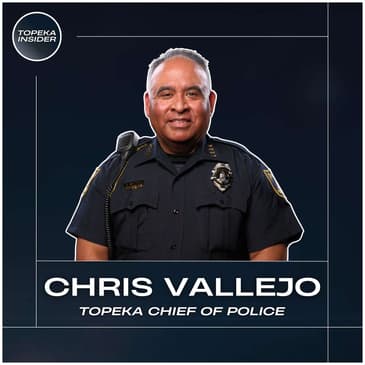
We sit down with Topeka Police Chief Chris Vallejo to talk about what the job really looks like, why he believes he was sent to Topeka, and how purpose shapes leadership. We dig into crime trends, community trust, and the real-world tradeoffs behind staffing, budgets, and new policing technology.
• organized chaos of leading a police department and setting a clear vision
• faith, purpose, and the decision to leave Austin for Topeka
• what separates patrol work from the police chief role
• community-oriented policing built through training and policy advisory input
• why Topeka feels more like a community than a big city
• crime perception versus reality and why “hot spots” matter
• community violence interrupters and the PACT team approach
• what a chief carries on the belt and why showing up in uniform matters
• lessons from the Austin serial bomber case and how policing evolves over decades
• staffing goals, budget constraints, and what keeps a chief up at night
• technology in policing including body cameras, AI report writing, and license plate readers
• rapid-fire favorites around town and what Topeka still needs to grow
Like this podcast.
________________________________________
0:00 - Sponsor Message And Setup
0:41 - Monster Cheers And Guest Welcome
1:45 - Faith, Calling, And Why Topeka
5:46 - What A Police Chief Does
10:17 - Topeka Vs Austin Community Feel
12:38 - Crime Reality And Recent Drops
15:00 - Violence Interrupters And The PACT Team
16:51 - What’s On The Duty Belt
20:06 - Austin Serial Bomber And Policing Changes
23:55 - Staffing Needs And Budget Limits
24:46 - Tech, AI Reports, And License Plate Readers
30:32 - Leading Under Pressure As Chief
32:13 - Police Cruisers And Practical Tradeoffs
35:06 - Rapid Fire Topeka Favorites
40:09 - What Topeka Still Needs Most
________________________________________
Beyond the Podcast: 🎙️
Be sure to follow our Topeka Insider Socials below and check out our website for additional stories and articles pertaining to Topeka, KS
Website -- https://topekainsider.com/
Facebook -- https://www.facebook.com/topekainsider
Instagram -- https://www.instagram.com/topekainsider/
Follow Your Hosts: 📱
Follow both Justin & Jon on their personal socials to get connected. They would love to connect and answer any questions about the show or their day to day.
Jon Griffith's Instagram -- https://www.instagram.com/thejongriffith/
Justin Armbruster's Instagram -- https://www.instagram.com/armbruster_jd
For Any Inquiries, please DM @TopekaInsider on Instagram!
Sponsor Message And Setup
Chris VallejoI think it's a wonderful place and it can make a difference.
Justin ArmbrusterWe should lose a little bit of a screwing. Like this podcast. This podcast is brought to you by Washburn University, a Titanic College and a City of Opportunity.
Jon GriffithWashburn offers small classes and big experiences. It's public prestigious and has the lowest student debt in the state.
Justin ArmbrusterWashburn delivers a personalized education that you won't find at larger schools. Learn more at washburn.edu.
Monster Cheers And Guest Welcome
Jon GriffithWelcome to Pika Insider, another episode. We have a special guest today. We have Topeka Police Chief Chris Valenjo in the house with us. Welcome to the studio.
Justin ArmbrusterGood morning.
Jon GriffithCool to be here.
Justin ArmbrusterAndy brought his taser in case you act up, John.
Jon GriffithI just want to tell you a little behind the scenes for the viewers. I went to a gas station like 30 minutes before we recorded to get drinks for my co-host and Gabe behind the camera. And then I'll ask for energy drinks. And then the police chief shows up and he's like, Should I bring my monster from my car? And I was like, Yes, please. We can all. So I think maybe we should just start with a little like monster cheers on. Gabe, you want to come on camera? And what what flavor are you drinking, chief? This is uh Peachy Keen. That's my favorite ultra peachy keen. And I got the the Java. You got the white monster, and he's got a Celsius. Cheers. Let's go. All right. I like this podcast already. See, we're already going in the right direction. Absolutely.
Faith, Calling, And Why Topeka
Jon GriffithChris, could you give us a little rundown? What is it like being the police chief in Topeka, Kansas?
Chris VallejoUh it's organized chaos. You know, it can go up, down every uh every day. You really don't know what's going on. Um make some people happy, other people unhappy with the decisions. It's everything I wanted it to be.
Justin ArmbrusterIt's like a great job. How did you get here? What does it look like? What's your past look like? Are you from Topeka?
Chris VallejoNo, I'm actually from Austin, Texas. So I was born and raised there in the in in Texas in the South. I spent 30 years at the Austin Police Department. Wow. For that was three decades. So in a lot. Yeah. Austin's changed a lot. It has changed a lot since I was a kid. It's almost doubled in size. I think it hit the million mark recently. So that's an entirely different experience than here. But you know, you know, I I sensed towards the end of that career that another door would need to would be opened for me if I had faith. And you know, I'm a I'm a man of faith, I'm a Christian. Come on, let's go. Yeah. And the good Lord at one point in the early 2024 said, you know, just uh if you're looking for more, if you're looking for a mission, purpose, go ahead and close this door and rely on me, and I will open another door. So towards the end of that year, this potential door came open, and I prayed uh about it. And the and the good Lord said, You know, I will grant your wish to be a police chief. I'll choose where you but I'll choose where you you're going to do that. So this is how I got here. So I'm cool. So I'm sent here.
Jon GriffithI did not realize this is where this is gonna go. Come on, man. Uh so I pastor this church that we're in. And uh guy right here is a leader in his church as well.
Justin ArmbrusterYeah, super cool. That's awesome.
Jon GriffithThat's cool, man. Just to see how your faith has really uh led the way in this. And it's it's cool for me, just kind of knowing, you know, our police chief is you know in tune with the Lord and you know, pursuing his faith is a part of what he's doing. That's cool, man.
Chris VallejoYeah, so you know, if you know, I kind of joked a little bit about, you know, the you know, you sometimes you win, sometimes you lose. But the people that get to know me in the community at least know uh if they get to know me, they they know where I'm coming from. You know, they know what guides me. So whether or not you agree or disagree, you know where the decision where it came from and uh what it is I'm here to do. Since I feel sent to be here, I feel like uh, you know, I've I have a responsibility. I always uh you know pray before I give a talk or before I do anything that, you know, you know, you know, Lord, speak to me and through me uh in everything that I do.
Jon GriffithWell yeah, uh that seems like uh either is a di a slightly different perspective maybe than just like having a job. It's like the kind of the sense of like, hey, I've been sent here. So I have there's an intentionality that is maybe slightly different than just trying to work a job.
Chris VallejoRight. No, it wouldn't it wouldn't be for a job. You know, that's uh the I had a job, I had I had a career, I had everything. Um I'm here uh for a specific reason, I'm here for purpose. Uh just yeah, you know, the Lord directed my steps on where to serve that purpose.
Jon GriffithWhat do you think that purpose is? Like why Topeka? What's what do you what do you feel like God placed you here for?
Chris VallejoWell, generally, um for me it's to leave it better than when I found it. But when I saw what uh what they were looking for in a police chief and I matched it against the things that I was able, been able to successfully do, it was a good fit. It just felt uh everything fell into place when I interviewed here, when I when I came here with my wife, her name's Angie, and my boy, Josh, who's with me at Washburn. We're all we're all here. We everything fell into place. I never had to ask or want or worry about anything. Housing fell in place, uh, everything fell in place. Wow. It was all laid out for me because uh, you know, the Lord said this is where I'm gonna go. I don't want you don't want me to worry about any small things other than my reason for being here. So that's how I know. I I think Topeka is a wonderful place. Um Yeah, we sometimes people joke, you know, that there may be crime here or it's an unsafe city, but it's it's not like it's it's like any other city. It's not an unsafe city, it's just a place or a city that has places where people feel unsafe. And I believe we're tackling that, we're addressing that very well for the last couple of years. Wow.
What A Police Chief Does
Justin ArmbrusterOkay. So I know very little about uh the police, police chief, what you guys do, and you know, the uh overlap. What is the for people who don't know, what's maybe the difference between someone who just works, you know, as a policeman versus the police chief? Obviously, you know, you're the top dog, you're the head honcho. What does your role look like? Uh do you oversee them or what's your directly?
Chris VallejoWell, like any organization or company, they're stratified into different roles. You have your patrol officers, the ones I'm most proud of, the ones out there in the in the uh patrol cars that you see that out there in the heat, out there in the cold, out there taking calls, out there with the community solving problems, out there on people's worst day. Um those are the folks that we support. That's the f that's that's the base layer. Everything else above that is support. So we have our detective bureau who does investigations, our support bureau that does everything else that doesn't fall under those, community police officers, all those things. And then you have different layers layers of of management. They all have a role. My my role is to s is to provide guidance, support, and the things that this organization organization needs to run forward. You need a somebody at the top, uh, because I'm uh I'm I'm just one person in the entire organization, but you need someone to set the vision and support the officers and give them a purpose and a reason for coming every day to work. So that's that's what I do. How many officers do we have in Topeka? We have about 273-ish right now. Wow. With uh a small academy getting set up for August. And yeah, right. That's where we're at. It's it's always fluid in an organization where people retire and things like that.
Jon GriffithI have a buddy who he I think he's maybe in his second year uh as a patrol guy, and he loves it. He feels like he's just found his calling in life. And uh his name's Zeke Wood. Yeah, uh, just an incredible young man and just a fun guy. It's just fun just kind of hearing him tell stories about uh because he patrols the area I live in. Right. And so every now and then I'll see something go down and I'll text him, like, hey man, like anything I need to know about this? He's like, nah, man.
Justin ArmbrusterYou need a white monster?
Jon GriffithYeah, you how can I help? And he's like, no, stay at home. I don't need your help.
Chris VallejoYeah. You know what's reassuring to me is, you know, I come from a larger metropolitan area. This is more Midwestern. Yeah and what I've found, and it gives me uh kind of a pulse on the organization, is a lot of the new police officers we get are referrals from someone that works here. Uh-huh. So, you know, I read their application books, uh, they're looking for two things. They're looking to work with their friends, which is a small thing, but they're also looking for purpose. Wow. So um I would gauge that as a success because if I guess if you work for me as a patrol officer and you're asking someone to come work here with you, you you kind of buy into what I'm selling. Wow, yeah, yeah, absolutely.
Jon GriffithCome on, man. Yeah, dude. So uh I'm curious, um how did a guy from Austin become the chief? Like what was it they were looking for when they found you from Austin?
Chris VallejoThey were looking for someone that was community-oriented, uh but really truly community-oriented, somebody that's within the community that spends time within the community, not just using the slogans, the words community or policing, but somebody that would spend time to not only be within the community, to be part of the community, and include the community in the things they do. So over the past year and a half, we've uh slowly incorporated more of uh the community into what we do. We've included a training advisory council, uh, a group of uh splendid ladies who help us uh over over they oversee our training uh academy curriculum. They give input, they help us develop the best training curriculum for our recruits that we can develop with community input. My my my ask from them is are these are these I don't expect them to be experts in every training uh that we do, but does the some the the can you wherever you can contribute does uh is what we're doing, does it meet community standards? You know, we have evidence-based standards, we have professional standards, K L E T C uh standards, but I also want to it's important that it meets community standards as well. So and the uh the community policing advisory committee, uh policy advisory committee. There we just did a recent overhaul of all our policies from policy number one to policy number whatever. Uh we're about to finish that, and it took uh over a year to do that. We included members of the community to look at our policy. Did we always agree on everything? No, but but that input is important and we do take their input and we do it uh when it's when it's appropriate and correct. We include them into our policies on how we do things.
Jon GriffithThat's cool.
Topeka Vs Austin Community Feel
Justin ArmbrusterSo being from Austin, moving to Topeka, you've been here for a couple of years. Everyone that I know in Topeka always thinks the grass is always greener, you know, and we're gonna go move to Texas, you know, Texas is bigger and better, or you know, all these Colorado. We're getting out of Topeka. Topeka sucks. What is something that, and it could be something small, something big, that you're like, you know what? Topeka is better than Austin in this way. I I would rather live in Topeka because Topeka has this, or because of this or whatnot. What's one thing that you would say Topeka's got on Austin? Topekas talk to each other more.
Chris VallejoWhen you're in a when you're in a community that of over a million people with two people in the metro, it's hard to define actually what community is. Wow at that point. You're you're just kind of a number uh in that, you know. So community policing in a large city is a little bit harder than it is here. You know, I can, you know, I I can, you know, I can go to community meetings or I can just be at Dylan's yesterday. I was, you know, shopping for the for the week's groceries and ran into some community members and we talked about uh some issues in in their neighborhood and and things like that. And so I think it's easier to actually what we say be community uh in Topeka than it would be in Austin or a larger city. Yeah.
Jon GriffithSo I think you're gonna run into the same people. Right. Like when you go to the grocery store or like the schools and things like that.
Chris VallejoIt's easier to get to know folks. Yeah, you know that that's always challenging in a big city. So here it's uh much, much uh I I can I can get my message out a lot quicker. Yeah.
Justin ArmbrusterYeah. You can you can make a difference. Yeah, you can get stuff done here. Yeah.
Jon GriffithIt's interesting. Like uh I always heard when you go to New York City, um, no like you pass people on the sidewalk, no one smiles, they don't look you in the eyes, they don't say hi. It's a very Midwestern thing to want to just kind of greet everyone you pass, you know, just kind of Midwest politeness, you know? Yeah. Uh you're at the grocery store, it's hard not to be like, hey, excuse me, how you doing? Hey, have a great day. Uh and I had someone explain it to me, because I experienced that in New York, like, man, people are just mean here. Like, you know, and he's like, No, no, no, think about it. If you're gonna pass a million people on the sidewalk on your way to work, you don't have the energy to say hi to everyone you pass in the Midwest. It's not like that, you know? And it's so true.
Chris VallejoYeah, so we should uh we should we we should really celebrate our community here. So it's it's not found everywhere. I'll I'll tell you that.
Jon GriffithYeah, wow.
Crime Reality And Recent Drops
Jon GriffithMan. So uh what was it like? Um you kind of hit it on the head a little earlier saying, like, hey, it's like this everywhere. Um, but uh the reason we started this podcast is because Topeka has such a dark cloud over its head um in the way it views itself. So many in Topeka say things like what he just said, like, man, Topeka's the worst. There's nothing to do here. And one of the things people say a lot is the crime here is so bad. Like it's a dangerous place to live. I even I saw uh some random clip online from some national thing that wasn't even based in Kansas, and Topeka caught astray in this random national thing. They were like, oh yeah, don't move to a place like Topeka. And I was like, dude, what the heck? Like, and I'm sure they had they had never even been here before. Uh so what's it like as the chief police? Like, no one knows better than you what's actually gone on? What are the pros? What are the wins? What are the challenges that we need to work on?
Chris VallejoSure. I I'll re-emphasize like any other city, Topeka is a safe city. We just have places, specific places where people feel unsafe and there's more crime. So that that's that's pretty much bar for the course. It's that's just not like uh it's unsafe anywhere in the city to go. Yeah. I think you know, so I think it's putting it in perspective. And plus, you know, over the past several years that I've been able to do research and I've just uh you know, since 2020 and things, you know, where things went a little bit differently. Yeah, crime went up universally throughout the United States and throughout the world. Topeka was not any uh any was not left out of that.
Jon GriffithOh, so maybe Topeka thought this is unique to us. They didn't realize, hey, this is everywhere.
Chris VallejoIt was everywhere at the time, but you know what? Since 2023, we've had a dramatic uh decrease in what we call violent crime and part one crimes and things like that. Next I think this Thursday, Kim, if if if um uh if at six o'clock to eight o'clock, we're gonna have a state of public safety mid-year report that uh we're gonna put out at uh I'll get the location for you, but we're gonna it's gonna be on social media from six p.m. to eight p.m.
Speaker 3Cool.
Chris VallejoUh at a community center, we're gonna give the state of uh public safety. It's gonna involve dramatic crime drops over the past several years.
Speaker 3Wow.
Chris VallejoUh I believe that's a factor of a lot of things. It's uh one, it's a trend that's nationwide. But what makes it unique to Topeka is we've revised the way we police, you know, the way we put our resources out. Like I said, that added community engagement, going out there and working and collaborating with our community to work on these things.
Violence Interrupters And The PACT Team
Chris VallejoUh the uh Capital Peace Project, I don't know if you're familiar with that, community violence interrupters that are out there uh behind the scenes, working on on their own tempel, uh preempting things before they happen. You know, that's that's um that's a new uh it's a new type of program. It's shown the work if you do it right, and Topeka has that. Tell us like what is that? Community violence interrupters go out and they do just that. They interrupt things either before they happen or in the uh you know, if somet after something happens, they're out there, they have the credibility to be out there in the places and locations that maybe we don't.
Jon GriffithSo these are community people trained to identify potentially dangerous situations?
Chris VallejoIs that kind of the I would call them uh the technical term is credible messengers, where maybe people with former lived experiences behind that that have uh you know turned a new uh direction in their lives that are willing to get back to the money. Okay, okay. So people who had experienced Right. So they're out there doing their things. You know, we you know we give them the information that they need, the data to make smart choices on where to be, and they go do their thing. So we're working in j, you know, it's another way of working in conjunction with the community to keep it safe. Uh you know, we last year we started our violent crime team that's called PACT. I don't know if you uh heard the acronym before the but the PAC team is uh the acronym is policing community together. You know, so when we when we came up with a name for that team, I wanted them to be mindful of what my philosophy is about working with the community. So the PAC team, which goes out there and does some fantastic things uh for violent crime sus uh suppression. Their other mission is to get information, get the trust of inform uh of individuals that might get that might give them information that we o otherwise wouldn't have had we not uh developed those relationships. It's not the same as community police officers that go out there and take pictures and do things with kids. This is a little bit different, but it's still very much effective. Wow. That's cool.
What’s On The Duty Belt
Justin ArmbrusterI have a a less serious question. But this is this has been this has been a bug in me since you got here. Can you walk us through what's all in your belt? You got a lot of things in your belt. That's a great question. Yeah, yeah. What's some of the highlights of what's in a police chief's belt?
Chris VallejoWell, first I want to press uh preface this with not not every police chief has a belt that looks like mine. You know, it just depends. I think if you're a leader and you want patrol to go out there and you go out there and do their thing and you want people to be safe and you want people to uh uh be effective, you need to look like them and you need to walk the walk. So uh I'm uh I'm one of the rare police chiefs that wears his vest. Have that on there. I have I have a camera that I carry, but it looked kind of weird in this in this setting right now.
Justin ArmbrusterRight. I just thought you were buff. You were just a little bit of that.
Chris VallejoThat's who I have a way to talk to somebody if something happens. I have my taser that I qualify for, my firearm, my handcuffs, uh uh my tourniquet in the back, everything that I'm trained for, everything that I'm asking patrol officers to carry, I carry it as well. Wow.
Jon GriffithI will say I was shocked when you walked up to the door uh to see that you were in full uniform. I expected a police chief to be like, I don't know, in a suit or something, and man, you're in the full patrol gear.
Chris VallejoThat's that's uh, you know, I spent, you know, 30 years in a large agency, most of that in some form of uh uh patrol. You know, nine years as a patrol officer, uh a little stint as a detective, six years as a patrol sergeant working at night or on third shift, uh uh two and a half years as a lieutenant working at night on third ship. Um, you know, a little bit of a stint in the chief's office and then coming back and being a patrol commander. So I understand 18 or more years of that 30 was in uniform. So so I understand the the basic uh uh the backbone of what we do as a patrol. So if I want to have legitimacy with people that are on the uh working the streets, I need to if they're out there hot, you know, wearing uh all this stuff, then I'd who you know who am I not to wear this stuff if I'm asking that. So that's that's the reason behind all the stuff on the belt. Could I get away with that? But I'm not as effective with uh wearing a polo shirt.
Jon GriffithSo okay, so you have 30 years experience before you became the police chief down in Austin. Was it all in Austin? Yes. Okay, so can you uh could you give us some stories? Stories? Like, like what do you have any like cases like from your experience of like 30 years down in Austin? Like what was like the most exciting case you you got to be a part of, or you know, what like you know, like when your kid when your grandkids around Christmas are like, Grandpa, tell us some stories about being a police officer. Like what what are the exciting moments you look back on?
Chris VallejoI you know, I gosh, in 30 years, we you know, a a lot, you know.
Justin ArmbrusterUh Washburn, a proud sponsor of this podcast, wants to keep its homegrown talent here at home.
Jon GriffithGraduates of Shawnee County High Schools and homeschools might be eligible for the Prives Scholarship.
Justin ArmbrusterOther local graduates may qualify for the Promised Scholarship, meaning you could go to Washburn tuition free. Learn more about these amazing opportunities at washburn.edu. Washburn is just right.
Chris VallejoJust for you. Now, back
Austin Serial Bomber And Policing Changes
Chris Vallejoto the show. I don't think I have any specific, like, uh stories that I could probably clean up enough to tell you about. But you know, I remember uh We can game clean it up later. I remember f I remember way back as a lieutenant, I was working at the in the chief's office and uh and we uh trying to remember how far that was. It was uh maybe somewhere after 2020, but the the we heard of an explosion in Austin and and then we had another explosion. Then we had another one. We had a serial bomber in Austin, Texas. So that was interesting being at the chief's office at the time and seeing that unroll. Uh because it was a large, you know, large scale incident that was making international news. And we had this person that was sending bombs to people. Like mailing them? Mailing them in. Um and we had some fatalities because of that. It was it was an interesting time because you don't really set up for that kind of uh tracing. You can't you can't send out extra patrol cars to like you how did you you have to do some investigation and trace some things. Wow. You know, I had you know, I had people calling me in the office, people I've known, neighbors, family, uh scared, unsafe. Yeah. But how do you protect them? I can't send them extra patrol cars that way. This is unusual.
Jon GriffithSo where would you send them? Right.
Chris VallejoSo that was uh that was a major event uh in in Austin, Texas at the time.
Jon GriffithDo you remember how they ended up catching the guy?
Chris VallejoUh he made a mistake when he mailed something at UPS or something that had his name or had his face, and we we traced it back and and we we got him. So that was uh that was hundreds and hundreds of uh you know, federal people, local people, state people, and you know, I got to sit there and and watch that unfold and be a part of that. Wow. Um so that was uh probably one of the most interesting stories. Yeah. I I think more for me, it's the errors, er eras, eras of decades of of work, you know, from you know, going back starting in ninety four to you know up until now even. you know, living through different uh time frames. You know, the the you know the community policing era, the go get them and m arrest everybody era, you know, the you know the um the 2000s when we became the uh homeland defense era you know when the you know when the you know the plane struck the tower you know a lot of police officers today don't don't remember that yeah I was a young police officer when uh September 11th that happened wow that that changed policing for a long time wow uh that we were guarding we just didn't know what was going on at the time we were guarding everything what were some of the changes that happened as a result of that a lot more technology a lot more homeland defense oriented a lot more security a lot more national profile we you know we weren't just a small town you couldn't just be a small town police uh department anymore you had to be wrapped into the the federal level and understand what homeland defense is so uh was that like understanding what national targets were in your city like that kind of a thing understanding your threats understanding your vulnerabilities understanding national intelligence how do you fit into that uh because you know the towers were one example but that's you're not immune to that from that as a small city. You know we have our capital, we have anything that's those those things you have to be mindful of. So and then and getting into the twenties and you know how to police in a in a COVID environment. Uh how to police in a COVID environment with civil unrest. So those things we're trying in in any police department we lost a lot of people on the way but we have a lot of resilient police officers in the United States who stuck it through and are still here today.
Justin ArmbrusterSo that's where we are we're emerging out of that and so far we're making a recovery back to where we should be but we have to be mindful of that as a police profession where we've been when you when you told us that there's two hundred and seventy ish patrol officers in Topeka when you hear that number is that an adequate amount of patrol officers or are
Staffing Needs And Budget Limits
Justin Armbrusterwe short? You know are you always looking for more?
Chris VallejoI'm looking for the to staff what is right you know so we're unfortunately going through some uh budgetary concerns uh in Topeka right now so that's going to affect uh the number of of those officers you know I have a responsibility to deliver a certain quality of service but I also want to deliver what I call some ancillary services my community police officers my motorcycle officers you know my PAC that I talk about the violent crime team my intelligence officer officers out there that are working with the federal entities and things like that I want to increase that and want to make sure the patrol is adequately staffed but there are a lot of things that I want to bring to this police department that take uh take people yeah so that's always a balance between that how do I weigh the what I can what I have versus what I want to do.
Jon GriffithYeah absolutely so policing seems to have changed a lot in the 30 years.
Tech, AI Reports, And License Plate Readers
Jon GriffithBut where do you see it going?
Chris VallejoI see um a big it's kind of like um it goes in steps or stages. You know we started in this new what I call a just making up my own term the technology era you know the the booming of technology how does it fit into I get asked often you know how does technology fit into policing well we've had it for a while uh give you an example when I started I'm gonna date myself in ninety four we were handwriting our police reports and then some we evolved and we evolved in little t Toshiba laptops and the old guys said they I'm never going to use that technology and now in in this stage you know if I asked a young police officer a handwriter police report I don't know if they could. So we write it in cursive what's that? Yeah exactly so the the evolution of technology and how it fits in you know we we can't do anything without uh email and technology and uh body worn cameras uh we have uh a real-time crime center and there's uh things are developing at such a rapid rate as as a profession I think we need to also do a better job of communicating what we're using and why.
Justin ArmbrusterYeah.
Chris VallejoSo uh but I think it's uh I'd say the future is more much more technology oriented.
Justin ArmbrusterSo on that uh same line are is the the police department are they using AI in any way that you'd think would be interesting.
Chris VallejoVery small facets of it. I I think there's there's more advanced um uh things that that are in the process you know I've considered you know uh AI in report writing you know uh trying to speed up uh the officers the way they write reports so that's something I've been approached on that I'm considering it's it's kind of a more of an experiment we I've been asked to explore uh im implement technology that would that would turn the audio of uh you know when we turn on the cameras and turn that into a report ai generated report oh yeah so what I've been asked to do if there's funding from a re uh researcher I know is can we test it to see if it's actually does what it say it does.
Justin ArmbrusterYeah.
Chris VallejoUh and see if it actually saved time. If it if it saves time then it's something might be worth sure uh implementing if it if it's doesn't save any more time then it's it's more happy.
Justin ArmbrusterSo like it'll write the report from the camera over what it picks up and sees that way you don't have to give it details.
Chris VallejoRight. So that's that's one way of like wow that's a that's a that's a game changer if it works. Yeah if it works. So we come a long way from the you know on this date I responded yeah that's where I came from.
Jon GriffithYeah. Are there uh I've saw there are like cameras now that I think maybe use AI to like track like license plates and stuff like that. We do have license plate readers and that's a point of contention is it really what's the contention there?
Chris VallejoAs that we're using them randomly and at will um those are those are tightly regulated you know between me and the sheriff's department that we've that this technology predates me uh probably over a decade but it's been very helpful uh in in finding uh lost people uh wanted people um people that are lost uh yeah you know you're if you're driving around and you're lost and we can see your license plate we can you uh you know we have a reason it has a hit we know that's just not out randomly looking at things that's the one thing we just don't have the time for that and keeping it in a secret database somewhere in my office it's just not there.
Jon GriffithOkay so that's the the contention is people are like hey you're tracking normal people right and kind of keeping tabs on the Chris is saying they're not that important.
Justin ArmbrusterThey don't he doesn't care.
Jon GriffithOkay so that that's kind of a point of contention but that's that's not really how it's being used.
Chris VallejoI think I think I think police departments need to do a better job of explaining why. And I think you know in a community if uh if your chief your police department can can explain why they need it and you understand it then we we should have the benef of benefit of the doubt to use it. Sure. Maybe in Topeka before I got here we didn't do such a good job of explaining that. So I know that's a point of contention but uh th those things are narrowly focused. You know that we have Supreme Court law that keeps it narrowly focused, you know, that use it just for a reason. J the same way as you would uh want to go into your house and grab uh a grab some papers or books it's the same thing with intellectual property same thing with digital stuff same thing with your license plate. You know they're when you're out and about you have a little less expectation of privacy when you're out on Noto or or just making things up around the highway or Kansas Avenue. So those things but uh you know the community I think would expect us to be focused. Um you know the we last year uh we had uh unfortunately we had two homicides that were um that were uh done on the same day and there was a kidnapping of a young child and we put up we set up the alerts we set up the FBI uh within that day we we found that child we found them to technology through the that camera little small town in Illinois whoa uh out there we we we uh from Topeka they booked it all wow right so you know technology to track the go the uh the the path and some young some small uh town I forgot the city patrolman out there who was tracking said well there it is with uh uh in 1994 in the 90s when I started that would have been impossible right he would have been gone so we do have uh the capability to do wonderful things for it and as long as we uh I I think there's m we're transparent uh we're narrowed specific tailored and focused on what we do I think it's okay. But I understand community concerns and in Topeka the case is that we use it for a purpose.
Jon GriffithSo you're saying basically like it's not just on watching everybody but like when something bad happens and we need to find someone we can like turn it on to try to find that yeah that that makes sense that's interesting man um what are some of the big challenges as you're stepping in this role you're two years in the police chief what are the big challenges just for you personally being in that role?
Leading Under Pressure As Chief
Chris VallejoUh just as Chris yeah I I guess uh you know I'm I'm a perfectionist by heart you know I'm a I I I want to leave it better than when I found it so the challenges are to like how to do that in a uh in an in a maybe a budgetary uh era that's that's going that's correlating the opposite direction of where I want to go.
Jon GriffithYou can't do all the things you want to do yeah that kind of thing.
Chris VallejoYeah so I you know I'm a I'm a I was a Marine for six years before I started here so I'm used to more with less but uh you know how much less is less so though those are the decisions that uh keep me up at night like well how does this police department look how does it function in a real in a realistic environment where uh people are mindful of wanting to pay more in taxes and the revenue is not where it is but they still want uh they still want to feel safe. So those are the things that the the challenges that I face.
Justin ArmbrusterI guess I didn't even think it's correct me if I'm wrong this is probably part of your job is helping manage the budget. You know you have a certain amount of money that you get to use to for for staffing and you know all the expenses you guys have as well. I mean uh I didn't even think about that but that's probably part of your job is managing that budget.
Chris VallejoAbsolutely and you know the you know some people we do take up the largest chunk of the budget public safety does in any city but 86% of that budget's already spoken for before I even look at the books. Really? Because that's your people you know salaries you're just like any organization you your your your human capital is where it's laid out. So and then you know you have your uh your other stuff to pay for technology for cars for things like that. Yeah then you have a little left over that it would be nice to do something with like something forward thinking or innovative or community oriented.
Police Cruisers And Practical Tradeoffs
Jon GriffithSo what uh what is the best police cruiser that police have ever used? The best? Like maybe the Crown Vic or the you know the Ford what are they using now? The is it the Ford a 40?
Chris VallejoFord Explorer Ford Explorer is what they're using now. The best I I you know when growing up I we I loved my patrol cars and all the guys do. You know we have a uh we have a newly designed uh Ford Explorer that's out there if you see the all black one.
Justin ArmbrusterThose are sweet yeah we're fading out the black and white because the white uh portion of it is a like a stick on kind of thing and that thing gets bent and and bumped and tattered and it starts looking crappy scratched up yeah if you could pick any make and model of a car to be the police cruiser what would you pick? Probably a Corvette.
Chris VallejoI mean if but then I'd have to probably wouldn't keep it very long before they ask is there a is there like a Dodge SUV that gets used sometimes? Well we have Dodge Durangos as well you know we we sometimes we have to depending on inventory just just think every year right about the midpoint in a few months every police department's thinking I've got to order the cars for next year so we're always uh looking for inventory or fighting for the same amount of cars do you get a say uh as the Topeka police department or is there like a national agreement with say Ford or whatever like could you theoretically pick whatever you wanted? Sure it's just got to be practical. It's got to be uh you know a fit the budget cost effective got to fit the budget and then and police officers are carrying more and more stuff. Oh it's got space it's got to have a little bit of space and some of my guys are up to six foot eight tall so so a little support is a little bit it'll work for me just fine but some of my guys they need a little more space. So that that's um yeah vehicles are are uh cool I've I've I've you know I've read I grew up in the Ford Crown Victoria era you know where you know we had sedans and slow move away to into SUVs and you'll see everything out in in their brother out in police world I guess it's a local culture but Ford products I probably gonna be the number and do they they custom make those like do they buff out the engine and things for police departments specifically have a police interceptor package. Okay yeah and then of course I think the uh the civilian version has a uh a floor shifter where this one would have uh one here where the so you can use your computer got which is mounted to the what did you call it a police what package interceptor?
Jon GriffithPolice interceptor could I go to the dealership and be like hey man can I get the police interceptor package?
Justin ArmbrusterI don't know I don't know especially if we could hey my friend Chris sent me down here.
Chris VallejoChris said I could have it those things eat up gas so that's another bill um budget oh I'm sure the the fuel budget yeah well if I'm just putting around town you know I can afford it well you want to switch some rapid
Rapid Fire Topeka Favorites
Chris Vallejofire?
Jon GriffithYeah man so we just have some just Chris as a citizen of the city of Topeka questions. Okay I'll try to need to do rapid fire so first thing that comes to your mind uh do you have a favorite local restaurant?
Chris VallejoYes and I think it's called the wheelbarrow. The wheelbarrow. Let's go yeah that's a vibe the Noto's a kind of a vibe that's it's it's different than Kansas Avenue. Right so we we let some whenever we want to go to my wife and Angie and I go to Noto we're shopping in the antique stores or she is in the weather and we gotta gotta hit the uh the wheelbarrow there.
Jon GriffithThey have some fantastic I think that my wife would join you on that she loves the antique stores and wants to hit the wheelbarrow too right after that.
Justin ArmbrusterAbsolutely yeah now uh local coffee shop you you coffee drinker?
Chris VallejoI I don't I don't drink coffee but I spend a lot of time in coffee shops though the the coffee bean coffee bean over on Kansas that's a that's a downtown location yeah it's a it's walking distance from the from the law enforcement center so we we go up there to have uh meet with community or just talk and things like that. So it's a good vibe.
Jon GriffithYeah love it. Love it man you're doing a home project. Home project um no you know I I pay people now in my uh well that's a good preface for this question let's see if the theory is if you're doing a home project are you going to Home Depot, Lowe's or Maynards?
Chris VallejoI um primarily I go to Lowe's and and then if I go to I have to stop calling it Maynards and I got corrected on that one when I when I got you an out of towner you know I was talking about Maynards and like what dude you got to stop saying I think that's a boat for Mainard no that's not he said Lowe's man. So Lowe's and then well we go to Menards uh for you know for different things so there's kind of like a the Walmart of of of of buildings it's a little bit different. So you can buy your sink there and some uh monsters at the same time and cereal for your dog I think you could even buy some roast beef there while you're there. So it's kind of interesting story. It is interesting. Yeah yeah so I I it depends on who's got what and what's on sale. So did you hit any potholes on the way over here today? Not over here today but I you know I I do I am cognizant of them. When I got here you know when I got here you know you know I started in January of twenty five I got here a little earlier uh and it was I think we we had like fourteen inches of snow you first got to Teka the big snow that's when you got here so you know I had to wait for some of it to blow over and then we we got here in uh those that's when I found out you know more about potholes because you really can't see them uh you know when there's snow on there. Right. Yeah. So that was something losing axle. Yeah so that's with but also the 14 inches of snow is probably uh 12 inches more than what I've seen in my entire life you know with Jackson so I broke a record that's also yeah yeah that was a lot even for us. Yeah it was interesting you know being in my rental home you know we moved in you know we had to we had hired some guy to had to find some guy to come shovel the driveway so we could get in and then parts of it still needed so I I got introduced to the big shovel uh I snow shovels which I've never seen before um sat out sitting out there at zero degrees wondering what I got myself into yeah why did we move here like Florida Lord I'm being obedient yeah I don't know why uh I'm here but I've never seen this much snow.
Justin ArmbrusterWhy have you abandoned me? Just wait till you uh you're here for a couple of winters you get one of them snow blowers. Yeah bro nice oh yeah yes um go to date night if you're gonna go out with your wife uh where are you going? What are you doing?
Chris VallejoDate night you know I my age date night is more like uh going out to get something to eat going to the bookstore uh and things like that and and shopping around and taking Angie where you know things where she finds interesting you know I I but I value that very much. You know I I just uh you know the I I think I do more of the the quote date night if we were out of town where I'm somewhere else. Yeah sure.
Justin ArmbrusterNo hey I think that's a great that's great. Yeah. Date night looks uh it's funny we ask that question to everybody and everyone's answer is very different yeah on what they consider a date night. Yeah some people laundry list this five hour evening of oh they're gonna do this and this and this. Some people are like we're just gonna watch a movie without the kids. Right.
Chris VallejoYeah it's like that's great. Yeah for me and June it was date vacation because you know I spent we spent a couple weeks out of the office I I I get out maybe once a year and we went to Texas for a little while but we flew uh over to California on Catalina Island and spent four let's go we spent four days there on a beautiful estate overlooking the beach that was a date vacation yeah that was beautiful almost considered I don't know is this a good time to retire but I came back so yeah love it.
Jon GriffithOkay if you could change one thing about the city of Topeka instantly what would you change?
What Topeka Still Needs Most
Chris VallejoWell I'm setting myself up on well no matter what I say How about how about this?
Jon GriffithLet's frame it like this uh what's one thing Topeka's missing?
Chris VallejoI think more uh I think more things to do more more stuff for date night yeah I I think you know the Kansas Avenue is budding and growing I I'd I would love to see that continue more. I mean Neto has a vibe Kansas Avenue has a vibe I think there could be more and then there's growth there there's happening uh there's growth happening there I'd I I I see Topeka as a a as a uh town with a lot of potential you know I some folks see empty buildings and abandoned buildings I see that could be a housing that could be a nice apartment complex that could be a very cool in the warehouse area you know I see empty buildings that that could be a that could be a a a brew uh brew pub yeah you know so those are come on those are things that I I see there I think it has a lot of potential I'd like to just see more things for for Topekans to stay in Topeka and not have to go not have to go somewhere else I got a final question for you and we'll end our time with this one.
Justin ArmbrusterWhat is your favorite crime show that is a great question.
Chris VallejoYou'd think that I would I hate crime shows. There it is there it is can't stand them but you know my wife Angie she loves the the uh British crime shows yes the murder mysteries yeah I don't I don't I don't get them but she disagrees but she'll she'll she'll cons she'll watch some I mean she knows all the British crime shows and things like that which is cool but I didn't I yeah I don't watch crime shows many my is it my I don't know if that's weird but I don't think so we don't think so yeah you uh you you work it all day you don't want to go back to work when you get home and you know get into that world yeah most of the time it's like that's not the way it works. Yeah you know you know you got ever seen the typical crime movie or the crime show where they got the they're going after the bad guy and the SWAT team's about ready to make entry with all their gear on and then you got the detective with the peace shooters or that in his suit that says get out of the way let me go first. That would never happen.
Jon GriffithHave you ever seen a police show or movie that you felt like was kind of accurate?
Chris VallejoSome of the older uh ones that have to do with patrol I I don't remember the names of the of the uh of the shows but they were more like on like the a day in the life of patrol officers those are a little bit more accurate when you start getting into the into the uh ones that have to do with the the you know the organization the chief that becomes more yeah dramatically what's the end of watch Jake Gyllenhaal oh I've heard from patrol guys that one's like the most accurate.
Jon GriffithYeah it was uh when it came out we we uh I was still uh pretty young in Austin we got um to do a uh pre-screen of that and that's cool that that was that was pretty awesome yeah it's brutal that it's the most accurate because it's like a brutal movie yeah not every uh career ends up like the way they did but yeah but uh just being on the street and seeing yeah yeah it's interesting well man thank you so much for giving your time thanks for what you do uh man it was just a pleasure having you in the studio with us my pleasure too thank you have a good one