
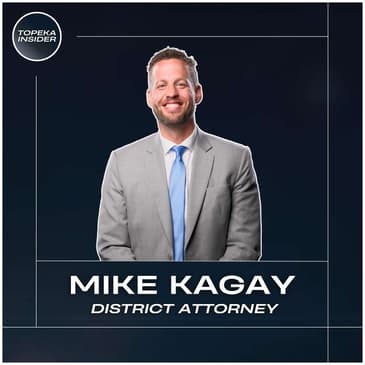
We sit down with Shawnee County District Attorney Mike Kagay to unpack what prosecutors really do, how he thinks about fairness, and why leadership in the justice system starts with ethics. We also get candid stories about jury trials, campaigning for an elected role, and the surprising moments when accountability helps people change.
• defining the DA’s role as courtroom advocate and elected prosecutor
• becoming the youngest elected district attorney in Kansas history
• growing up on debate and learning what TV gets wrong about the law
• why “winning” arguments at home can cost you more
• seeing violent crime up close while still believing in the community
• focusing on repeat offenders and accountability to reduce harm
• managing trials, COVID disruptions, and a large prosecution team
• jury duty stories from both sides of the courtroom
• drawing a hard line on prosecutor ethics and dismissing the wrong case
• what campaigning teaches about leadership and building a team
• laws he would change, including jury unanimity and prosecutor guidance
• rapid fire Topeka favorites and where to find him locally and online
________________________________________
0:41 - What A District Attorney Does
6:40 - From Debate Kid To Elected DA
12:04 - Marriage Rules For Professional Arguers
14:53 - Crime Reality And Feeling Safe
22:09 - Trials, Trends, And Writing Laws
27:39 - Jury Duty Stories And TV Myths
37:09 - Campaigning For DA Without Losing Yourself
42:09 - The Laws He Would Change
51:00 - Rapid Fire Topeka And Final Reflections
________________________________________
Beyond the Podcast: 🎙️
Be sure to follow our Topeka Insider Socials below and check out our website for additional stories and articles pertaining to Topeka, KS
Website -- https://topekainsider.com/
Facebook -- https://www.facebook.com/topekainsider
Instagram -- https://www.instagram.com/topekainsider/
Follow Your Hosts: 📱
Follow both Justin & Jon on their personal socials to get connected. They would love to connect and answer any questions about the show or their day to day.
Jon Griffith's Instagram -- https://www.instagram.com/thejongriffith/
Justin Armbruster's Instagram -- https://www.instagram.com/armbruster_jd
For Any Inquiries, please DM @TopekaInsider on Instagram!
I said you were the youngest elected yet.
Mike KagayIt may have been a little more episode.
Jon GriffithEven as a distributed professional debate. Professional debater. You're telling us the wife wins.
Mike KagayThere's something that happens when you are advocating for fighting for somebody.
Justin ArmbrusterThis podcast is brought to you by Washburn University, a Titanic college in a city of opportunity.
Jon GriffithWashburn offers small classes and big experiences. It's public prestigious and has the lowest student debt in the state.
Justin ArmbrusterAbove all, Washburn delivers a personalized education that you won't find at larger schools. Learn more at washburn.edu.
What A District Attorney Does
Jon GriffithWelcome to the studio. We've got Mike Kage, the Shawnee County District Attorney. It's great to be here, guys. Thanks for having me. Yeah, thanks so much. I'm sure you you just had an empty schedule. You're looking for things to fill. That's right. Yeah.
Mike KagayYou just sit around all day waiting for an opportunity like this.
Jon GriffithYeah. No, thanks so much. I mean, no, you have a ton going on. So um, man, for people that might not know who you are, you're a district attorney. Can you just give us a little bit of your background?
Mike KagayYeah. So uh a district attorney is a prosecutor, and it's actually the elected prosecutor in any given jurisdiction. My jurisdiction is the third judicial district of Kansas, which is Shawnee County, just Shawnee County. So that means within the boundaries of Shawnee County, if someone commits a violation of state law, I am the one responsible for enforcing that. So I'm the top law enforcement official in the county, but I'm not an officer. So I don't do arrests. Uh I can't cite someone for speeding, although sometimes I wish I could.
Jon GriffithYeah.
Mike KagayUh, but my job is to, you know, file a case, initiate a legal proceeding, make arguments, go to court, work with law enforcement as they develop that investigation, present it as evidence ultimately to a judge or a jury.
Jon GriffithCould you legally borrow a cop's cruiser and pull someone over?
Mike KagayNo. That would be highly illegal. Okay. Where are you getting these questions from, John?
Jon GriffithI don't know. He said he'd like to pull someone over. It'd be interesting.
Mike KagayYeah. Uh no, I legally I could not do it. And there's there's good reason why. There needs to be a separation between my function as a prosecutor and the function of a law enforcement officer. It's just the way our way our system's built.
Justin ArmbrusterYeah. Separation of power. So how long have you been the district attorney?
Mike KagayUh almost 10 years. So January of 2017 uh is when I took my oath of office. I ran for the position the first time in 2016.
Justin ArmbrusterCool. I saw online that you were the youngest elected DA. Feel free to brag on yourself.
Mike KagayWell, it's funny because I didn't know that when I was running. Uh, you know, I I had decided to run uh for a number of reasons. Uh, but when I made that choice, I knew I was younger than normal. And actually, one of my uh one of my good friends, an attorney I worked with, when I told him I was running, he he told me literally, Well, you can't. And I said, Why not? And he said, You're too young. And I said, Okay, well, that's not really a thing. I was 33 at the time, and you know, I was old enough to be a member of Congress. I was old enough to be the governor of the state. Right. You're telling me I can't be the elected prosecutor in Shawnee County. Yeah. It didn't make sense to me. Uh, but on election night, a reporter, uh, a really good reporter who's since uh passed, uh named Steve Fry. He worked for um the Capitol Journal and then later WIBW. He was at my watch party that night and he came up to me and said, Mike, do you know that you're the youngest one? I said, The youngest what, Steve? He said, You're the youngest DA we've ever had.
Jon GriffithWow.
Mike KagayAnd I said, No, I didn't know that, Steve. And I'm glad I didn't, because I would have been a lot more nervous about it. Yeah.
Jon GriffithWow. So you're the youngest DA that Shawnee County's ever had?
Mike KagayNo, in the history of the state. In Kansas. In Kansas history, Kansas state history. Uh, but I need to qualify that. So uh there were no DAs in the state before 1978. Uh everyone was a yeah, everyone was a county attorney. Sure. Right. So I want to make sure uh everyone understood.
Jon GriffithStill going back to 1978's pretty decent. It's pretty cool. It's pretty cool. Yeah, that's awesome.
Mike KagayYeah, it's not bad.
Jon GriffithSo how did you get into law?
Mike KagayUh well, uh when I was young, I wanted to be a cop. Um, that was my that was my objective. And I think I got there because I liked the idea of uh pursuing justice, but but really standing up for people who couldn't do it for themselves. And the idea of protecting others was really appealing to me. You know, uh, like a lot of kids in grade school uh in the grade school era, um, I had the opportunity to witness bullying, um, and not so much against me, because I was actually the the biggest kid in the class. Um but I would see it happen with some younger kids and I would step in and say, Hey, don't do that.
Jon GriffithWow.
Mike KagayAnd then that kid would become like my buddy, right? Nice, yeah. I was like, hey, this is pretty great. I should, I should go down this road. Uh so in my you know eight-year-old brain, it was like, Well, how do I do this? And so I I tended towards law enforcement. But then by the time I was probably 12, 13, I discovered my passion for debate. And you know, I would argue with my brothers just for fun. And I quickly realized that cops don't really, you know, that's not a thing. Yeah, you know, you don't argue with people on the side of the road. You just pull them over.
Jon GriffithLike, hey, let's have a formal debate here.
Mike KagayYeah, let's settle this here on the side of the street. Uh for the record, that is a terrible idea. If you do get pulled over, you know, be respectful, be polite, uh, you know, comply with any lawful order. Um, if there is a debate to be had, it happens in the courtroom.
Jon GriffithYeah, okay.
Mike KagayAnd that's when I realized I needed to shift a little bit.
Jon GriffithOh, interesting.
Mike KagayAnd it it it may have been, it may have been a law and order episode that set this off from now. I'm I'm I'm being serious. Uh, because they work with the cops, they work with law enforcement, they are part of law enforcement, but they're also there making an argument. Um so all that to say, my job is to protect other people and to argue for a living. So it's a perfect fit.
Jon GriffithWow. So did you do debate like in high school and things like that?
Mike KagayWe didn't have a formal debate. Um we had uh a debate competition, uh, but we didn't have a formal debate team.
Jon GriffithYeah.
Mike KagayUh most of my experience growing up was you know, I grew up with a lot of brothers. We would debate, you know, you pick a topic, you pick a side. It didn't matter.
Jon GriffithOh, you would that would be like an activity. You guys would sit around, like you pick a side.
From Debate Kid To Elected DA
Jon GriffithWow.
Mike KagayWow. And this was before smartphones. Yeah. And this is before Google. So you couldn't verify. It goes all up here, you know, what you had read at the library or in a textbook. Wow. And it could be something silly like, you know, who's the greatest quarterback of all time? Yeah. You know, you take Joe Montana and I'll take, you know, John Elway or whatever. Even if I don't believe that position. Sure, right. Yeah. Which I which I don't, to be clear. John Elway is not the greatest quarterback of all time.
Jon GriffithUm Can we get you on the record about who the greatest quarterback is?
Mike KagayFor sure. Yeah. Uh I I have to give it to Brady right now. I have to give it to and I and I don't like that, I'll be honest. But I think I think Mahomes has a chance. I like that. Oh, okay. Come on. He he's got a chance. I mean, his his career, if you stack it up against Brady, it's very comparable to this point. Wow. So his second act has to match Brady. And then I think we're having a real debate about is it Mahomes? From a physical standpoint, I I don't think there's a comparison. Mahomes is, you know, out of this world. Right. But Brady worked really hard to be very precise and accurate and master the playbook and do all those sorts of things that give a quarterback an edge. And I say I I don't like to give it to him because I feel like by the end of his career he was fairly obnoxious.
Jon GriffithYeah.
Mike KagayUh but I remember his first Super Bowl win when he came back against the Rams, I was pulling for him. So early on, I was a Brady fan. Um, but I I I gotta tip my hat to the guy to to be drafted where he was and end up doing everything he did. You gotta you gotta respect that.
Justin ArmbrusterYeah, if if you don't say Brady, even as a Mahomes fan, you just lose some credibility right now. So that's good. You came clean up front. Yeah, yeah, yeah.
Jon GriffithYou have to acknowledge that.
Justin ArmbrusterSo okay, you mentioned Law and Order. Do you have a favorite uh lawyer TV show or movie that you go to?
Mike KagayUm, well, I I'll tell you, I I used to. I used to watch Law and Order, and I would watch Law and Order SVU, which I thought was probably the best of the Law and Order shows. I watched a lot of Blue Bloods, loved that show. I love Tom Sellick. Uh I watched suits when that came out. Oh, yeah. And that was just fun. Yeah. You know, because mostly not criminal, it was all civil stuff and the drama and the intrigue, and you know, uh, that was a good time. Uh, but when you do this sort of work every day, it does make it uh it it does kind of push that down your entertainment list. Yeah.
Jon GriffithYou know, if you're trying to relax, it's not like you're not interested in watching work again. I was just getting ready to ask. It felt like you were just going right back to work. Right.
Mike KagayYeah, it it can.
Jon GriffithAnd then just the anxiety of your to-do list when you see all the paperwork they're doing in the show. Or you're like, oh, I have a stack of papers on my desk.
Mike KagayThat's right. I forgot to do that. Um, so yeah, it and then the other part of it is when you're watching a show like that and they're talking about a legal issue, you immediately think about you know, the parallel thing that you're working on.
Jon GriffithSo yeah. Have there been times where you're watching a show and you're like, that is not how that works.
Mike KagayYeah. Yeah, all the time. Uh in a movie or a show. And that's actually why we stopped watching Blue Bloods. Uh my, you know, my wife, uh, you know, we were watching that show together, and I think we made it through like season four or five, but we stopped watching it because there's um uh a female character on that show who who's an attorney, she's an assistant DA, and she would say something about hearsay or something about admissibility of evidence. And I would pause the show and turn to my wife and say, that's not actually how that works.
Jon GriffithThat's not a real law she's citing.
Mike KagayYeah. And she would say, you know, we we gotta stop watching this.
Jon GriffithYeah, yeah. Wow, that's awesome. How do you feel about have you seen the movie My Cousin Vinny?
Mike KagayOh, yeah. Yeah.
Jon GriffithGood or oh no, no.
Mike KagayIt was well, it really entertaining. Yeah. Um and one of my law school professors actually would play uh clips from that movie. It's such a classic. Yeah. It's such a classic. These two youths. Yeah, the youths. Where'd you go to law school at? Washburn. Oh, okay. Come on, let's go. Yeah, yeah.
Jon GriffithYou can't tell from the I wondered, but yeah, represent the same color right here.
Mike KagayThat's right.
Justin ArmbrusterYeah, were you before, I guess I don't know when that the new law building was put in.
Mike KagayYeah, no, it was before the new law building. Um, and actually I did my undergrad there too. Um, so I majored in English um uh at college, and then I I went to the law school and it was in the old building.
Justin ArmbrusterI was thinking KBI building. That's that's what it was. The law buildings new, new.
Mike KagayYeah.
Justin ArmbrusterYeah, for sure.
Mike KagayIt is. And it's it's beautiful.
Justin ArmbrusterYeah. Have you gotten to walk it and see it?
Mike KagayOh, yeah, yeah. No, I um I was there when they when they opened it and I I did the little tour, and I told myself, man, I I picked the wrong time to go to law school. This thing's amazing.
Jon GriffithI've got to imagine, I mean, not to like blow smoke, but I've got to imagine that you're probably one of the law school's favorite people, being the local district attorney who graduated from Washburn law.
Mike KagayYou know, uh I don't know if they have like a ranking system over there. Top five at least. Yeah. Uh but they've they've always been great to me. And I'm I'm really grateful to Washburn for the education they gave me and the opportunity. And uh, I'm not just saying that because I'm also now an adjunct professor.
Jon GriffithOh, okay. Totally unrelated. I wondered if you ever would go back and teach classes.
Mike KagayWell, yeah, and I, you know, I kind of jokingly told them look, this this building is too perfect. It's beautiful. I gotta I gotta come back somehow. Yeah. So yeah.
Jon GriffithYeah, you gotta let me back. You're not going to school again.
Marriage Rules For Professional Arguers
Jon GriffithYeah. As a uh as uh district attorney who loves to debate. Yes. Are you one of the rare husbands who wins arguments with your wife?
Mike KagayYou can't win an argument with your wife.
Jon GriffithSo even as a district attorney, even as a district attorney Professional debater. Professional debater, you're telling us that even still the wife wins.
Mike KagayWell, I'm telling you that if you win, then you really lose. Right. Yeah. Yeah.
Jon GriffithAnd so this really is a universal law. Yeah, absolutely.
Mike KagayI mean, you you gotta make a decision there. Like, do you want to be right or do you want to be happy? Right.
Jon GriffithYou know, because you want to be right or stay married.
Mike KagayYou know, uh, and I have plenty of outlets for debate. So if I want to, you know, go have a debate with someone, I can go do that at work or, you know, with friends.
Jon GriffithAre you ever tempted to be like, you know? Well, according to uh Article 7 of our marriage vows.
Mike KagayYeah, uh, I would say early on, you know, we've we've been married for uh actually we're getting ready to celebrate our 20 year old. Come on, man, congratulations. No way this month is our 20 year that's incredible. So I would say you're um the first five years maybe I made some of those rookie mistakes. Yeah, you know, like, well, actually, this is what this, you know.
Jon GriffithUh yeah, an older buddy is like, hey, listen, man, that's not the way.
Mike KagayYeah, you got you you got you gotta stop.
Jon GriffithYeah.
Mike KagayYeah, and it's funny. Um, the advice I give um right before someone gets married or to one of my buddies um or brother or somebody is just remember these phrases. You're right. I'm sorry. Yeah. Yeah. And I love you. Just have those three on standby.
Jon GriffithYou can practice them, just muscle memory.
Mike KagayYeah, and you can get through pretty much any situation anyway.
Justin ArmbrusterI bet it's similar for you though, John. I heard uh one of my pastors at my church, he gets his wife gets mad when uh he pastors her or uh counsels her and you know, is trying to be get things out of her, you know, even if it's you know just loving, but he's just asking questions to try and get answers out of her, and she's like, quit pastoring me. Yeah, yeah. So there's a little bit of that, I'm sure.
Jon GriffithShe's never said that phrase exactly, but that's that's a similar kind of like early on, like a mistake like, oh well, I'm obviously right, so I need to like you know, disciple you and not obviously not saying anything, but kind of treat you like that. And it's like, no, that's not the way, man. That's not the way.
Mike KagayYeah, I 100% have made that mistake where uh instead of just like trying to convince, I'll ask a series of questions.
Jon GriffithBuild up an argument.
Mike KagayYeah, because this is what I this is what I do, right?
Jon GriffithI go to court and I'm I'm according to premise one and two, I got you.
Mike KagayAnd she'll say, Don't interrogate me. I'll say, I'm not interrogating you, I'm lawyering you. That's the difference. It doesn't help.
Justin ArmbrusterOh,
Crime Reality And Feeling Safe
Justin Armbrusterthat's amazing. Well, let me ask you this question in uh maybe a little more serious of a question. You try a ton of cases in Shawnee County, yeah. You see, for lack of a better word, the dirt of our city and county. Does that hurt your perception of our city? You know, because you kind of have an inside look as to the junk that we don't see.
Mike KagayYeah, uh it it it changes the way you see things. Um, but but there are there are a number of factors at play here. So let me walk through it. Um you you see things that challenge you, but you see what human beings are capable of doing on kind of the very low end of the spectrum, right? Things that uh I don't want to believe as a dad, as a husband, just just as a guy who lives here, right? You so you you see all these really horrible things. But you also see some of the most inspirational and empowering things too. People who have been through abuse, people who have been through um just unimaginable loss, and they stand up and they they show you resilience and grace and strength through that process. And it's very inspiring. So I like to say I see maybe both sides, you know, some of the hardest things, but also some of the most inspiring and encouraging things at the same time.
Jon GriffithWow.
Mike KagayAnd and none of these are issues that are um you know just just located here, right? Sure. The things that I see, my colleagues around the country, they're saying the same thing. So this is more a community level human nature expressing itself. And yeah, I mean, how long have people been doing terrible things to each other?
Jon GriffithRight, forever, right? Kane and Abel.
Justin ArmbrusterI guess that would be that would be helpful, having colleagues outside of your county, outside of your state, where it's like, oh yeah, we have all that too. Yeah.
Jon GriffithYeah, it's kind of like the pothole conversation. People are like, dude, everyone has potholes. Like we think it's just us, it's not, you know. Yeah. I was talking to uh uh, I have a buddy who's a cop in town, and he was I was just asking him about it, and uh we're super pro Topeka, you know, think people need to be more excited about you know what's going on here. Um, but yeah, man, it you know, it's hard to solve a problem you're not looking at, you know, or willing to face. And yeah. So I was asking him about it, and I was it was really interesting what he was saying. Cause I was like, hey, like, is the crime as bad as people say? And he was like, he said two things I thought was really interesting. He said, one, he's like, honestly, it's probably worse than you think. Like the things that I see, just like the types of things that I see sometimes are pretty brutal. But because I then I was like, does that make you scared for like your family's safety? And he's like, actually, it makes me less scared because it's 99% of violent crime is targeted. Right. It's not like a random person was in the wrong place, you know. So, like normal people, you're more safe than you think you should be in the city. Yeah, you know, because it's like gang violence or you know, something like that. Yeah, drug stuff, you know, stuff. So I thought that was really interesting. He's like, you know, people, you know, break into you know, your storage shed and steal your rake. That no one's no one's safe for that. But like the violent stuff, like you're probably more safe than you think.
Mike KagayYeah, and I agree a hundred percent. Um and I I've said this to kids, I've said this publicly a number of times. But uh if you are uh a citizen who complies with the law, you know, and tends to follow it, you're safe. Yeah, you're perfectly safe. Uh the property crime thing, that is a deal. You know, lock your doors to your car. And um if you do lock your doors to your car, great, but don't leave your purse like on the seat.
Jon GriffithRight.
Mike KagayThat's just a that's a property crime thing that applies everywhere, all over the country. But as far as violent crime and like your your personal safety, as long as you're not in a gang, you're not dealing drugs, you're not going to drug deals, things like that, you're safe. You're over overwhelmingly safe in this community. And uh I live here with my family. You know, I've got five kids and a wife and a dog. Uh I I wouldn't live here if I didn't think it was safe. Right.
Justin ArmbrusterYeah, absolutely.
Jon GriffithYeah. What what are the trends of just crime and Topeka? Is there anything that um you're excited about? Anything that, you know, you're cautious about, you know, things like that?
Mike KagayYeah. So uh crime and Topeka, uh like crime around the country, uh, can be cyclical. And so you'll see some violent crime trends that will kind of go up when it goes up around the state and around the country, and then it goes back down. And criminologists can debate all day about uh those factors and how they apply. My experience is when you when you find the bad actors, right, and it's usually a smaller, it's a pretty small group of people, even within the criminal world, that are doing the violent crime, but you identify them, you hold them accountable, and that's my job. And once you do that, they're inside the jail or they're inside a prison. And guess what? They're no longer able to commit crimes in our community. Wow. And then those crime rates go down.
Jon GriffithWow.
Mike KagayIt's the strangest thing.
Jon GriffithWow.
Mike KagayYeah.
Jon GriffithThat is yeah, yeah.
Mike KagayAnd so uh my focus has been on accountability and enforcing the laws the way that they are, but also trying to find ways to strengthen the penalties uh and to target um what I would consider to be repeat offenders on the felony level. And we've been successful in doing that. And actually, one of the reasons I am pretty optimistic right now, we just passed a law um this last session that does exactly that. And I was the the primary author of the law.
Jon GriffithUm so you help write legislation. I didn't know that.
Mike KagayYeah, for sure. Wow. Um actually I think there were a hundred and gosh, maybe a hundred and fifty-seven, a hundred and fifty-eight bills that got passed last year. Two of them were ones I wrote.
Jon GriffithWow. Yeah. So you how does that work? You like write something and submit it to a senator or yeah, yeah.
Mike KagayYou gotta find someone over there who is um who's on, you know, the same page with you. So uh it really helps to have an advocate, someone who is willing to champion that bill and kind of carry it, because obviously I'm not a member of the legislature. That's a different branch of government. Um, so I come at it as uh, you know, a subject matter expert in my field, uh, which is prosecution and law enforcement. And so I'm coming to them with a solution uh usually to a problem that they are already generally aware of. Okay.
Justin ArmbrusterYeah. Gotcha. Uh how many cases do you feel like you try a year?
Mike KagayUh uh in Shawnee County? Sure. Um well before I took over the office, it was usually in the fifties and historically over the last several years, it's been I would say low to mid thirties. Okay. So those are those are jury trials only on the felony side.
Justin ArmbrusterYes. So I mean, yeah, going to going to trial, I mean that's a that's a big part of your job. I mean, you're doing that almost well nowadays, not as much, but you were almost every week.
Mike KagayYeah. Yeah. Yeah. And you know, even now we might have a couple trials in a week. Um when COVID happened, that's the only exception.
Trials, Trends, And Writing Laws
Mike KagayThe court suspended jury trials for about 18 months.
Jon GriffithWhoa.
Mike KagayWhich was a long time to go with that trials.
Jon GriffithYeah.
Mike KagayUm, but in our first week back, uh, we had four murder trials going the same week. Wow. Yeah. So that was, you know, going from zero to a hundred. Yeah.
Justin ArmbrusterAnd you were doing all four?
Mike KagayOur office, which yeah, yeah. How could you do that? No, no, no. So to be clear, I have uh 26 attorneys that work with me in the middle office. Wow. Yeah. It's the third largest prosecution office in the state.
Jon GriffithWow. Wow.
Mike KagayYeah. Uh, and we file thousands of cases every year, which is, you know, if I was doing all of that myself, A, I would never sleep. And B, I would have I wouldn't have time for things like this. Yeah. Yeah, yeah, yeah. But yeah, no, I've I've got a really good team of lawyers. That's great. I think I have the best team in the state.
Justin ArmbrusterOh, that's awesome. Yeah. Okay, let me ask you this. What's your best tip for someone like us to get out of jury duty? We get called in, they're asking us questions. What do we need to say to get out of it?
Mike KagayYeah, yeah. So it's not legal advice, uh, because I can't give that. But um one of the questions that is pretty standard is do you know the DA? Um, so you might just say, I don't know if you're gonna get it, you know, next month. You just say, hey, we just met with him, we interviewed him, he's a great guy. He just practiced this is why we had you on. We now no longer have to do jury duty. I thought that's why you guys asked me that.
Justin ArmbrusterYeah, this is over now. Have a good day. Yeah, appreciate it. We got all we needed. Have you seen the show Jury Duty on Amazon Prime?
Mike KagayI have seen part, I think, part of the first episode. Yeah, but it's it's on a queue somewhere for me to watch.
Justin ArmbrusterDo you know the premise of it?
Mike KagayYeah, one one guy that doesn't know and everyone else isn't on it.
Justin ArmbrusterHave you seen the show? No, uh yeah, it's on our queue as well. It's hilarious. It's it's one of those uh like the office kind of dry humor type stuff. I I eat that up. And he said uh he's uh one of the guys tried to get out of being selected for a jury by saying he's racist. Because if you say you're racist, there's no way they're gonna keep you. He openly admitted it and got ridiculed on the show. She was just joking. I like this answer better. Oh, yeah, I know. Yeah. Yeah. I've never Mike.
Jon GriffithI've never gotten beyond the like call the phone number part. Really? I get I get letters probably at least once a year in Topeka. Yeah. And uh it's always like, hey, call the number on whatever time, you know. And then it's always like, hey, we don't need you. And I'm like, okay.
Mike KagayOne of these days, man, you're gonna make the cut. I between law school and working in the DA's office, I actually got called and I served on the city. Really? Really? Yeah. It was a felony trial. And uh They kept you? They kept me. And they knew I had gone to law school. Yeah, I I was sure they were not gonna keep me. Right. So I was kind of laughing and joking during the process, but they didn't they didn't strike me. Um Interesting. Yeah. And they give a an instruction to the jury uh that you gotta select a four-person. And this person doesn't have to have any kind of special knowledge. Like anyone who serves doesn't have to have any experience in this area. And we go back for deliberations, and that's the first thing you do. And so we sit down, and I'm by far the youngest person on this jury. And they all look at me and said, Well, you're the foreman. Why? He said, Well, you went to law school. I said, Yeah, but the judge said that didn't matter. You guys have all this life. No, you're the foreman. Okay.
Jon GriffithWow.
Mike KagaySo um You can't help it, man.
Jon GriffithYou're being put in these positions of overseeing stuff.
Mike KagayYeah, they just, I mean, they just put it on me.
Jon GriffithCome on, man.
Mike KagayYeah.
Jon GriffithThat's cool.
Mike KagayBut I also got called on my own case one time. My case that I was prosecuting. So we're going to trial, and it was a uh a felony case.
Jon GriffithLike just the random letters going and got to you. Oh, yeah.
Mike KagayNo, I got it on my case, my actual case. And so I go in there. This is before I was DA, I was in a an ADA at the time, and I go to the jury coordinator and I said, This is my case. And the jury coordinator's office is right across the hall from the courtroom where I was going to try this thing. And she said, Well, you got to talk to the judge. And I said, Okay. And so I go in and I go in there and I grab the defense attorney and the judge, and I said, We have a problem I'm on for today. Obviously, I'm prosecuting the case. I can't do that. And the judge kind of smiled and said, Well, we'll take that up at the appropriate time. Wait, what? What are we doing? And then um, when you when you go in for jury duty, they call your name and they'll they'll have like a list of, you know, 40 people or 50 people and they start calling one at a time and they come in. And there's an initial block of people, and the judge will say, you know, is there anyone who can't be here for whatever reason? Things like that. And then those people get excused. So that happened, like four people got let go, and then they read four more names, and I was the fourth name. And so I'm at, when you go into the courtroom, you've got everyone sitting on these benches, and then there's a bar, uh what they call the bar that separates the attorneys from the non-attorneys. And then you have two tables, uh, what are counsel tables where the attorneys sit. And so I'm at my council table and they call my name and I stand up and everyone just starts laughing. Yeah. And the judge goes, Oh, I think at this time, Mr. Kage, we'll release you from jury duty. Unless defense has any objection, the defense attorney was laughing. It's like, okay.
Jon GriffithSo they just wanted to see the funny scene play out. That's funny. That's awesome.
Jury Duty Stories And TV Myths
Jon GriffithUh so we were we talked about shows and you know, media and stuff like that. Um we were talking before this that a lot of the like defense-oriented shows, uh like Lincoln Lawyer and things like that, uh, paint uh prosecutors and cops like, man, they're just bloodthirsty. They don't really know what they're doing.
Mike KagayYeah.
Jon GriffithUm what ha have you ever had an experience like that? Is that true? Like what's Yeah. So Washburn, a proud sponsor of your favorite podcast, wants to keep its homegrown talent here at home.
Justin ArmbrusterShawnee County graduates of local high schools and homeschools are eligible for the Thrives Scholarship.
Jon GriffithOther local graduates may qualify for the Promise Scholarship, which means you can go to college tuition free.
Justin ArmbrusterLearn more about these incredible opportunities at washburn.edu. Washburn is just right. Just for you. Now, back to the show.
Mike KagayWell, I would say, does that happen? Yes. Um, but it again, it's the exception rather than the norm. Most prosecutors, in my experience, are good people who are earnestly trying to do their job, which is to uphold and enforce the law, which means you pursue the guilty and you protect the innocent. And so it may be that an investigation in its early stage points in one direction and you charge someone based on all available evidence, but then the investigation continues or new information shows up. Someone's got a cell phone video or a surveillance video that gets discovered or forensics come back on something. Because all that takes time to unfold. And then you say, wait a second, we don't we don't have the right person here. And then the only thing to do is to share that information with the defense attorney and that same day to file a dismissal of the charges.
Jon GriffithSo that happens. When you find out, hey, we we're sure this guy's innocent, then release it.
Mike KagayThat happens. Wow. And but I can say that.
Jon GriffithBecause that's not what's painted in shows. Like it's like, no, we're gonna keep going, we're gonna get this guy.
Mike KagayYeah. And and again, I say that's the rule.
Jon GriffithRight.
Mike KagayBut sometimes people do that. And sometimes even a prosecutor might do that. And that's completely unethical and wrong and violates the basic premise of who we are. You know, our job is to enforce the law and to bring accountability to the community. And if we're not willing to follow that ourselves, then we have no business being in that position. And I feel very strongly about that. And I I do have some personal experience. Uh, yeah, are you able to tell us about that? Yeah. So when I was in uh an ADA in the office uh before I ran and took over, uh, we had somebody in the office who was the chief deputy at the time. Uh and the chief deputy is the number two position in the office. Uh and in the absence of the DA, they essentially run things and uh make judgment calls on cases and things like that. And I noticed uh it took me probably a couple of years to figure this out, but I started seeing some things happening that were not in line with what I believe a prosecutor is supposed to be. And little things like, you know, the way you approach a case, the way, you know, if if you're staffing a case and you have some concern, maybe not guilt or innocence, but uh strategic things, right? And you get direction that's, you know, kind of a gray area or kind of like walking towards that line makes me very uncomfortable with that. And and most processes.
Jon GriffithIf someone asking you to cross a line, well, or at least are like skirt the line.
Mike KagayLike let's go up there and take a peek. Yeah, you know, and that's just not the way to do it.
Jon GriffithSure.
Mike KagayUm my approach has always been, and my approach in the office with my team is we're gonna take the most conservative interpretation of this rule. So even if we're not required to do something, we're gonna do it because we believe it's best practice.
Jon GriffithWow.
Mike KagayWe want to make sure we have clean hands in everything that we do and we're acting with pure intentions, and that no one's ever gonna be able to say, well, you guys, you know, guys hit the ball on this thing. But back then, some of that was happening and those conversations were happening. And I can think of a case where I was prosecuting a drug dealer uh and the court had entered an order that was not gonna let me present some of the evidence that would have been helpful. It was actually evidence of a prior conviction, which there's a process under a statute uh 6455 where we can file a motion and the court will grant leave for us to present that evidence. Um and the court for good reason said no. Um and I share this information with the chief deputy and was told, we'll just do it anyway. No, I'm I'm not gonna do that. And you can't do that.
Jon GriffithYou can't go against what the court is. No, yeah.
Mike KagayNo, absolutely not. And uh so things like that were happening. I had a case one time where uh someone had been charged with a burglary. It was a domestic kind of situation, a divorce was ongoing. Um, and when I looked at the case, it had been charged and assigned to me. When I looked at the case, it became clear to me that we should not have charged this woman. She went into the family home and she retrieved her property. And there was a separate court order saying that this was her property and she was entitled to it. And so uh the defense lawyer at the time was her chief public defender. She's a judge now in Douglas County. She came to me with text messages between uh our defendant that we had charged and the victim in the case. I'll say victim.
Jon GriffithRight.
Mike KagayAnd it was clear that this was a setup and this was meant to manipulate and kind of control what was going on. And so I had just got this case and I am receiving this information in real time. I felt sick to my stomach. Like this is wrong. We have to stop this. I went to my supervisor and said, We got to dismiss this case. Supervisor agreed with me, but said, You got to go to the chief deputy and talk to her because that was the office policy. So I went and did that. And I got about 30 seconds in, and she said, You're not gonna dismiss that case, you're gonna try that case. Wow. Like, what is this? This is so wrong. Yeah, this is completely backwards. So I went back to my office.
Jon GriffithI said, Can I just pause you for a second? Yeah. Why why why? Why do you think they wanted you to push it forward?
Mike KagayYou know, um anything I could offer would be speculative.
Jon GriffithBut yeah, um you think it was like the need to like win cases, kind of have like a track record?
Mike KagayYeah, I think it's we, you know, we have charged this case, so we're going this way, and you need to get on board with that. You know, and your, you know, your concerns are are not important here. Um you have an ethical situation, you know, that's too bad.
Jon GriffithYeah. Interesting.
Mike KagayAnd so I go and I sit down at my desk um for a minute and I thought, it's clear to me what the right thing is, right? And if I do that right thing, I believed at the time it would be the end of my career as a prosecutor. And I said, Okay, well, I guess this is it. And I went and dismissed the case. And then I sat down naively, waiting to be fired for about 15 minutes.
Jon GriffithWaiting for alarms to go off.
Mike KagayYeah, like I was sure it was gonna happen and nothing happened. I said, Okay. So I picked up my next case and moved on.
Jon GriffithYeah. But did it just why? The the your the boss person didn't it didn't come to their attention.
Mike KagayYeah, it didn't get flagged. There was no there was no clear tracking mechanism or so they didn't even know.
Jon GriffithNo. Oh, gotcha.
Mike KagayYeah, guaranteed. You know, things like that start to paint a picture and start to show you the reality of the situation that you're in. It got to the point where I told my wife, you know, this is not what I signed up for. And the way things are being done right now is is completely wrong. And I have a decision to make. Either I have to walk away from this dream that I have of what a prosecutor is supposed to be, or I can try and take over the office and run things the right way. And without hesitation, she said, You should go for it. And uh I said, Okay. And so did a lot of prayer, uh, talked to some friends and family, and made that decision. Wow. And when I took over the office, uh I did not keep that chief deputy for the reasons that we've discussed. Oh, I said, yeah. Yeah, yeah. Uh and she was subsequently disbarred by the Kansas Supreme Court for unethical conduct.
Jon GriffithWow.
Mike KagaySo I would say that was the right call.
Jon GriffithWow. Is it did you have to run for election against your boss?
Mike KagayNo. Uh he uh retired.
Jon GriffithOh, okay. Yeah.
Mike KagayYeah.
Jon GriffithSo it would that what would that have been like if you had to do that?
Mike KagayUh that would have been that would have been interesting. Yeah. Yeah, that would have been very different. Yeah, for sure. Um and I've I've heard stories about things like that happening. Um, but uh no, he he retired uh from his position. And then I did have two opponents, uh, but they were uh lawyers outside the office.
Jon GriffithYeah, gotcha. Interesting.
Campaigning For DA Without Losing Yourself
Justin ArmbrusterTalk to us a little bit about running for DA. What's that like? You uh you mentioned off-air how that vote happens with the presidential vote, so maybe it gets overlooked a little bit, but what was that process like?
Mike KagayYeah, for sure. So it's every four years. Uh whenever they're voting for president, they're voting for the DAs in Kansas, and that's why most people aren't really tracking it. Uh it's interesting. It's an interesting process because uh it kind of requires you to move out of yourself and maybe do a lot of things outside of your comfort zone, unless you're an extrovert, which I am not. Uh so uh you end up going door to door and talking to thousands of people. Really? Yeah. Just knocking on their door, ringing the doorbell, and hey, do you got a you got a minute to talk about this this issue? And the responses you get are all over the board. Sure. Uh sometimes they're very interesting, uh, but usually they are uh really good conversations. And some people really care uh about what you're doing and they they want to ask questions and they want you to know how they feel about things. So uh that's an interesting process. And then you've got to raise money, so you have to have donors, uh, which is maybe the most uncomfortable part of it, or at least it was when I started asking people for money to support, you know, your campaign. Uh, but you have to have the money so you can buy the yard signs and do the mailers and all the things.
Jon GriffithRight.
Mike KagayUh so for me, it's an opportunity to get to know my community better and and hear what their concerns are. And that's the part I most enjoy about it.
Jon GriffithDo you uh it seems like you know, on one level, it's so different from what you do on your day-to-day job. It is. It's night and day. Yeah. Yeah. On on another level, I wonder, is it kind of like the trial by fire that like you just kind of have to go through that sets you up for a more successful career? Yes. Like, you know, like you've knocked on all these people's doors and all these things.
Mike KagayYeah. No, 100%. I think uh it's a good litmus test for how you're gonna organize and run a larger team, right? Because your job, my job as the DA is to run the office. I'm responsible for everyone that's there, everything that's happening there, even when I'm not there, right? It's on me. And so what's the best way for the general public to get a sense of of how you're gonna do that? I believe it's past experience, but also how you actually run your campaign. And there's no way to run a campaign by yourself. You have to have a team. And I, you know, the way I was raised and the way I always operated was uh very much independent and self-reliant. So if you have a job to do, handle your job. If there's a problem, figure it out.
Jon GriffithRight.
Mike KagayYou know, don't ask for help, like handle your business. And at the very start of the campaign, I quickly realized I have to let go of all of that.
Jon GriffithWow.
Mike KagayBecause there's no way. There's no way for me to do this without without help. And I and I was grateful I had a lot of people offering to help.
Jon GriffithReally? Yeah.
Mike KagayAnd so that was great training. The campaign was great training for running the office.
Jon GriffithWow. Yeah. That's interesting. Wow. Dang. Is there anything uh I mean you so you've had to run three times now?
Mike KagayUh yeah. In 2016 and 20 and 24, but in 24, I did not have an opponent.
Jon GriffithOh no.
Mike KagaySo I ran into tested. Yeah, which was pretty good.
Jon GriffithIs that kind of nice? You just like, did you have to do much of the same stuff? Or you just kind of like, let's just hold out and see if it works?
Mike KagayUh I I didn't I didn't do as much as I typically would, but I still wanted to, you know, I went door to door some and nice, did some things here and there.
Jon GriffithUh just because I So every four years you've got to repeat the whole the whole thing.
Mike KagayYeah.
Justin ArmbrusterIs that unusual that you don't have someone else running?
Mike KagayUh not for DAs. Okay. Uh I think uh, you know, looking around the state, there are there are some DAs who have been in their positions for a long time. And some of them have not drawn opponents for a long time. I think one of my predecessors here in Shawnee County, the first actual DA that we had, I don't think he ever had an opponent when he was the DA. Wow. When he was the county attorney, I think he had a couple times, but after that and and I think what that what that means is the the people that we serve, the communities that we serve, if they can sense and believe that you're trying to do the job the right way, you're getting good outcomes, you're being fair with everyone, and you're not engaged in, you know, political or partisan kind of things. I think that's what they want. That what that's what they expect from people who are here to enforce the law. Right. Right. Because I can try and change it, I can try and influence it. I've even written a couple of laws, like I said, but the legislature passes the laws and then the executive approves them. And then my job is to enforce.
The Laws He Would Change
Jon GriffithIf you could change one law today, what would it be?
Mike KagayOh man. Just one.
Jon GriffithYeah, it gives your top three.
Mike KagayTop three, yeah. I was just having this conversation with somebody. Think about, you know, my job when I go to jury trial is I gotta take 12 strangers. Okay. And I have to convince them beyond a reasonable doubt, which means almost to a certainty, right? Or pretty much. Yeah. And they all have to agree. So you think about 12 strangers, you know, go out here and, you know, go to go to a coffee shop or wherever, pick 12 strangers, and you try and convince them to agree on any single thing. Yeah, it's incredibly difficult. I'm aware of other other places, including England, which served as the foundation for our entire system of justice, where they don't have to have a unanimous verdict. I think it's 10 out of 12.
Jon GriffithOh, interesting.
Mike KagaySo if you get 10, you're good to go. Oh interesting. Okay. Now, I don't know how excited people would be about that idea. We've always done 12 out of 12. Right. But if I could change that, I think I would.
Jon GriffithOh.
Mike KagayI think I would, yeah.
Jon GriffithSo it seems like maybe you've had experiences where there's like a person who's just kind of a stick in the mud. And that's kind of the reason for that. Like it kind of Yeah.
Mike KagayI I won't say stick in the mud. I respect every juror that serves. I respect their service. Uh, it's a hard job for sure. But I have had experience with people who I can think of one case in particular that I tried when I was an ADA. You ask all these questions and you're asking, you know, some general questions to the entire panel. And sometimes it's specific, like, have you ever done this? Have you ever done that? But a lot of them are has anyone ever done X? Has anyone ever done Y? And if no one answers, right? That's all you have to go off of. And that's what A drug distribution case. So it's a drug dealer and prosecuting, and the questions are all about meth. You know, do you have any experience with this personally? Do you know anybody? Do you know anything about addiction?
Jon GriffithTo the jurors. To the jurors.
Mike KagayAnd no no answers from anybody. Go through the case, present the evidence, good evidence, strong case, and they come back 11 to 1. And I know this because the 11 stayed. And they were so angry because the other one uh didn't answer any of my questions about drugs. But as soon as they got back into deliberations, told everyone how she was an expert on this because of her job and all the things that she knew and was absolutely opposed to um what everyone else wanted to do. So when you have situations like that, right?
Jon GriffithInteresting.
Mike KagayHow do you how do you plan for that?
Jon GriffithIt's her job dealing drugs. Yeah.
Mike KagayNo.
Jon GriffithIn my job selling meth on the weekends.
Mike KagayNo. Uh no, it it wasn't that. It was uh she had a professional connection where she sometimes came across people who who dealt with, you know, drug addiction, substance uh abuse disorder. But when you have situations like that, there's no way to anticipate it. Right. What can I do at that point? You guys have heard of double jeopardy uh generally. Uh also also a really once Jeopardy has attached, which happens when the jurors take their oath. Okay. So Jeopardy attaches, meaning anything that happens after that, um, unless it's a mistrial, you can't you can't run it again. So you got one shot.
Jon GriffithRight. Yeah.
Mike KagayAnd so the verdict comes back 11 to 1, Jeopardy is attached. It's not a mistrial.
Jon GriffithUh that means that person can never that person could have been guilty and cannot be prosecuted for that again.
Mike KagayThat's right.
Jon GriffithYeah.
Mike KagayYeah. So in that case, because uh possession of the drug is what we call lesser included offense, he was convicted of possession, but not of distribution. Gotcha. Gotcha. Yeah, but but for some cases there are no lesser included offenses.
Jon GriffithInteresting.
Mike KagayAnd the example I give students is uh someone's charged with murder, we go through, they're acquitted. They could walk out on the courthouse steps and say, I did it, I got away with it, and there's nothing I can do about it. So that that's one of the reasons why sometimes we'll delay filing charges on a case while the investigation is continuous to make sure we have everything we need.
Jon GriffithMake sure it's as airtight as you think it should be. Right. Interesting. Okay, so that's number one. Do you have another two or three laws that you would change?
Mike KagayYeah. How much time do we have? I think um, you know, there's there's a lot of for good reason, there's a lot of checks and balances in our system. But one of the things that is has been frustrating to me over the years is the prosecutors have a distinct function and law enforcement officers have a different one. And the way the laws are written, I cannot, you know, I cannot tell an officer, even if they're asking, and sometimes they ask, should I arrest this person? Do I have probable cause? You know, what should I do next on the investigation? I can't tell them those things.
Jon GriffithOh, you guys can't communicate.
Mike KagayNo, no, we communicate, but I can't answer those bottom line questions for them because those are distinctly law enforcement uh they have to follow their own evidence and instincts and things like that. Yeah, they have their own internal policies, they have a legal advisor, they have their own training, their own structure. And it's it's frustrating to me because on the federal level, their model is different. So for example, my colleagues in the U.S. attorney's office can call an FBI agent and say, I want you to go and do this.
Jon GriffithPlease go arrest this guy. We have all this evidence.
Mike KagayYeah, they can direct the investigation. And so one of the laws I would like to look at changing is giving us the ability to be more direct in our communication because it can be frustrating for them too. You know, the officers are doing this investigation. We're, you know, we're not giving them clear direction. We're giving them here are some things that might be helpful to us. And then they're working hard to bring this investigation to a conclusion. They bring it to us, and then we're saying, well, this isn't enough. And, you know, here are some other things that that could be helpful.
Jon GriffithSo, like what can you say? And so you can't say, go arrest that person.
Mike KagayNo, you can never say, I can never tell them to arrest or not arrest. I can never tell them they have enough or they don't have enough. Evidence. Yeah. And I think those are the biggest sources of frustration.
Jon GriffithUh-huh.
Mike KagayBecause they'll ask questions like, well, you know, are you going to charge this? Like, well, I have to wait until your investigation is done and then you bring it to me. It would be nice to be able to say, no, I can't charge this right now because we need this other piece.
Jon GriffithBasically, if you had kind of the like 100% bar and they're asking, Are we at 100 yet? Yes. And you're like, no, no, no, we're not quite there yet. Yeah. You know, or you're like, yeah, we're good.
Mike KagayYeah. Yeah. Exactly.
Jon GriffithYeah. Interesting. Interesting.
Mike KagayYeah.
Jon GriffithWow. That's wild.
Justin ArmbrusterNow that you're in the job and you've been in it for almost a decade, do you feel like from the outside, I look at your job and go, that's sweet. That's Harvey Dent. You know, you know, the Batman. Do you feel that way when you wake up in the morning, like, hey, I love my job? You know, it's uh or is it a lot of pressure? And it's like, you know, this is this is tough.
Mike KagayYeah. Well, I think both. I, you know, I I think I feel both pretty much, you know, together. Uh it is a hard job. It's a heavy responsibility. And I feel like I carry that pretty much all the time. And uh that's that's part of the the deal, right? But that's a choice that I'm willingly making every single day, and certainly every four years when I decide, yes, I want to keep doing this.
Justin ArmbrusterYeah.
Mike KagayBut at the same time, you know, it's it's it's a hard job, it's challenging. The most challenging thing I've done professionally, but also the most rewarding. Yeah.
Justin ArmbrusterYeah.
Mike KagayAnd I absolutely love it. Yeah. And there is something that happens when you are advocating for and you're fighting for somebody who can't do it for themselves. Yeah. It's so empowering.
Justin ArmbrusterWow.
Mike KagayYou know, and it's a stronger feeling, I think, than you know, I I played competitive sports when I was younger, and you make a big play and the crowd's like, yeah, you know, it feels good. This blows that out of the water. Wow. Yeah. And it's I I'm I'm not even sure how else to to compare it for you guys. But it it's such a powerful feeling because it's not about you.
Jon GriffithRight.
Mike KagayRight? It has nothing to do with you.
Jon GriffithRight.
Mike KagayIt's all about the the victim in that case, fighting for justice for them, serving them. And in that moment, you know, you're you're absolutely willing to do whatever that takes, including, you know, standing up in front of a bunch of strangers and making these arguments and you know, fighting with everything you can, obviously within within the ethical rules.
Jon GriffithRight. Yeah, yeah. Wow. That's wild, man. Well, this has been great.
Rapid Fire Topeka And Final Reflections
Jon GriffithThis has been awesome. You want to move to rapid fire? So with every guest, we have some rapid fire. They're basically just about life in Topeka in general. All right. Okay. So ready? Yes. Just off top of your head. Um, I don't think I'll be curious to see which questions. Sometimes we have people in kind of the political sphere, they're questions they don't feel like they're able to answer.
Justin ArmbrusterUm you need to give multiple answers, you can.
Jon GriffithYeah.
Justin ArmbrusterOkay.
Jon GriffithSo favorite local restaurant.
Mike KagayUh Jong's Thai Kitchen.
Justin ArmbrusterOh nailed it.
Mike KagayLook, that's crazy. It's not just the best Thai food in town. I I do think it's the best food in town. And I will admit, I I know, I know the people that work there. Oh, yeah. They're they're personal friends.
Jon GriffithWell, can you get them on here? We've tried reaching out.
Justin ArmbrusterReally? Because I know they're not going to watch this. They're the only people that have told us no. Really? Yeah. I think they were nervous their English wouldn't maybe come across. Yeah.
Mike KagayYeah, but no, they're they're wonderful people.
Justin ArmbrusterAnd if you've if you've been there, you know how good the about 50% of the people when we ask that give that. Well, there you go. Doing a home project.
Mike KagayYes.
Justin ArmbrusterLowe's, Home Depot, Menards, where are you going?
Mike KagayTypically Home Depot.
Jon GriffithLet's go. Yeah. Finally. Yes. It's been a while. Yeah.
Mike KagayI I will admit Lowe's is a little bit closer to my house. Yeah. It's like a minute or two closer. So if I'm pressed for time, or if it's a small thing, I might go to Lowe's. Um, but I I prefer Home Depot. I like the design. I like the layout. The customer service I've gotten there has always been good. Didn't even mention menards.
Jon GriffithI know.
Mike KagayThe old guy that you I don't like menards. I'm a man. I don't like menards. I've been in there. I don't like the layouts.
Jon GriffithExactly. Exactly. This is an internal debate we've been having for uh ever since it started.
Mike KagaySo funny.
Justin ArmbrusterUh local coffee shop you got to go to. Uh Circle Coffee. Circle. Yeah, all day. That's a softball answer related to David.
Mike KagayYes. Unbelievable. Best coffee, best pastries, best atmosphere, great service. 100%. Yeah. It's incredible. Love circle.
Jon GriffithHonestly, my wife and I were just at Thursday Club, uh like two nights ago or whatever. I don't know what day it is right now. But uh we just sat and we're like, we should we like we should be so grateful that this exists in Topeka. Like this is we come here all the time. Yeah. And it's like, I think it's such a great place. Like Topeka would be less if we didn't have that.
Mike KagayYou know, I agree, man. It's so great. Such a cool thing they've done.
Jon GriffithYeah. Yeah. Uh you a golfer? Yeah, golf. I wouldn't call myself a golfer. They were settle cases on the course.
Mike KagayNo. No, people, I think people kind of have that expectation, but uh Hey man, so we can just call this guilty, right?
Jon GriffithAll right. Right.
Mike KagayYeah, no, I I would say I'm not a recreational golfer. Okay. I I play in like uh, you know, charity shotgun scrambles.
Justin ArmbrusterYou know, so you got a course you like playing at?
Mike KagayWherever it wherever it's set that day. There you go. Yeah.
Justin ArmbrusterThere you go. Good answer.
Jon GriffithGo to date night.
Mike KagayI'm I'm more of a pickleball guy than you.
Jon GriffithWhere do you like to play pickleball at?
Mike KagayUh usually at uh uh AFP over there off of Yurish. 21st?
Jon GriffithYeah, like Family Park. Yeah, yeah. Yeah, yeah. Super nice. I've never heard it called AFP. What is uh?
Mike KagayWell, I think it's Archer Family Park. Yeah.
Jon GriffithWe just call it Family Park. I just call it the one off Yurish. Oh, my friends just call it Family Park. I thought it was officially called Family Park.
Justin ArmbrusterI thought everyone called it AFP. No, dang. Okay. I I'm inclined to believe you on that.
Jon GriffithNo, I I think you're right. I've just all my friends have always called it Family Park. It was someone's name and then Family Park. Yeah. That makes way more sense. Whatever.
Mike KagayWe can call it FP, I guess.
Jon GriffithYeah, no, AFP. I'm gonna start calling it. Yeah. Um go to date night. Go to date night.
Mike KagayOh, wherever she wants to go.
Jon GriffithOkay.
Mike KagayWherever she wants to go. And and look, that that's a little song and dance, okay? And and I don't want to speak out of churn, but sometimes I'll say, where do you want to go? And it's, you know, she doesn't know. And then I'll come up with like a list of three places. And then she'll either choose one of those or then she'll know I want to go somewhere else. Right.
Jon GriffithThose three confirmed, not there.
Mike KagayYes.
Justin ArmbrusterSo I I don't care. I usually hit my wife with uh, and feel free to write this down, guys. Yeah. I tell my wife, hey, I got a place picked out for us. I'm super excited about it.
Jon GriffithOh I know where you're gonna be able to do it. I'm super excited for it, you know.
Justin ArmbrusterTake a guess.
Jon GriffithYeah.
Justin ArmbrusterOh Thursday Club.
Mike KagayI've heard of this. I've heard of it in a lot of time. I haven't deployed it, but I've heard of it.
Justin ArmbrusterI haven't tried it either. I know I need to. Yeah, it works about once. Yeah. Then you gotta go back to the old song and true. I don't care. Yeah, yeah, yeah.
Jon GriffithIt's like the notebook, you know? It's like, where do you want to go?
Justin ArmbrusterIt's not that simple. It's not that simple. What do you want me for? How many potholes did you hit on the way over here today?
Mike KagayNone. Not a single one.
Justin ArmbrusterCome on, let's get a skill driver. Yeah. We tell all of our guests this because we just found it so interesting. But we had on uh Dan Garrett uh with the city, yeah, talking about just what he does at the city. He talked about pothills, potholes, and he says they fill 650 of them a week.
Mike KagayWhat? Yeah, that's wild.
Justin ArmbrusterYeah, which blew my mind. Like I didn't know how you'd do that.
Mike KagayOh, yeah, I bought that the see it, click it, fix it. Yeah, right. Yeah, didn't know that. You can't. Yeah, I've used it before.
Jon GriffithThere you go. Let's go. Come on, man. Uh, what else we got? What is one thing Topeka's missing? What's one thing you'd love to see in any way? It doesn't have to be law related, just anything.
Mike KagayI think we need Chiefs training camp here. Yeah. Chiefs. I think the Kansas City Chiefs should move their training camp here to Topeka. Really? And use the Washburn campus, use that indoor facility, and then we can go and watch it anytime we want.
Justin ArmbrusterThat would be dope. The indoor facility, that's a big spell. You had that answer locked and loaded.
Mike KagayNo, I actually thought about that. No, I I in real time he asked the question, and that's what came to mind. Lawyer. Yeah.
Jon GriffithIt's awesome. I wish my brain moved that fast. Is there a supplement I can take that my brain can move that quickly? That would be great. Uh that's a cafe.
Justin ArmbrusterYeah. Yeah. That would be really cool. That would be cool. Do you think that I don't know, that facility is big enough to do everything? Yeah. Yeah.
Mike KagayI mean, that's state of the art. It's it's great. Yeah. If you haven't been in there, uh go in there and check it out. That's really cool.
Jon GriffithThat'd be cool. Yeah. That's a great answer.
Mike KagayWill it happen? I have no idea, but I would love to see that.
Jon GriffithYeah. That is cool. Well, we've we've got some great lawyers in town that could help you know iron the details out.
Mike KagayThat's right. Yeah. I'll volunteer my time. Yeah.
Justin ArmbrusterUh finally, where could people find you at? Are you on socials? Are I mean do people do the public communicate with you ever? Or what does that look like?
Mike KagayOh, for sure. Um, I think, you know, anytime I go out at a grocery store, like I'm in Hyvee or I'm at the pharmacy or wherever I'm at, I'm at circle, people stop me and they'll say hi and they'll talk. Uh so people can find me out and about. I'm downtown for work, uh, so I'm in the courthouse every day. Uh, people can find me there. People call the office, they email, that that happens all the time. Uh, I have a Facebook page, um, DA Mike Kage. People can check me out there. Uh, and then our office uh is on I think pretty much all major social platforms at this point. Shawnee County District Attorney's Office.
Jon GriffithIs that where you're posting selfies with criminals you're putting away?
Mike KagayAnd like just sealed another one. Uh, you know, uh I've never done a selfie with with a defendant. That is funny. Uh I it the this is interesting though. I I've been stopped by people I have prosecuted.
Jon GriffithOh, ooh, like in public places. Yeah.
Mike KagayIn public. But it didn't go the way you would think. Really? Yeah. It was always friendly and one guy um who had a he had a drug problem, and um I we got him sent away for a couple years, and he was so excited to see me.
Jon GriffithReally?
Mike KagayReally saying, hey, that's my DA. And he was and he came over and shook my hand and he was happy to see me.
Jon GriffithSo I So he had changed then, or wow.
Mike KagayYeah. And and I and I've I've also heard from people that I didn't personally prosecute, that our office did, and they've approached me with the same story. Like, look, I needed that. Wow, I needed that in my life, and it gave me an opportunity. You know, some people uh find God when they're inside, some people get educated, but when they learn from that experience, when they reflect on what got them there and realize they need a different path, that's really that's the goal. That's the whole point. You want them to make better choices, right?
Jon GriffithKind of wake up experience.
Mike KagayYeah. And so it's been really uh just awesome for me. And and and frankly, I've I've forged some friendships with people because their their insight is valuable.
Jon GriffithWow.
Mike KagayI've I've never been on that side. And so uh they have things to say that I that I need to hear. Wow. But it's it's encouraging when I have stories like that. Actually, my last campaign in 20 when I was walking doors, a guy stopped me and said, You know you prosecuted me for felony DUI. And I said, uh no, I I didn't, you know, because we've got thousands of cases. And he said, Yeah, you did. And uh I said, Well, what was that like? And he said, Well, it was it was hard at the time, but you guys were fair. Wow, you guys did a good job, you were fair with me, and you know what? I'll take a yard sign and I'm gonna vote for you. Wow. And that blew me away. Yeah. Wow. That's crazy. And I think what it what it shows me is that when you treat people with respect, regardless of what they're accused of doing, and they understand you're doing your job, right? This isn't personal. It's not like, oh man, I'm gonna get you. Yeah, I'm here to do my job. You broke the law. My job is to prove that you did that and enforce it. When you do that the right way, people respect it, even people that were prosecuted.
Justin ArmbrusterWow, that is so interesting. That's a great way to end our episode. Mike, thanks for being here. Appreciate your time. Thank you guys.
Mike KagayThis is great.